Fun With Science / Globe Deconstruction / The /42 paper · book pp. 127–128
Perspective Cannot Make a Sunset
Globe Deconstruction Review — paper 1 of shapedebate.com/42: its real content, and the one thing its own equations forbid.
Compression makes things small. It does not make them absent.
The compression equation: correctThat it explains sunsets: refuted by its own p. 5Lens distortion at frame centre: zero
Where this lands
The claim. At p. 127, beside the QR code numbered 42, the book says: “If you have any doubt that our vision is globular, read through this technical paper from Vortexpuppy (PhD in mathematics).” The link lands on a 52-page PDF at shapedebate.com/42, cited in two of the video descriptions as a technical paper that “100% proves” visual geometry is distorted compared to tangible geometry, and the stated root of the book’s three-part explanation for why the Sun sets and Polaris descends: angular resolution, distorted linear perspective, and refraction. This page answers the middle leg, which is what the paper supplies.
The verdict. The paper’s central equation, φ(Z) = arctan(h/Z) — the angle an object sits above or below eye level, falling off nonlinearly with distance — is correct, and we grant it without reservation. On its own page 5 the paper evaluates it for an aircraft at 30,000 feet: 90° overhead, 48.8° at 5 miles, 10.8° at 30 miles, 3.2° at 100 miles. That sequence approaches zero and never arrives. The mechanism can dim a thing, shrink it and blur it, and can never cut its bottom off against a horizon — and a sunset is precisely a disc going below a horizon with its lower half gone and a sharp edge left behind. Its lens-distortion case ends the same way: radial distortion is zero on the optical axis, and the paper’s own deflection table reads 0 px at the vanishing point.
Naming. The PDF is five documents bound together, with different authors and very different standards. This page reviews the first — the unattributed six-page monograph at the front, on which the sunset and Polaris arguments rest — and calls it paper 1. Vortexpuppy is named on p. 46 of the file, over the Euclidean treatise later in it. Which parts are whose is taken up on the companion page; nothing here depends on it.
1 · What the paper gets right
The core relation is φ(Z) = arctan(h/Z), with dφ/dZ = h/(Z² + h²) — the nonlinear mapping of depth into vertical visual angle. It is correct, uncontroversial, and the equation our flat-surface page is built on: the 0.199′ depression of a waterline at 540 feet (an arcminute, ′, is 1/60 of a degree) is this expression evaluated once.
Two things follow that the paper does not stress. It is a property of angular mapping, not of any defect: an ideal pinhole with no lens and no eye has it identically, so calling it “distortion” adds no physical effect at the object. And it acts on separations along the line of sight; it does not shrink a frontal object beyond the ordinary inverse-distance law, and it removes nothing.
2 · The equations are right. The sentences underneath them are not.
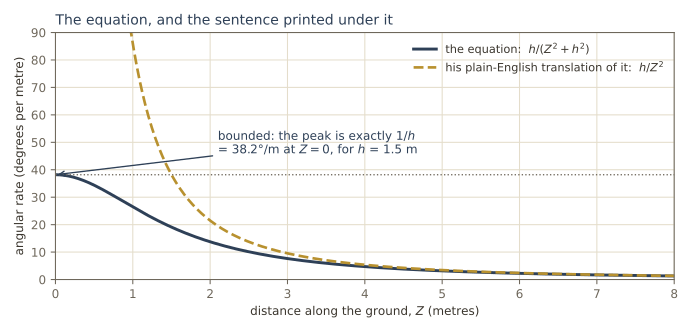
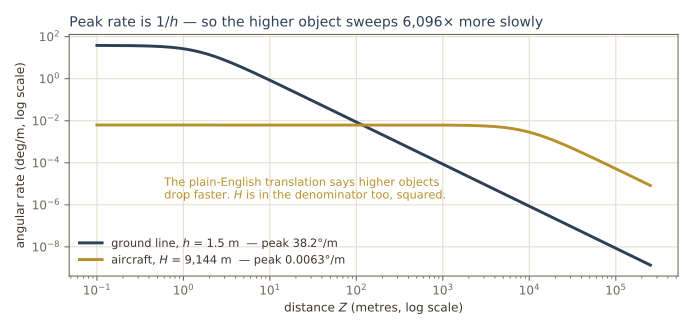
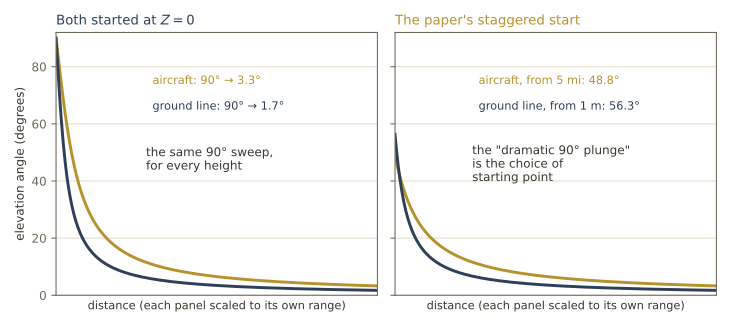
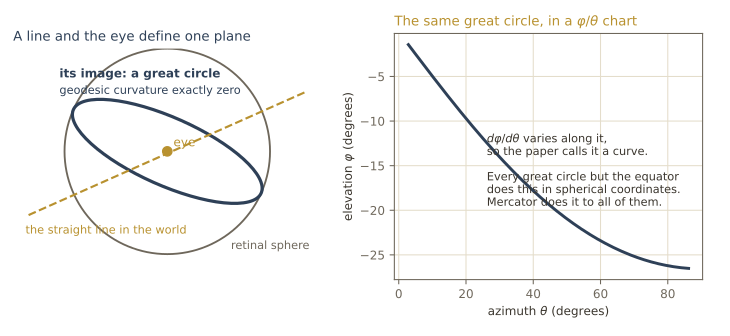
Paper 1’s fourth section is where the mathematics becomes conclusions, and it is the part the flat-earth application uses. Every equation in it is correctly written. Each is followed by what the paper calls a Plain-English Translation, and in each case that sentence says something the equation does not — in three of the four, the reverse. The figures are ours; the paper draws none.
| The paper’s “Plain-English Translation” | What the equation above it actually says |
|---|---|
| “The term Z² sits in the bottom of the fraction. When an object is near your feet (Z is close to 0), the bottom of the fraction is small, meaning dφ/dZ is huge… This sudden, non-linear slowing down… physically curves the image path.” | Nothing blows up. The bottom of the fraction is Z² + h², which at Z = 0 is h², not zero. The rate has a maximum of exactly 1/h and is smooth everywhere: for eye height 1.5 m, 38.2° per metre at your toes, falling away steadily. |
| “Because H (height) sits directly in the top of the fraction, higher objects drop across your field of view at a much faster rate than lower objects rise.” | Height is on the bottom too, squared. Peak rate is 1/H: twice as high sweeps half as fast. A contrail at 30,000 feet drifts about six thousand times more slowly, per metre travelled, than a kerbstone at your feet — and both still cover the whole 90 degrees. 9,144 m ÷ 1.5 m = 6,096. |
| “The overhead structure undergoes a dramatic 90° vertical angle sweep down to the horizon, whereas the ground line only undergoes a minor 56° upward sweep that flattens almost instantly.” | Both go the whole way. Anything straight overhead starts at 90 degrees and ends at 0, however high; anything straight underfoot does the same. The 90-against-56 gap appears because the aircraft is started at Z = 0 and the ground line at Z = 1 m. Start both at one metre and it reverses: the aircraft has moved 0.006°, the ground point 33.7°. |
| “…the slope continuously changes value as you move down the road. In geometry, a line whose slope continuously changes is by definition a curve.” | It changes slope on the graph, not in the sky. A straight line in the world, together with the eye, defines one plane through the centre of the paper’s own retinal sphere (the sphere of directions around the eye that it uses as the image surface), and that plane cuts the sphere in a great circle — the geodesic, the straightest path a sphere permits. Plot a great-circle flight route on a wall map and it appears to bend; the aircraft flew dead straight. |
Three responses are arithmetic on the paper’s own expressions; the fourth is a standard result about geodesics.
And then the conclusion contradicts all four
Everything above converges on one paragraph, the one carried into the sunset and Polaris arguments:
“Crucially, this non-Euclidean geometry applies symmetrically across the entire visual field. For objects located high above the observer’s eye level — such as cloud decks, airplane contrails, or power lines — the non-linear angular transformation forces these structures to descend at a significantly steeper visual angle than ground lines ascend, creating steep, downward-concave arcs that plunge aggressively to converge at the horizon vanishing point. Both biological eyes and camera lenses natively transform straight perspective lines into non-linear, curving arcs as they converge toward the optical horizon from above and below.”
A running header and page footer fall in the middle of that sentence in the PDF and are elided here; nothing else is changed.
It is the only part of the section that is not arithmetic, and every claim in it is contradicted by the paper’s own equations.
- It contradicts itself inside one sentence. The geometry “applies symmetrically” — and then high objects descend “significantly steeper” than low ones ascend. The first clause is the true one; “steeper” is row 2 backwards.
- They do not plunge, and they do not converge. The second derivative of arctan(H/Z) is positive, so the descent decelerates: an aircraft at 9,144 m falls 6.24° over the first kilometre and 0.02° over the kilometre at a hundred miles out. And it never arrives — “converge at the horizon vanishing point” is precisely what an asymptote does not do (§7).
- The last sentence is refuted by a theorem the paper states correctly. Elsewhere it writes that because X and Y are divided by Z at identical rates the ratio between them stays constant — the theorem that rectilinear projection (the ordinary pinhole or camera mapping) maps straight lines to straight lines. A camera lens does not natively turn straight lines into arcs, barring the radial term, which is zero at frame centre. Nor does the eye: the image is a great circle.
3 · Lens distortion is real, small, and exactly zero where every claim sits
Paper 1’s camera half rests on Brown–Conrady radial distortion — barrel and pincushion, the bowing-out and pinching-in of straight lines that lenses produce. Those are real: they bend lines by percent-level amounts at the edges of a frame. They are also, by definition, a function of radius from the optical axis, so they vanish on the axis. Every observation this paper is cited for — the setting Sun, Polaris, the raft on the pond — is a centred subject. At frame centre the radial term is zero by construction, and on a phone it has usually been corrected digitally as well. Whatever barrel distortion does at the corner of an image, it cannot lower, truncate or hide a subject in the middle of one.
The paper agrees, in a table it prints as evidence for the opposite. Its measured-deflection table ends at a row labelled Vanishing Pt, whose deflection column reads 0 px. By its own numbers the lens does nothing at the horizon — the one place every claim it is cited for happens. We hold paper 1 to its printed numbers without vouching for them; where the table came from is a question for the companion page.
The cited literature says something smaller still. Brown–Conrady is a real model and a fair name — it covers the radial terms and the decentering ones together — but the 1966 paper paper 1 points at is the decentering half: it takes symmetric radial distortion as already handled and works on what is left when a lens’s elements sit slightly out of true. Brown’s opening paragraph sizes that residue: holding it under five microns across the plate takes “appreciable skill and patience”, and getting under two microns “calls for luck in addition to skill and patience.” His plates are 190 × 215 mm — an effect of a couple of parts in a hundred thousand of the frame, small enough that detecting it at all is what the paper is for. What paper 1 needs from a lens is the removal of the lower half of a ship.
4 · The eye half and the camera half share no mechanism
Roughly half of paper 1 concerns perceptual space: Luneburg’s model of visual space as hyperbolic (negatively curved) rather than Euclidean, the alley experiments of Hillebrand (1902) and Blumenfeld (1913), vertical-horizon shifts, empty-field myopia, oculomotor micropsia. These are claims about how the brain represents space. Luneburg’s model is contested and largely superseded, but its standing does not need settling here, because the observations at issue are camera observations. A sensor has no visual cortex; the document places the perceptual material beside the camera material, and no mechanism crosses between them.
The alley experiments are still worth drawing, because what they found bears on what they can be used for. An observer sits in a dark room; two rows of small flames — later, rods — recede into the distance, the furthest pair fixed and every nearer pair free to slide sideways. Asked to set the rows so they look like parallel straight lines, observers set them very nearly straight. Asked to set each pair so its gap looks equal to the far pair’s, they set a visibly wider figure that bows outward. A Euclidean visual space would give the same answer to both instructions; that the two alleys differ is the whole finding.
Drawn from the description in Erkelens (2015). Luneburg read the discrepancy as evidence that visual space has constant negative curvature; whether that is right has been argued over for seventy years.
Two things about the experiment settle the use it is put to. It is a binocular judgement, with nothing for a camera to do. There is no photograph in it, no lens, and no measurement of where anything actually is. And the effect runs the wrong way. People place the objects nearest them further outside parallel, and that tendency fades with distance: the departure is largest at the observer’s feet and smallest at the far end. To hide a ship at eight miles, or to bring a sun down at three thousand, a mechanism has to get stronger with distance. The paper’s own formula compounds this: it attaches X(Z) = X0 cosh(σZ) to the experiments (σ a constant), and a hyperbolic cosine is smallest at Z = 0 and grows from there — an alley narrowest at the observer and widening with distance, the reverse of what the experiments recorded.
Paper 1 describes the apparatus as twenty-four green light-emitting diodes on motorised transverse tracks, in 1902 and 1913. The experiments used flames and rods; light-emitting diodes came half a century later. The document’s sourcing is examined on the companion page.
5 · Nothing in 52 pages derives an object being hidden
Take the entire argument as granted. What it delivers is a claim about the shape of the projected path of a straight line across an image surface. A curve is not an occlusion. Nothing in the document derives an object being cut off, truncated, or displaced below a boundary, and nothing derives the crisp lower edge that every horizon photograph shows. The two mechanisms in play fail in different shapes, and the difference is checkable in one frame — the same test that decides the pond.
A resolution limit takes detail away everywhere at once. It has no favoured direction: the object softens on every side, its contrast collapses, and it goes out from the outside in, shrinking toward a point. Nothing about that produces a clean horizontal edge with a sharp top above it.
Angular compression does have a direction — and it still cannot hide anything. It squeezes vertical separations far harder than horizontal ones. But arctan is strictly monotone: it maps higher points to higher points, always. It can crush the gap between a hull and a waterline toward nothing, and it can never reorder them, never close the gap entirely, and never carry the hull to the far side of the horizon line. Compression makes things small. It does not make them absent.
Which gives the test. A compressed hull is still in the frame, so magnification brings it back; an occluded hull is not in the frame at all, and no zoom returns it. A ship with a clean waterline and a sharp superstructure above it is being blocked by something; a ship fading into a smudge is unresolved; a long lens tells you which. That is the point on which the pond footage turns.
The Euclid-style treatise inside the same PDF is more careful about this. Its distance theorems say that objects become indistinct with distance — a statement about detection, compatible with the detection-floor analysis on our bottom-up observations and flat-surface test pages, and one we largely agree with.
6 · How the book uses it, and what its own picture says
Paper 1 is the theory; the book applies it to the sky. At p. 128:
“The trailing path of an airplane that flies straight overhead appears to trace a spherical arc toward the horizon due to perspective. Before reading this book, you may have mistaken this visual phenomenon for the airplane moving around the physical curvature… Since the community has conducted so many long-distance observations at this point, we now know that the bottom of boats disappearing is due to angular-resolution limitations in the water. In this chapter, we will apply those same rules of angular resolution and linear perspective to the sky. By the end, you will realize that the globe defenders have no evidence to defend their light-year distances to the stars.”
The first sentence is correct. A straight contrail at constant altitude does appear to trace an arc across the sky, and the reason is perspective, exactly as he says: the trail and your eye define a plane, that plane cuts the sky in a great circle, and a great circle across a hemisphere looks like an arc (§2, row 4). But the concession is worth nothing to either side. Would a contrail arc if the Earth were flat? It would; the shape of the ground appears nowhere in that derivation. Both models predict the arc, so it separates them not at all.
One wrinkle runs mildly against us. On a globe an aircraft holding constant altitude along a great-circle track follows a circle of radius R + H, not a straight line, so its trail images as something very slightly off a great circle; on a flat plane the trail is genuinely straight and the image is a great circle exactly. The perfectly geodesic case is his, not ours. The departure is small — a trail 200 km long on a circle of radius R + H stands about 784 metres proud of the straight chord joining its ends, a fraction of a degree from the ground and far below what the chapter argues from — but the exactness belongs on his side.
What follows does not come with it. That arc is visible along its whole length, with nothing on it hidden. Deriving the disappearance of a ship’s hull from it — and then the distances to the stars — requires each step to be argued separately, and the paper does not supply them.
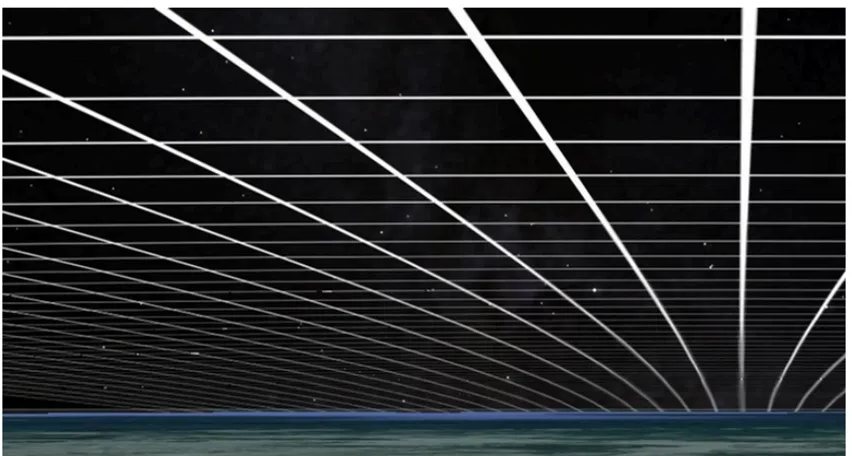
7 · The asymptote, which is the paper’s own arithmetic
Paper 1’s showcase example on its page 5 is an aircraft at 30,000 feet: 90° overhead, 48.8° at 5 miles, 10.8° at 30 miles, 3.2° at 100 miles. That is φ = arctan(H/Z), worked correctly, and it is positive at every finite distance: it never reaches zero, and at no point does the object’s lower limb vanish while its upper limb remains. No external source is needed for this, and no dispute about Luneburg or lens design has to be settled first: the document cited as proving the mechanism disproves it.
None of this needed to wait for the horizon
The discriminator between a receding lamp and a distant Sun is angular size, and it is most sensitive where the argument is least often made — high in the sky, hours before setting. The test needs no horizon and no sea, and can be run at ten in the morning. A lamp at height h seen at elevation α is at distance h/sin α, so its angular diameter goes as sin α. The height cancels; it does not matter whether the lamp is three thousand miles up or thirty:
| Sun’s elevation | Predicted diameter, as a fraction of its overhead value | Shrinkage |
|---|---|---|
| 60° | 0.866 | 13.4% |
| 45° | 0.707 | 29.3% |
| 30° | 0.500 | 50.0% |
| 10° | 0.174 | 82.6% |
By mid-morning the Sun should be visibly smaller than at noon; a third of the way up the sky it should be half its overhead diameter — obviously, in any filtered photograph taken on the same lens an hour apart. What is measured instead is a diameter constant to a fraction of a per cent all day. The usual reply, which goes back to Rowbotham, is that glare inflates the disc and masks the shrinkage; but a solar filter removes the glare, and the constancy is measured through the filter, at noon and at the horizon alike. Our companion page on the Sun’s angular size works this through with the measurements, the historical record and the two-frame test anyone can run. The horizon is where this argument is always conducted, but the mechanism has already failed by mid-morning, where its predicted effect is largest.
It also has to produce the path, and the path is your latitude. A lamp above a flat plane moving away from you recedes horizontally; every bit of apparent descent has to be supplied by perspective dragging the image toward a vanishing point along the lamp’s bearing — a fall toward one point, the disc shrinking all the way. The Sun we watch keeps a constant diameter and slides along a smooth arc inclined to the horizon. That arc meets the horizon at 90° minus your latitude — exactly so at the equinoxes, within a few degrees through the rest of the year — 90° at the equator, 52° at San Francisco, 38.5° in London, 30° at Oslo. Perspective has no term for where the observer is standing. And the lean reverses across the equator: facing west at sunset in the northern hemisphere, the Sun comes down from your left, because it crossed the southern sky; in Sydney it comes down from your right — and at 51.5° north and 51.5° south, mirrored by exactly the same angle. A vanishing point does not know which side of the equator you are on. A rotating sphere with an axis does.
Two fallbacks deserve closing by name. The first is that the Sun’s lower limb merely merges into the compressed band of sky just above the horizon. It cannot: a half-degree disc cannot conceal itself inside a compression zone thinner than half a degree while remaining half a degree wide. Anything that hid part of it would have to shrink it too. The second is the visibly flattened Sun at the horizon, offered as the compression zone made visible. It is not compression: a sphere presents a circular outline from every direction, and no projection flattens one. What squashes the horizon Sun is refraction, which lifts the lower limb more than the upper because the air bends light more steeply nearer the horizon — roughly half a degree of lift at the horizon itself, confined to the last few degrees of altitude, and tabulated in every nautical almanac. Compression would shrink the disc in both directions; the horizon Sun is shortened in one and unchanged in the other. Refraction as a general rescue for the flat plane is taken up on sunlight and shadows.
Polaris makes the same point from the other side. If elevation followed arctan(H/Z), the star would approach 0° only as distance ran to infinity, and would remain above the horizon everywhere on an unbounded flat plane. What is observed is that its altitude equals the observer’s latitude, falls linearly at about one degree per 69 miles, reaches exactly 0° at the equator — a finite, reachable, chartable place — and is simply absent south of it. A linear law terminating at a finite distance is the signature of a rotated horizon on a curved surface, not of an asymptote.
What would change our mind
- Derive an occlusion. Show, from any mechanism in the paper, an object whose lower limb is removed while its upper limb stays sharp, at a stated distance and height. Curvature of a projected line is not this; detection failure is not this.
- Break the asymptote. Show a distance at which arctan(H/Z) reaches or crosses zero for finite Z and finite H.
- Show a centre-frame radial term. Demonstrate barrel or pincushion distortion displacing a subject on the optical axis by a measurable amount, on any lens.
- A sun that never passes overhead. On a flat plane with a circling lamp, no observer is directly beneath it except those on its track; on a globe, everywhere between the tropics gets the Sun at the exact zenith twice a year, on dates fixed by latitude (shadows vanishing at the foot of a vertical pole). Show that those zenith passes do not occur where and when the sphere puts them.
- Polaris without a curved surface. Produce a flat arrangement giving altitude falling linearly with distance and terminating at 0° at a finite, identifiable line, rather than approaching zero asymptotically.
Where this page could be wrong
We are answering the lead monograph, not all 52 pages. The anthology behind it contains careful Euclidean geometry which we have not reviewed theorem by theorem, and which is in places correct and simply over-extended.
We have not resolved the perceptual-space literature. We argue it is irrelevant to camera claims rather than wrong, and that argument would fail for any observation made by eye without an instrument.
The page 5 numbers are read from the document. We recomputed arctan(H/Z) and reproduce them, but did not re-derive the aircraft scenario’s assumptions.
Sources & further reading
- “Visual Geometry is distorted compared to Tangible Geometry”, 52 pp., linked from
shapedebate.com/42and cited in the descriptions of the raft video and the optics-debate video. Our copy is the one distributed at that link. Structure, authorship and sourcing are examined on the companion page. - W. Blumenfeld, ‘Untersuchungen über die scheinbare Grösse im Sehraume’, Zeitschrift für Psychologie 65 (1913), 241–404, and F. Hillebrand, ‘Theorie der scheinbaren Grösse bei binocularem Sehen’ (1902) — the alley experiments, as cited in the modern literature (Erkelens, ‘The Perspective Structure of Visual Space’, i-Perception 2015, doi:10.1177/2041669515613672). Establishes the standard form of both citations.
- R. Hartley & A. Zisserman, Multiple View Geometry in Computer Vision (2nd edn, Cambridge, 2004) — the standard reference for the result §2 and §3 lean on, that rectilinear pinhole projection maps straight world lines to straight image lines. Cited for a textbook result.
- D. C. Brown, ‘Decentering Distortion of Lenses’, Photogrammetric Engineering Vol. 32 No. 3 (May 1966), 444–462 — the source behind the Brown–Conrady model paper 1 invokes, and the paper it credits its measurement table to. Read in full: a glass-plate stellar calibration, measured by hand on a comparator, reported in microns, with two tables in nineteen pages, treating the decentering residue rather than the symmetric radial barrel and pincushion paper 1 names. Detail on the companion page.