Fun With Science / Globe Deconstruction / Bottom-Up Observations / The Flat Surface Test
Something Did Disappear Over a Flat Surface
The arithmetic on his slide is right. A globe hides nothing at 540 feet. His own frames show what hid the raft — and it is not the atmosphere, and not the Earth.
On 18 August 2026, Levi Miller towed a white inflatable lounger 540 feet across a suburban pond and filmed it from a lens 0.375 inches above the water — Can an object completely disappear over a flat surface? first 3 attempts. The raft vanished, low end first. We measured the published video and his camera originals: geometry, fade, focus, water surface, the whole eleven minutes of the main run.
Observation concededNot evidence about the Earth
Where this lands
The claim. The book’s Claim #1, p. 2 (restated at p. 209): “Objects can disappear from the bottom up across a flat surface due to the limitations of angular resolution.” The video is its demonstration — a raft gone low end first at 540 feet, with nothing in the way.
His slide is right. Curvature hides nothing at 540 feet from any camera height he used — zero inches — and anyone answering this video by disputing the geometry has not checked it. Objects really can disappear over a dead-flat surface, and he went and showed it.
What hid the raft is not the book’s angular-resolution limit. By the book’s own 1/60th-of-a-degree criterion the raft should never have been lost: it clears that limit by 2.1× in height. What hid it was angular compression against a camera working five times below that limit. From a third of an inch up, every foot of water from fifty feet out to the far bank piles into about two arcminutes of visual angle (an arcminute is 1/60 of a degree; the full Moon spans about 30), and the camera’s finest renderable edge is 4.8 arcminutes — the pond watched with 20/100 vision. The raft never sinks behind anything: it loses every background it could be told apart from and dims below the noise floor, thin end before tall, the ordering a tapering target gives for free.
Compression does not swallow the raft. It removes any clean background to see the raft against.
Refraction is the one candidate the footage excludes. Bending strong enough to bury four inches at this range would end the pond in a band of false sky 127 feet from the lens. Eleven minutes of footage show the opposite signature: erect reflections running unbroken to the far bank.
None of it bears on the shape of the Earth. Whatever hid the raft is roughly 48× stronger than curvature could possibly be at that range, and it lives in the first inches above the water: in attempt two the camera descends at a fixed framing and the raft goes from plainly visible, to a dot, to gone. Curvature does neither. It should also reverse under magnification from the low position — the cheapest test in §5, and the one nobody has run. The pond cannot speak for a ship eight miles out, in either direction.
1 · What the video gets right
The calculation slide is correct, every line of it. Recomputed independently with R = 20,903,520 ft:
| Quantity | His slide | Recomputed |
|---|---|---|
| Horizon distance from 0.375 in | 1,143 ft | 1,143.01 ft |
| Sightline reaches water past target | over 600 ft | 603.0 ft |
| Threshold eye height, d²/2R at 540 ft | 0.0837 in | 0.08370 in |
| Ratio, 0.375 in to threshold | ~4.5× | 4.480× |
| Height hidden by curvature at 540 ft | 0 in | 0 in |
It is conservative, too: fold in standard surveyor’s refraction (the refraction coefficient k, the fraction of the Earth’s curvature that ordinary air bends a sightline along, k ≈ 0.13–0.17 — the “seven-sixths Earth” rule) and the hiding threshold drops further, leaving his lens about 5.2× above it instead of 4.5×. “You forgot refraction” has it backwards.
He built a rig, checked his own arithmetic, published the raw files and invited criticism, and the arithmetic held up under it. The method visibly improves across his three attempts — fixed camera, towed target, thin strings, orientation corrections — and the fixes in §5 are the ones any experimentalist would reach for second time round.
But disappear covers three things. A target can fade, losing contrast until nothing is left to resolve; it can shorten, its thin end falling below what the lens can render; or it can be occluded from the bottom up, as a car is when a hot road bends the sightline into a false horizon. Only the last is what a curved surface would also produce; the other two happen to a target in plain view on a flat plane. Which took the raft is a question of evidence, and §2 measures it.
2 · What hid the raft
One observation repeats across all three attempts: the raft is plainly visible from a raised camera and gone from a lens under half an inch. That height-dependence retires two candidates at once — curvature, which hides zero from every height used, and the raft’s angular size, which does not change when a camera rises — and points at what the vantage does to the scene:
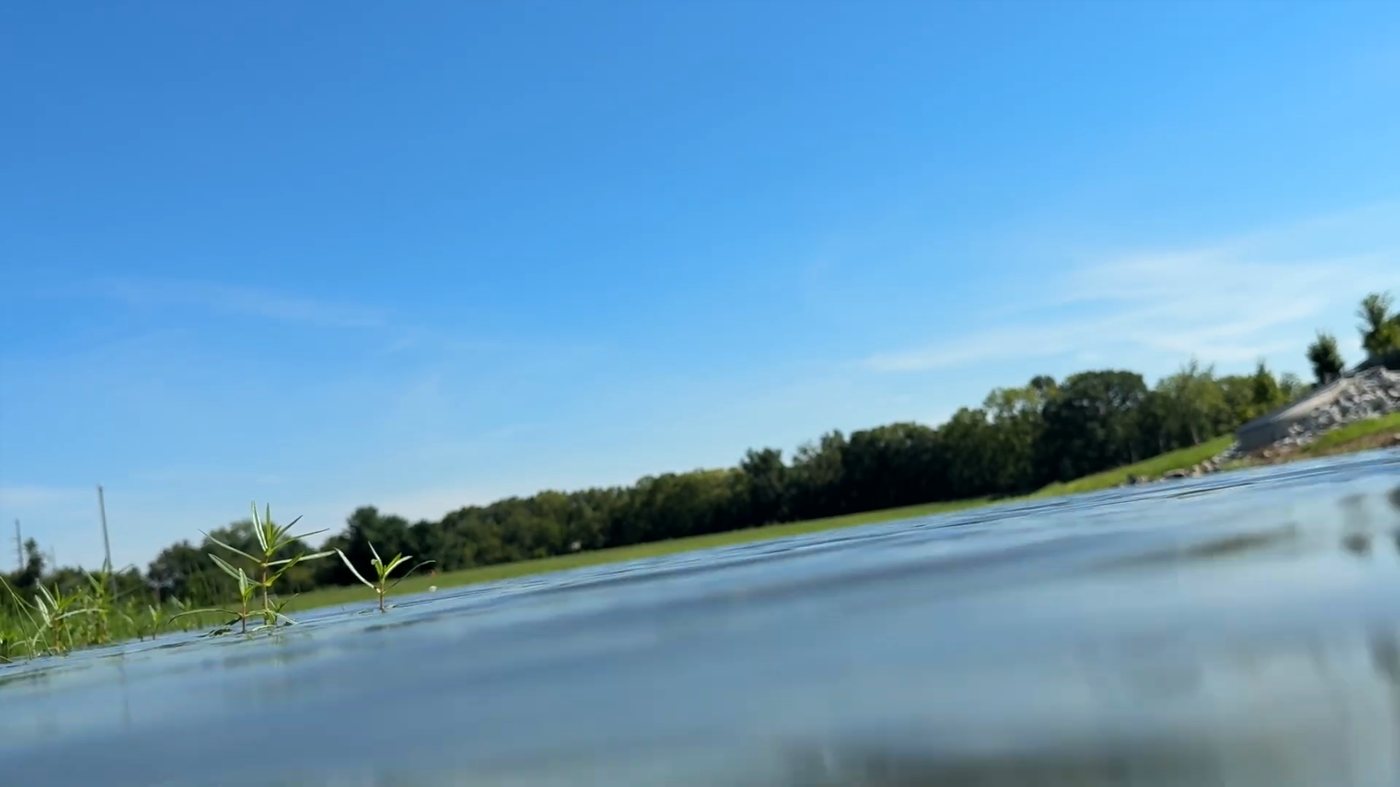
In units anyone can feel: the camera’s smallest renderable transition — nine pixels at 0.533 arcminutes each — is 4.8 arcminutes. An eye with 20/20 vision resolves about one. The video is watching the pond with roughly 20/100 vision, five times coarser than the person holding the phone. A 2.12′-tall, 37′-long, bright-white raft is a comfortable sliver to a human eye; to this camera its entire height fits inside half a blur width, and a pixel holds one colour, the average of everything that falls on it. Four inches of raft is outvoted by five hundred feet of scene sharing the same four pixels. It is the beach experience — the boat you cannot make out by eye, with the water visibly continuing past it, that binoculars bring straight back — built into the design: four hundred feet of “sea” squeezed into two arcminutes, watched with a fifth of the eye’s resolving power.
The fade says the same thing. The raft’s peak brightness against the background beside it:
| t (s) | 415 | 424 | 433 | 439 | 445 | 451 | 460 |
|---|---|---|---|---|---|---|---|
| Raft peak | 238 | 225 | 221 | 181 | 135 | 140 | 140 |
| Local background | 109 | 113 | 113 | 114 | 111 | 117 | 118 |
| Contrast | 129 | 112 | 108 | 67 | 24 | 23 | 22 |
The background never moves; the raft dims where it stands, from full contrast to the noise floor in thirty seconds during which its distance changed three percent. That rules out a mirage line, which replaces what it hides with bright false sky: the background here never brightens.
The raft does not sink; it fades out where it stands — faint edges first, bright core last. One caveat is load-bearing: at four pixels under a nine-pixel blur, a genuine rising cut could not have been resolved either, so these frames cannot separate fade from cut on the raft itself. They do not need to: the two mechanisms that would draw a real cut, curvature and a mirage line, are excluded independently, and a tapering target under falling contrast reproduces the ordering with nothing hiding anything. The low end did go first. That is evidence of the shape of the raft, not of anything it was floating on.
What the three attempts add
Attempts one and two lose the raft over glass. Mirror-smooth water, no wind, no focus trouble — and the raft still dims out as an unresolved dot where bank, waterline and reflection meet, while a white bench a few feet up the same bank stays plainly visible in the same frames. Whatever removes it operates only at the waterline: compression on a calm day, needing nothing else.
The main run adds weather. For its first six minutes the pond is glass. Around t = 380 s ripple trains sweep in, the camera’s focus leaves the far field — the treeline goes from its usual 8-pixel edge to 20–22 — and the blurred near water climbs the frame across the raft’s image band. The raft’s contrast collapses inside that window, 415–450 s. Defocus accounts for roughly half the collapse; near-field chop, standing into a sightline that begins nine millimetres above the water, owns the rest.

no crop.MOV, native-resolution crops.That blur is differential — the treeline’s edges roughly double while a reed a few feet from the lens holds its 3–4 pixel edges in every frame, which fogging, encoder trouble and a shaking mount cannot do — and static: the softened treeline edge holds position between consecutive frames to about a tenth of a pixel in the median, under half a pixel in nine columns out of ten, against the 20–22 pixel blur it would have to account for. Air turbulent enough to double an edge width makes it dance. A lens refocused toward the near field, baited by the new ripple texture, does exactly this.
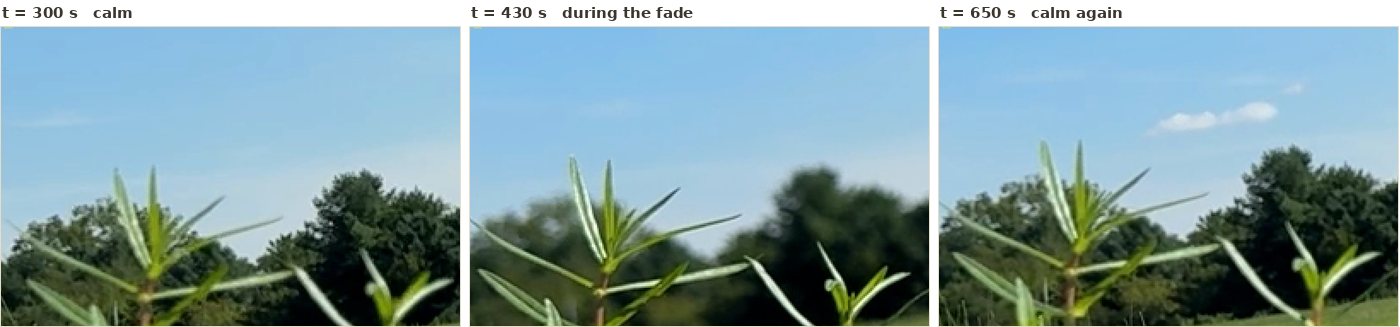
no crop.MOV, native-resolution crops.He anticipates the focus objection with a caption — the trees come back into focus and the raft is still not there — and he is right about that: four pixels against a nine-pixel floor predicts it stays invisible at full range. It cannot show why it went, because it went while the camera was soft and the near field was up.
The target itself. The lounger is a wedge — four inches at one end tapering toward nothing — towed on strings, and it yaws; his own method cards say he corrected its orientation mid-run. Thin ends carry less light, so under any uniform loss of contrast a wedge goes thin-end-first, and a yaw toward end-on cuts the visible streak severalfold. But a wedge losing its thin end gets shorter, not lower; bottom-up is the opposite ordering, height falling while length holds. At this range a low object shrinking a couple of arcminutes above the waterline reads as sinking — but the raft’s whole height is 2.1 arcminutes against a camera whose finest renderable edge is 4.8, less than half of one resolution element. There is no vertical extent to lose from the bottom; what can change is the length, and length is what the frames show changing.
The near shore. At the start of the run the raft is filmed through reeds inches from the lens, and an obstruction inches away needs almost no height: a half-inch crest fifteen feet out hides 4.9 inches at 540 feet. His calm-water check was filmed at the pond’s midpoint, where the lever arm is 2× instead of 36× and hiding all four inches takes a crest of about 2.2 inches — the one place along the sightline where surface state barely matters.

no crop.MOV, t = 20 s, enlarged.3 · What it was not
- — Not curvature. Zero inches hidden at 540 feet, from every height he used — his own slide, verified above.
- — Not mirage-strength refraction. Bending light the required 80× more sharply than the Earth curves puts the mirage’s own horizon 127 feet from the lens: the pond should visibly end there in a band of false sky, the far treeline truncated and mirrored beneath. Checked across all eleven minutes, including every frame of the fade: no band, no inversion, and through every calm stretch the erect reflections run unbroken to the waterline — a normal temperature profile, not the strongly heated surface layer a mirage needs. The gust during the fade cuts the same way: a breeze mixes such a layer out of existence. This excludes the strength, not the phenomenon: a weak layer shaving a fraction of an inch remains possible, which is what the thermometers in §5 are for.
- — Not the atmosphere in any other costume. Turbulence: the softened treeline edge holds still between frames (§2) — a couple of per cent of the motion turbulent blur would bring. Haze: extinction (light scattered out of the path) at 540 feet costs about 6% of contrast in ordinary visibility, against an observed loss of 83% — out by an order of magnitude.
- — Not the book’s angular-resolution limit. By the book’s own 1/60th-of-a-degree criterion the raft clears the limit by 2.1× in height and 37× in length. And a resolution limit cannot delete an object in any case: it destroys shape, not presence (every star you can see is far below the eye’s limit), it shrinks things toward a dot from all sides at once, and it has no way to take the bottom first. The disappearance lives in the gap between a threshold defined for human eyes and a camera working five times below it — an instrument that cannot test the book’s criterion in either direction.
4 · Why a pond cannot speak for the sea
Grant everything the video shows. To bury four inches of raft, something must hide four inches; curvature at 540 feet can hide at most 0.0837 inches, from a lens at zero height.
Local effects do not scale the way curvature does. Curvature’s hidden height grows with the square of distance beyond the horizon — 0.08 inches at this pond becomes forty feet at eight miles — while a near obstruction grows only linearly and the vantage effect dies when the observer stands up. What survives at sea ranges is the atmosphere, which accumulates along the path, and that connects this pond to the two classic low-camera anomalies:
One rule covers all of it: light bends toward denser air. Cool water under warm air bends rays down along the surface, and distant objects stay visible past where geometry buries them — the Bedford Level of 1838, and the Rampion turbines we answer on our own page. Warm surface under cool air bends rays upward, and low objects vanish early — the hot road, and the claim made for this pond.
A hull-down ship is a different observation in kind. Its truncation is resolved: a sharp cut with a sharp superstructure above it, at a height that follows d²/2R, and zoom shows the cut more clearly without bringing the hull back. The pond fade is unresolved, smooth, and reversed by optics: where the camera height of his zoomed shots can be established, the zoom recovers the raft. That is the standard both sides’ low-over-water videos should be held to — a P900 superzoom pointed at a “missing” skyline is running exactly this test, and what it brings back was never hidden, only unresolved.
5 · The afternoon that settles it
Wallace resolved this experimental design in 1870: raise the sightline out of the surface layer, and give the geometry a graduated marker so it can be read rather than argued. The modern version is five items, four of them possible at the same pond in one afternoon.
- 1 Zoom, from exactly where you are. Same lens height, same raft, focus locked, add focal length: 270 mm equivalent brings the raft to parity with the camera’s blur, about 580 mm matches a human eye, and a Nikon P900 superzoom reaches 2,000. This is the one test the published footage does not contain: his zooms recover the raft, but every zoom whose camera height can be established was taken from a raised camera.
- 2 Raise both ends six feet, and film both heights at the same instant. Every mechanism named here — compression, refraction, ripples, reeds, and the book’s own vanishing-point argument — weakens or dies when the camera rises, so a raft that reappears at six feet localises the cause to the first inches above the water. Two phones on one mast hold the background constant.
- 3 Calibrate what hiding looks like. Set a level board in front of the target and cut off a known amount — at least a foot, since at this framing one pixel is about an inch and anything less is invisible by construction. Nobody has filmed what genuine occlusion looks like through this camera at this range.
- 4 Swap the raft for a graduated staff, sized to the camera. A rigid pole ends the yaw and wedge problems, and bands make hidden height a number. The smallest readable band is the blur width times the range — nine inches at 540 feet for this phone — so use an eight-to-twelve-foot staff with one-foot bands, or the long lens from item 1. Walk it out in stages and note where hiding begins: a near obstruction hides from the first step; refraction strong enough to matter starts a hiding line around 127 feet; curvature cannot start one until 1,143 feet, beyond the pond. Where the line switches on names the mechanism.
- 5 Instrument the air, cheaply. Shielded temperature probes at 1, 10 and 50 cm, an infrared reading of the water’s skin, and a wind gauge — fifty dollars. The footage already excludes a layer strong enough to bury the raft; the probes turn “a weak layer might contribute” into a number, and any breeze above about 2 m/s retires the question on the spot. On ice this item stops being optional.
What would change our mind — written before the fourth attempt
Committed on 23 August 2026, and sent to the author on 20 August, before any fourth attempt existed. The raft comes back under magnification from the low position: it was never hidden, only unresolved, and the compression account held. It stays gone under 5× magnification from a clear sightline, focus locked: something physical stands in the light path and compression is insufficient on its own — the qualifier matters, because magnification does nothing about a grass stem inches from the lens. It still vanishes from six feet, filmed simultaneously against a ground-level camera: every mechanism proposed here is dead, and what remains is a plain detection limit, a fact about cameras. A staff’s hiding line begins near 1,100 feet and grows as distance squared at a rate matching 1/R; we do not expect it inside 4,876 feet. A run on ice is read per the note above, and only the probes say which way.
What would not change our mind is the same run in 4K. A cleaner encode buys nothing; genuine 4K capture would roughly halve the camera’s floor — four pixels under a nine-pixel edge becomes about eight under ten. That is a factor of two where the claim needs tenfold, against focal length’s five-to-twenty and elevation’s everything, and it touches neither the geometry, the near field, nor the focus. The design, not the pixel count, is what the five items repair.
Method notes
- Curvature geometry recomputed with R = 20,903,520 ft: horizon √(2Rh), threshold eye height d²/2R. Refraction requirements use the grazing-ray condition (the ray curvature at which a horizontal ray follows the surface); the 127-ft mirage horizon is √(2e/c) at the required ray curvature.
- Frame measurements (fade photometry, edge response, focus and surface-state timelines, frame-to-frame stability, vanish sequences) are from the uncropped run, the camera originals and the published video. Each figure states its file and timestamp; no frame has been sharpened, brightened or otherwise adjusted.
- The turbulence discriminator in §2–3 is a sub-pixel edge-tracking measurement: ten consecutive frames in each of five windows — a sharp control at t = 300 s and four spanning the fade — with per-column standard deviations of 0.08–0.16 px (median) and 0.13–0.42 px (p90) against a 20–22 px blur. The method is
measure_edge_jitter.py, which extracts its own frames fromno crop.MOVand reprints the table. This is a different quantity from camera-aim stability, which is coarser and sampled at 30-second intervals.
Sources & further reading
- Shape Debate (Levi Miller), Can an object completely disappear over a flat surface? first 3 attempts, YouTube, 19 August 2026 — 15:14, 1080p30. The video has carried two titles; it is cited under the current one, and was first published as Can an object disappear over a flat surface? first attempts. Collected by the author at shapedebate.com/flatsurface; all content as burned-in captions. Source files from the linked Drive folder: three setup clips plus the uncropped 11-minute run (
no crop.MOV, 1.34 GB, 1920×1080 30 fps, shot 18 August 2026, 11:07–11:19 EDT). - A. R. Wallace, Bedford Level experiment, 1870 — the raised-sightline and graduated-staff corrections adopted in §5. Companion discussion on Bottom-Up Observations.
- A. T. Young, “Inferior mirages: an improved model,” Applied Optics 54(4), B170–B176 (2015) — the appearance of real inferior mirages: the vanishing line and false-water band that §3 checks for.
- H. R. Blackwell, “Contrast thresholds of the human eye,” JOSA 36, 624 (1946) — detection as a contrast-and-flux threshold, distinct from resolution; and H. Koschmieder via W. E. K. Middleton, Vision Through the Atmosphere (1952) — the contrast-transmittance figure behind the haze estimate.