Fun With Science / Globe Deconstruction / Rockets in Vacuum / The Action Lab Footage
The Action Lab Footage, Frame by Frame
The book asks why the syringe takes so long to move. This is what the frames measure.
On p. 20, Globe Deconstruction? reproduces a still from The Action Lab's Rocket Launch In a Giant Vacuum Chamber under two captions: “Gas not being able to move a syringe in a vacuum chamber?” and “Why the long delay in movement? (see page 80-83)”. Those pages supply the reading. p. 80: “If we consistently see a more delayed reaction from the syringe as we increase the length of the chamber, this would mean that the vehicle is relying on the surrounding gases to move.” p. 82, Kampf's Law: gas propulsion “requires an external substrate to compress the molecular flow. This compressed flow can push against the back of the vehicle.” The claim as the book prints it, then, is that the delay is the signature of a push arriving from the surroundings — the chamber and its wall — rather than from the nozzle. This page measures the footage against that. The physics of Claim #2 lives on Rockets Don't Push Against Air.
Observation concededInference not supported
What the frames show
The exhaust crosses the chamber and fans out against the wall at about 332.8 s of video time (5:33); the syringe's first detectable motion comes at about 334.6–334.8 s. Gas reaches the chamber wall about two seconds of playback before the syringe moves — exactly the ordering the book's captions expect, and it is conceded in full. It is also an ordering no account forbids: a push too small to see looks identical, on video, to a push that has not yet arrived, so the ordering by itself separates nothing. The mechanism can.
For the wall to be the engine, the contact has to cause the motion that follows it. The gap between the two is 25 to 220 times too slow for a pressure wave, and the smoke that is slow enough to fill it carries 0.05% to 3% of the outgoing momentum, aimed mostly elsewhere. The one causal signature in the clip points the other way: when the propellant flares at 335.85 s, the syringe's acceleration answers within one or two frames.
Zero lag to events at the nozzle; two seconds of nothing after the event at the wall.
1 · What the video shows, in order
The source is Rocket Launch In a Giant Vacuum Chamber, published by The Action Lab on 17 November 2023, 6:43 long, in 4K. It is a third party's video, not Levi Miller's or Alex Kampf's; the book credits it at p. 20 (“Thank you, Action Labs!”).
The experiment runs from about 4:14 to 5:38. Flash paper is sealed inside a medical syringe with the plunger glued, so gas can only escape through the tip. The syringe hangs on threads inside a large chamber pumped down to about 0.02 atmospheres (19 mbar absolute — the gauge reads 827 mbar of vacuum against an 846 mbar ambient), and a laser sheet lights the exhaust. There are two runs: the first, at about 5:11, accelerates hard enough to destroy itself against the chamber wall; the second, from about 5:23, is the clean one, shown twice — under the “<0.02 atm” caption and again uncaptioned from 5:31. All timestamps below refer to the second showing, video time 331.65–336.05 s at 60 fps playback. The clip carries about 30 distinct frames per second (every frame appears twice) and the capture rate is never stated; both facts matter below.
Tracked in luminance against a frame from the same shot (method notes at the end of the page), the sequence is:
| video time (playback) | event |
|---|---|
| 331.65 | clip opens with venting already under way — a thin jet, and smoke already drifting |
| ~332.8 | exhaust reaches the wall and spreads radially against it (visible in the frames at 5:33) |
| ~334.6–334.8 | first detectable syringe motion (subtracting the pendulum sway puts onset at the early end, ~334.6) |
| 335.85 | main burn — plume brightness spikes to 2.8× its plateau, then collapses below it within two frames |
| 335.85–335.88 | acceleration peaks, within 1–2 frames of the flare; peak speed follows at ~335.90 |
Past about 335.85 the flash floods the frame and pulls the syringe's tracked centre, so magnitudes from that window are not used below. Only the timing of the speed rise relative to the flare is read from it, which needs the sign of a frame-to-frame change, not its size.
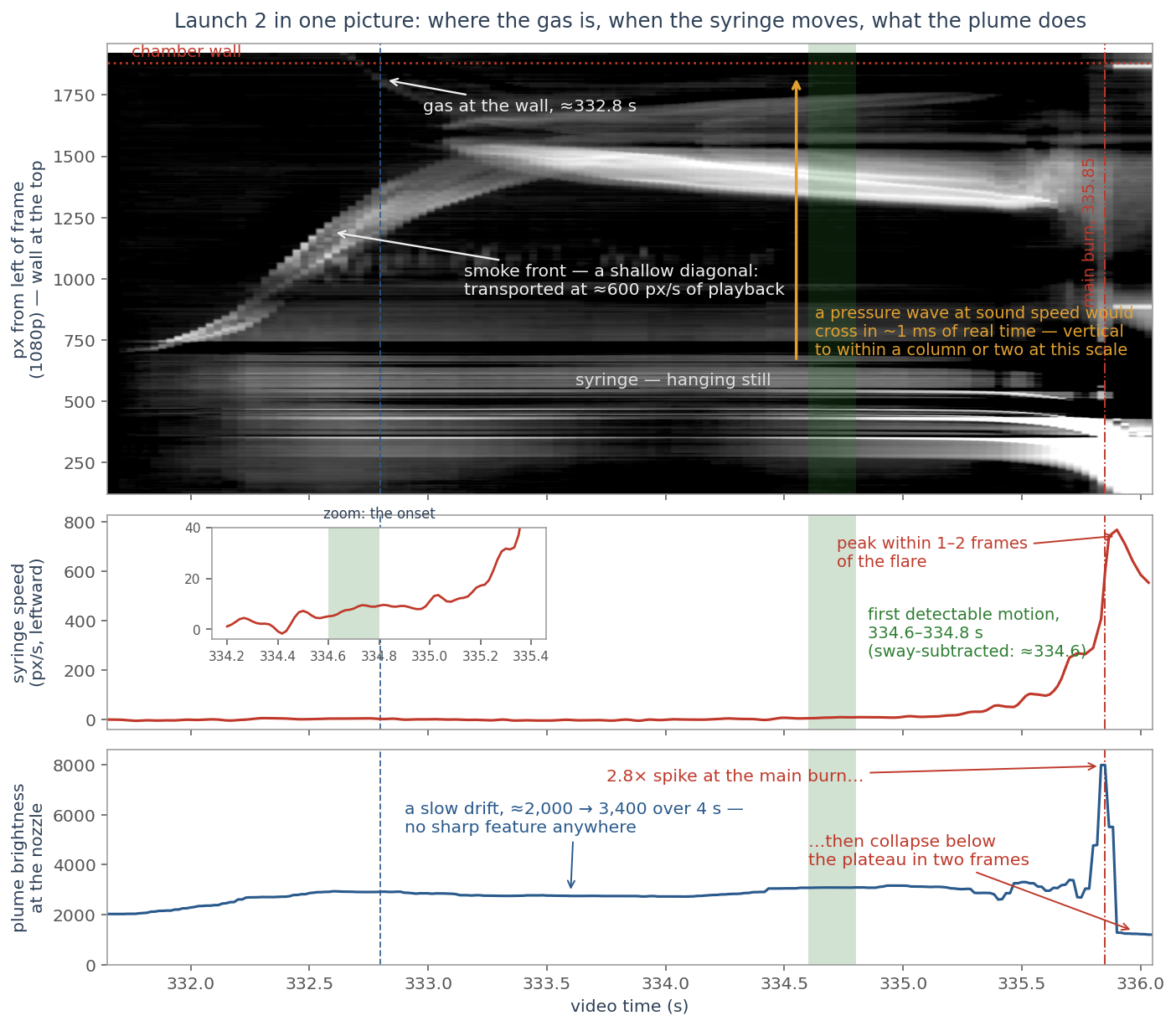
What the frames cannot do is run the book's own p. 80 test, which needs the same rocket fired with the wall at two distances; the video has one chamber. (In a small chamber the ordering is outright forced; the companion page runs that arithmetic for the book's own rig. This chamber is large enough that the crossing is finished by slow smoke, which is what makes its timing readable at all.) What the footage can answer is whether the contact causes what follows it.
2 · The control burn nobody used
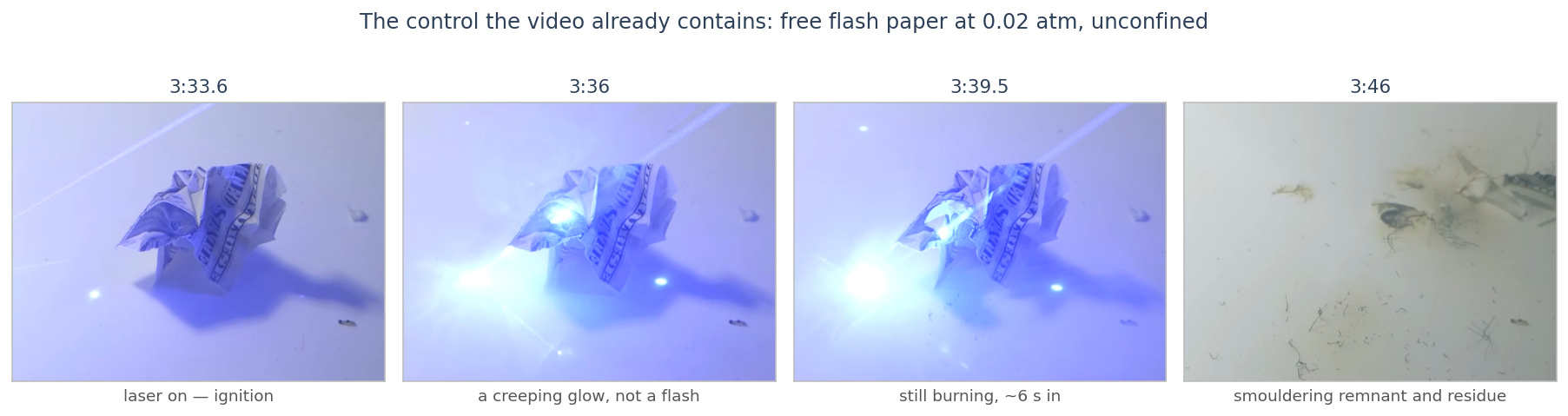
The video contains a control experiment that neither it nor the book uses. At 3:34, before any syringe is involved, the presenter ignites a piece of free flash paper on the chamber floor at the same 0.02 atm. It burns for about eight seconds — in open air flash paper goes up in well under half a second — as a slow glowing front creeping across the paper, with no flash, no terminal event and no peak, and it leaves charred residue on the floor at 3:46, though the video's own introduction (0:56) notes that flash paper burns with “no residue left over”. A factor of ~15 slowdown at 1/50th of an atmosphere is what the standard pressure-dependence of burning rate predicts: Vieille's law, r = aPⁿ with n ≈ 0.6–0.8 for nitrocellulose, gives a factor of 11–24 at 19 mbar. Near its low-pressure limit the combustion is incomplete.
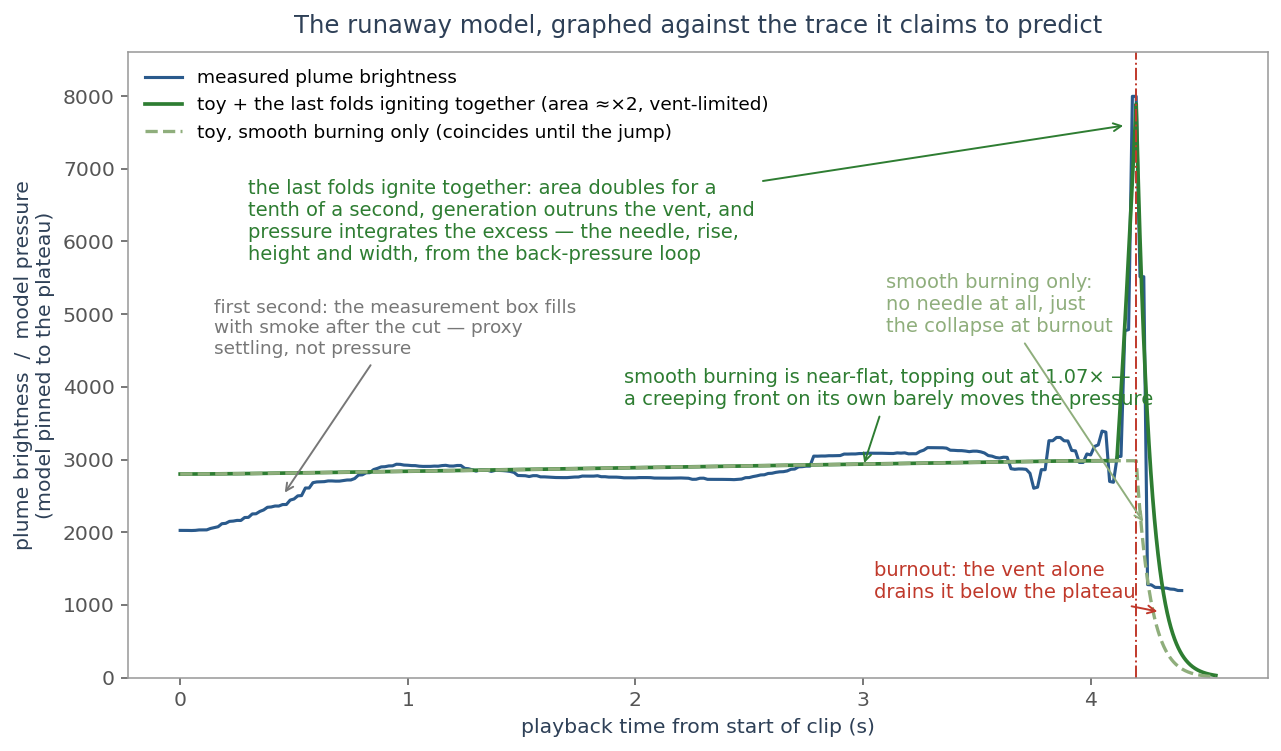
Now the confined burn, in the bottom panel of the figure in §1. Inside the syringe the same propellant vents gently for four seconds with only a slow drift in brightness, then spikes to 2.8× the venting-phase mean within two frames, then collapses below the plateau two frames later. That shape follows from the same pressure law that slowed the free burn. Because n < 1, pressure alone cannot run away in a sealed chamber; burning area can. Equilibrium chamber pressure scales as
where Ab is the burning surface area: doubling the area alight raises the equilibrium pressure roughly tenfold. A front creeping across paper grows its area slowly and the pressure barely responds — the flat phase. When the front reaches fresh folds and the area jumps, generation briefly outruns what the tip can vent, and burnout cuts it off before the tenfold equilibrium is reached. The method notes graph that model against the measured trace.
3 · Why the delay cannot be the wall
For the wall to be the engine, the contact at ~332.8 s has to cause the motion at ~334.6 s — something has to carry the push from the wall back to the syringe across that two-second gap of playback. There are two candidates: the gas carries it as a pressure wave, or as returning material. Both fail, in opposite directions.
Too fast: a pressure wave
The book's mechanism (p. 82) is compression — the substrate “compresses the molecular flow” and the compressed flow pushes the vehicle. Compression travels as a pressure wave, at the speed of sound: about 340 m/s in air-like gas, and near-independent of density (c = √(γRT/M): thinner gas means fewer collisions but proportionally longer free paths). Across the roughly 0.36 m from nozzle to wall, a wave makes the trip in about 1.06 ms, the round trip in ~2 ms; the gap runs from contact at the wall to motion, so the one-way figure is the one that matters. Even with the image scale's ±30% uncertainty, it lives between 0.7 and 1.4 ms.
The observed gap is 1.9 ± 0.3 s of playback — the contact time comes from a luminance threshold on diffuse smoke, the onset from a sub-pixel centroid (the syringe's brightness-weighted centre, tracked to a fraction of a pixel), and each carries a couple of tenths of a second. The capture rate is never stated, but across the plausible range of high-speed capture (240–2,000 fps, i.e. 8× to 67× slow motion at 30 distinct frames per second) the central figure is 28 to 238 ms of real time — a factor of 25 to 220 too slow for a compression wave. Take every uncertainty against that at once — the shortest defensible gap (1.6 s), the fastest plausible camera, the longest chamber (0.47 m) — and the wave is still some seventeen times too fast; doubling the chamber adds about one more millisecond. For a carrier to take 28–238 ms to cross 0.36 m it would have to travel at 1.5–13 m/s — and the footage shows exactly what moves at that speed: the drifting smoke.
Too weak: returning material
Could the smoke itself — gas molecules bouncing off the wall and coming back — deliver the push at 334.6? It moves at the right speed; the space–time image in §1 shows it transported across the chamber at metres per second, the shallow diagonal that a sound-speed signal would render vertical. But a material return fails on what it could deliver, three times over.
- — There is nothing for it to copy. Whatever rebounds off the wall is the nozzle's own output, delayed by a round trip and smeared by the spread of return times, and smearing cannot create a feature where the input was flat. The emission history is flat: the plume trace drifts from about 2,000 to 3,400 over four seconds, with no sharp feature until the flare itself. So no round-trip time of any length lets a delayed copy of the emission supply the abrupt onset of motion or the 2.8× spike; a rebound of a featureless vent is a featureless push.
- — It is far too sparse. A real surface at these energies re-emits diffusely rather than mirror-reflecting, and the fraction of that re-emission a syringe-sized body intercepts at these distances is 0.05% to 3% of the outgoing momentum. The claim needs essentially all of it.
- — It is aimed wrong. That budget is already the generous case — re-emission from the point of the wall on the jet axis, sent straight back. The footage shows the gas fanning out radially and meeting a curved wall over a wide footprint, almost everywhere at oblique incidence; a rebound leaves at the angle it arrives, so even the directed part of any return sprays off around the chamber rather than back down the jet line — there is no flat plane squarely behind the exhaust to bank the shot off. An oblique push would also swing the syringe across the jet line as it accelerates, and it does not: over the clean acceleration window the syringe covers 41 px along the jet axis against about 3 px of lateral wander, the same size as its pendulum sway before motion begins. It departs straight back along its own exhaust line.
Nothing physical lives in the gap the book needs. Against that, the case for the nozzle is one sentence long, and it is the strongest measurement in the clip: when the propellant flares at 335.85, the acceleration answers within one or two frames.
One reply remains: that 19 mbar is not vacuum, so the residual gas throughout the chamber is the substrate and the wall was never needed. That version gives up the delay argument — nothing then waits on the wall — and what residual gas can do to a nozzle is priced on the companion page: it bears rearward across the open nozzle mouth, and engines are hot-fired on thrust stands in chambers far emptier than this one.
4 · A version offered in correspondence, and Kampf's Law
Beyond p. 82's compression, the book prints no mechanism for the two seconds. In correspondence the author has offered a sharper one: treat the exhaust column as effectively rigid, so that once gas spans the gap, pushing on it is like pushing on a rod — force at one end appears at the other with no lag. This version survives §3: a rigid link delivers force instantly, as reaction-at-the-nozzle does, so no timing measurement here can separate the two.
The book has already ruled on it. Kampf's Law (p. 82) exists to mark gas as categorically unlike dense matter: “Dense matter (liquids and solids) can generate thrust for a vehicle from reaction forces, while gas propulsion requires an external substrate to compress the molecular flow.” p. 79 sets up the same distinction — the ice-skater-and-bowling-ball picture of the third law is said to fail because it “assumes solid objects and gases work the same way.” A rigid gas column is a solid under another name — rigidity is the defining mechanical property the law denies to gas — so the fork closes on its own:
- a If the exhaust column is not rigid — if gas really is unlike a solid, as the law insists — the claim falls back to transmission through the gas, which §3 closed: too fast as a wave, too weak as material.
- b If the exhaust column is effectively rigid, it is behaving as dense matter — and dense matter, by the law's own first clause, can generate thrust from reaction forces. The syringe recoils from its own exhaust, which is the mainstream account wearing different clothes.
Either branch ends with the rocket moving for the mainstream reason. Writing the law down as a law is what makes this checkable at all, and the argument may take the stronger branch of the fork — it is just that the stronger branch is Newton's.
5 · Where this page could be wrong, and what would change our mind
In order of how much they matter:
- — This footage can refute transmission-through-the-gas; it cannot separate reaction-at-the-nozzle from the rigid-column version by measurement. Both predict zero lag. The separation in §4 comes from the book's own structure, not from the frames; the measurement that would separate them is the book's own p. 80 design, run with the right instrument (below).
- — Plume brightness is a proxy for mass flow, not a measurement of it. It scales with the amount of scattering material near the nozzle, which is all the arguments here need; nothing on this page converts brightness to grams.
- — The syringe is a pendulum. Its swing fits a period of 1.90 s at about 1 px of amplitude, comparable to the early motion itself. Subtracting the fitted sway favours the early end of the §1 onset band (~334.6); either end leaves a delay of tens of milliseconds of real time, no closer to a millisecond-scale wave. That 1.90 s playback period, with the thread length, would pin the capture rate — a pendulum's real period is set by its length alone — and collapse the range below to one figure; this page has not measured the thread.
- — The acceleration trace is too noisy to fit a thrust curve. Differentiating pixel positions twice leaves ~±2,000 px/s² of noise in the venting phase; the page uses acceleration only for its timing, never its magnitude.
- — The capture rate is never stated and the image scale is good to about ±30%. That is why real-time figures appear as ranges (28–238 ms) and why the wave-speed argument is built to survive the whole range. The slow-motion clips begin after venting has started; the normal-speed footage around 5:00–5:04 shows the syringe hanging quietly beforehand, at no useful frame rate.
The test that would settle the remainder is cheap. The book's p. 80 design — the same rocket, the wall at two distances — asks the right question; it just cannot be read with a camera, because the onset differences at stake sit inside a single frame at any consumer rate. Put a load cell between the vehicle and its mount, a pressure plate on the wall, and both on a common clock: reaction-at-the-nozzle predicts thrust onset independent of wall distance, any wall-mediated mechanism predicts onset scaling with it. There is a cheaper version that needs no instrument: keep the distance fixed and turn the exhaust instead. Hang the syringe so it can swing in any direction, fire it once square at the wall and once through a fixed plate that sends the gas off sideways, and film from above. Reaction-at-the-nozzle predicts the same recoil along the nozzle line both times; a push carried back from a surface predicts a recoil that follows where the gas came back from. A direction is readable on a phone; a millisecond is not. The Self-Test Protocol states both in hand-off form, as Tests 6B and 6C, for the book's authors to run.
On scope: this page examines a video the book cites, not Miller and Kampf's own chamber experiment, which remains unpublished. Nothing here settles what their rig will show — though §2 makes one prediction for it: confine this propellant in a small volume, and the peak will find you. The observation at p. 20 stands; the inference drawn from it does not.
Method notes
All traces are luminance-based, background-subtracted against a frame from the same shot. The material that crosses the chamber is grey-white smoke, not the blue of the laser-lit jet; a blue-channel measure sees only the sheet and misses the crossing entirely. Syringe centroid and plume brightness were tracked over video time 331.65–336.05 s at 60 fps playback (~30 distinct frames/s), 1080p; the space–time diagram is per-column luminance along the jet axis; the smoke-front speed of ≈600 px/s of playback is a linear fit over 332.0–333.0 s; the pendulum period of 1.90 s is fitted to pre-onset sway. A glare-driven artefact at 335.80 — any threshold detector “detecting” wall arrival at the flash — was excluded using a control band 300 px off the jet axis, which shows the same spurious signature.
Sources & further reading
- The Action Lab, Rocket Launch In a Giant Vacuum Chamber, YouTube, 17 November 2023 — the primary source. Flash-paper introduction at 0:56; free-burn control at 3:34–3:46; chamber-pressure demonstration at 3:46–4:14; rocket construction 4:14–4:44; launch 1 at 4:44–5:13; launch 2 at 5:13–5:38 (shown captioned from 5:23 and again from 5:31); the maker's own momentum explanation at 5:38–6:06.
- Levi Miller, Globe Deconstruction?, prerelease draft, 2026 — p. 20 (the still, the credit to The Action Lab, and the two captions), p. 79 (“solid objects and gases work the same way” named as the third law's assumed premise), p. 80 (the two-wall-distance design and the conditional delayed-reaction discriminator), p. 82 (Kampf's Law and the “compress the molecular flow” mechanism), p. 183 (the claim that the experiment is conclusive).
- Sutton & Biblarz, Rocket Propulsion Elements — ch. 2–3 for the thrust equation and why ṁ·ve is set at the nozzle; ch. 12 for solid-propellant burning rate, Vieille's law r = aPⁿ, and the dependence of chamber pressure on burning area.
- Companion pages: Rockets Don't Push Against Air (the physics of Claim #2, including the forced-ordering arithmetic and the load-cell test in detail), Thrust, Measured in Flight (the same question answered with flight data), and the Self-Test Protocol.