Fun With Science / Globe Deconstruction / Bottom Up Observations
Bottom Up Observations, Answered
A torch on a bracket, 410 feet across a pond, and what actually made it disappear.
Two headlights that merge into one blob have not switched off.
Bottom up observations (Shape Debate, 2026) argues that a small light — 2.5 in tall, 410 ft away — vanishes when the camera drops from ~2 ft to 0.5 in above the water, without curvature: the explanation offered is angular resolution. (The pond footage and apparatus are by a separate creator, “LifeIs Short”; the measurements, slides and narration analysed here are Shape Debate's own.) Verdict: the curvature arithmetic is right — a globe predicts zero hidden height at 410 ft at every eye height used — and the stated explanation is refuted by the experiment itself. Angular size does not depend on eye height; and by the book's own 1/60° threshold the target subtends 1.75 arcminutes (an arcminute is 1/60 of a degree), 1.75× the limit, and would have to stand at 716 ft to fall below it. A disappearance that depends on eye height is occlusion or refraction, and his own daytime slide photographs the occluder.
Curvature intactClaim does not follow
What the test actually establishes
A small light near a pond's surface became harder to see, or briefly vanished, when the camera was lowered to within half an inch of the water. Nothing connects that to Earth's shape: his own geometry shows a globe predicts no obstruction at this range, so curvature was never a candidate explanation.
Conceded, in his favour. The curvature arithmetic is correct (§2). And things really can disappear bottom-up over a flat surface: the wheels of a distant car vanish over a hot road every summer, the mechanism §7 describes. Nothing here defends “impossible.” What curvature predicts is a pattern: an amount hidden that grows as roughly d²/2R — distance squared over twice Earth’s radius — comes back when you raise your eye, and does not come back under magnification. These tests check none of it.
1 · The claim and the setup
Two tests, same pond. A night test (~2:45–5:15) with a small blue anodised torch on a bracket at the far shore, aimed by eye; a daytime test (~10:50–12:10) with a similar target and near-field debris visible in frame. The measurement slide gives the numbers: distance 410.105 ft on Google Maps, target height 2.5 in, observer (camera) height as low as 0.5 in — an iPhone with its case touching the water, lens centre half an inch up. A control shot is filmed from roughly 1.5–2 ft. The camera is handheld, autofocus and auto-exposure both active.
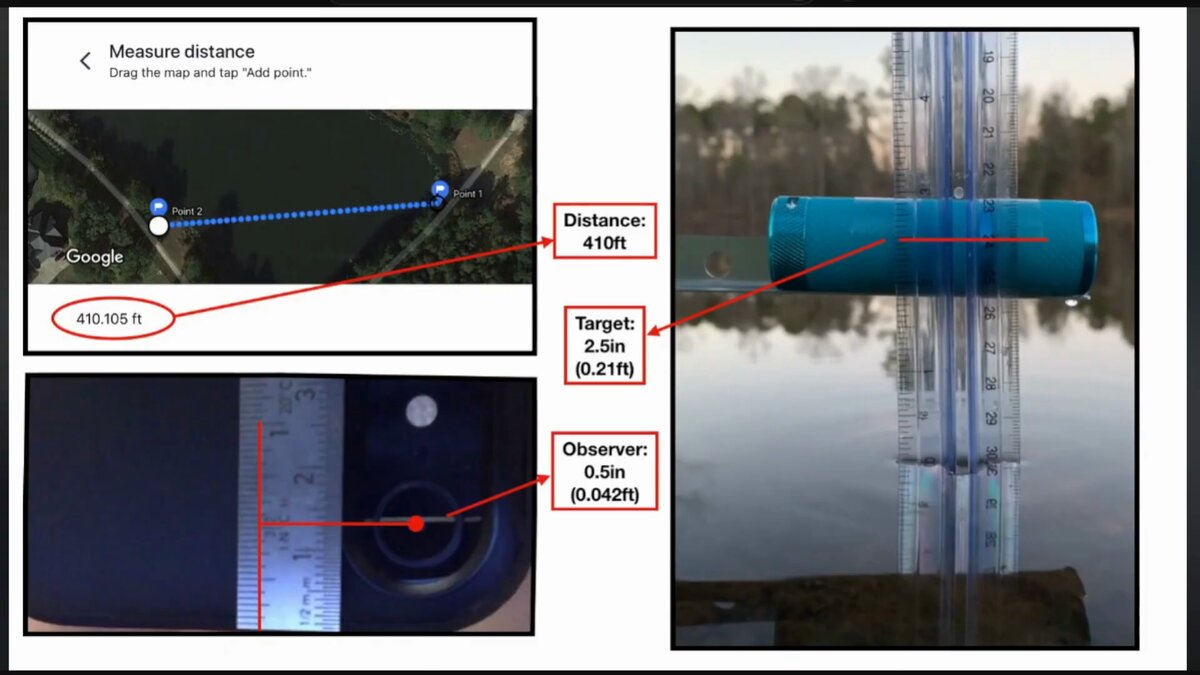
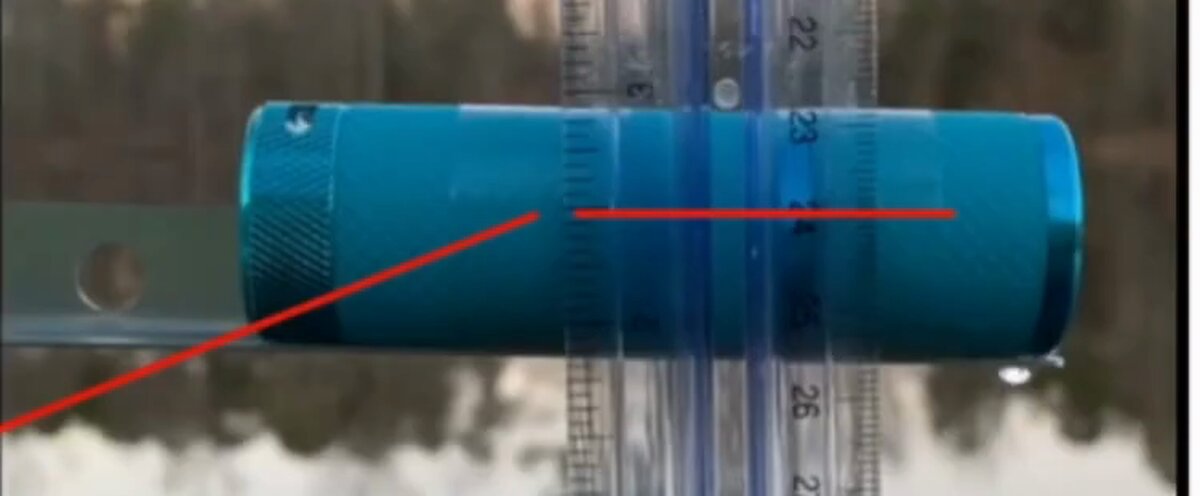
Dropping from ~2 ft to 0.5 in, the light is reported to become harder to see or drop out. His explanation: at extreme range and low eye height, distant objects become too small to resolve, no curvature required.
2 · The curvature arithmetic he gets right
| Observer height | Geometric horizon | Hidden height of a 2.5in target at 410ft |
|---|---|---|
| 1.5 ft (2 ft: ~9,140 ft) | ~7,900 ft | 0.00 mm |
| 5 in | ~4,170 ft | 0.00 mm |
| 0.5 in | ~1,320 ft | 0.00 mm |
At 410 ft the target sits far inside the geometric horizon at every height used, even with zero refraction. Standard refraction (k, the refraction coefficient — the fraction of Earth's curvature that bending in ordinary air cancels — here ≈ 0.17) only extends that horizon. A spherical Earth predicts exactly zero obstruction, as he says; the reflex “that's just the curve” is wrong here.
3 · His own experiment refutes his own explanation
Angular resolution governs whether you can tell two things apart, not whether you can see something at all. Headlights merge into a single point long before the car is out of sight; they do not go dark when they merge. Past the resolution limit an object loses its shape, not its position, and a bright torch on a dark pond is nothing but position. Whether a point source is detected is a matter of contrast against the background (Blackwell's 1946 thresholds are contrast thresholds, not size thresholds), and that limit sits far below the resolution limit: a star subtends well under a thousandth of an arcminute, a thousand times below the eye's limit even for the largest, and thousands are visible on a clear night.
Angular size does not depend on observer height. Full stop.
The angular diameter of a fixed 2.5in target at a fixed 410ft is a constant — it does not change by an arcsecond whether the camera sits at 2 ft or 0.5 in. If the target vanishes because the camera was lowered, resolution and perspective are ruled out. Something has to be blocking, dimming, or bending the light path. (To the extent eye height changes the distance to the target at all, the low camera is the nearer one, by about 1.2 mm — Method notes.)
Nor is it a stable effect. In the daytime clip the light drops out and returns within about a second — “there it's gone… and I haven't even touched the water yet. There I touched the water and it's back again” — and in the night clip it drops out for a single frame. Curvature does not switch on and off inside one second; a marginal near-surface effect does.
4 · The book makes the same case with a diagram — and the diagram gives it away
The same argument runs in Globe Deconstruction? (Levi Miller, prerelease draft, 2026), pp. 96–107 of a chapter that runs to 115, from the headlights analogy through a hallway-perspective sequence to the pond test. It's worth answering separately because the book commits to a number: the visual angle falling below “1/60th of 1 degree” (p. 102), restated as 0.0167° (p. 107). That is the standard naked-eye figure. It is never applied to anything: “the mathematics of angular resolution” appears on p. 100, but no arithmetic follows it anywhere in this chapter — the one worked example is a p. 134 warm-up in the star chapter. So here it is, with his threshold and his measurements.
What the diagram on p. 107 actually shows
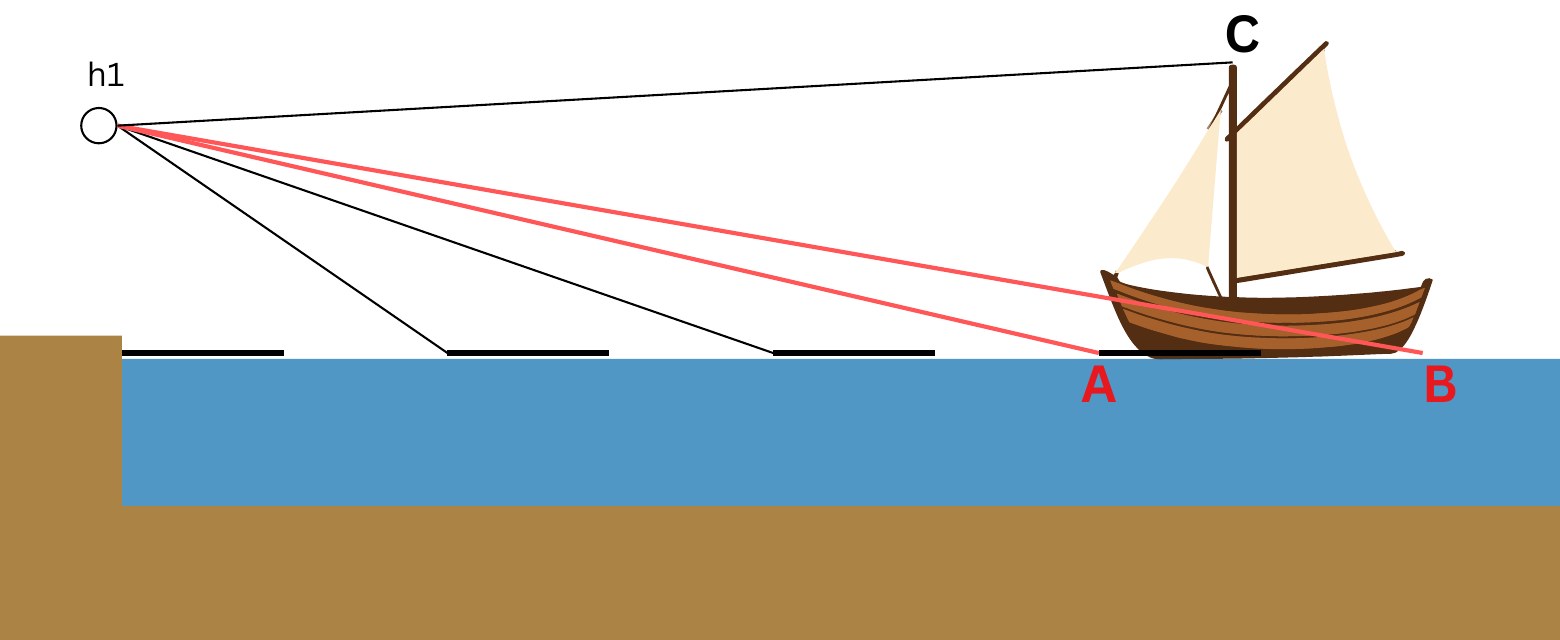
A and B are both on the water, at the near and far ends of the hull — so angle AB is the boat's length measured along the line of sight. It is a depth. C is the masthead, so AC and BC carry the boat's height. Now his own sentence against his own drawing:
“When angle AB reaches 0.0167 degrees, it will be visually invisible to the eye, while angle AC and angle BC will still be visually distinguishable.” — p. 107
That is the argument conceding itself. When AB collapses, the boat keeps AC and BC — its full height, waterline to masthead. What is lost is the ability to tell bow from stern. His mechanism deletes the hull's length, not the hull; the boat is still entirely visible, at an ambiguous distance. Loss of depth information is not what “disappearing bottom-up” means.
Why the two angles behave completely differently
For a horizontal segment of length L on the water with its near end at distance d, seen from eye height h, the subtended angle is h/d − h/(d+L), approximately hL/d² for d ≫ L. For a vertical extent H at distance d, it is approximately H/d. The first is proportional to h; the second contains no h at all. That is the whole error: the book correctly derives the height-dependence of horizontal extents on pp. 105–106, then applies it to a vertical one. Lowering the camera foreshortens the water, not the object standing on it.
In numbers, by pinhole projection over idealised flat water: a 6 m boat with a 3 m mast, 26 m away, seen from 36 in and from 1 in. The mast subtends 6.60° from the high eye and 6.58° from the low one; the deck flattens from 22.6′ to 0.63′, already below the 1′ limit the book sets, at only 26 m; the 16 m of water between 10 m and the boat compress from 3.21° to 0.09°. From an inch up you lose the deck and the sense of distance — the boat sits pasted onto a horizon that has come down to meet it — but no part of the boat. To make the hull go missing you need something in the way.
The numbers rule out the photographic example too
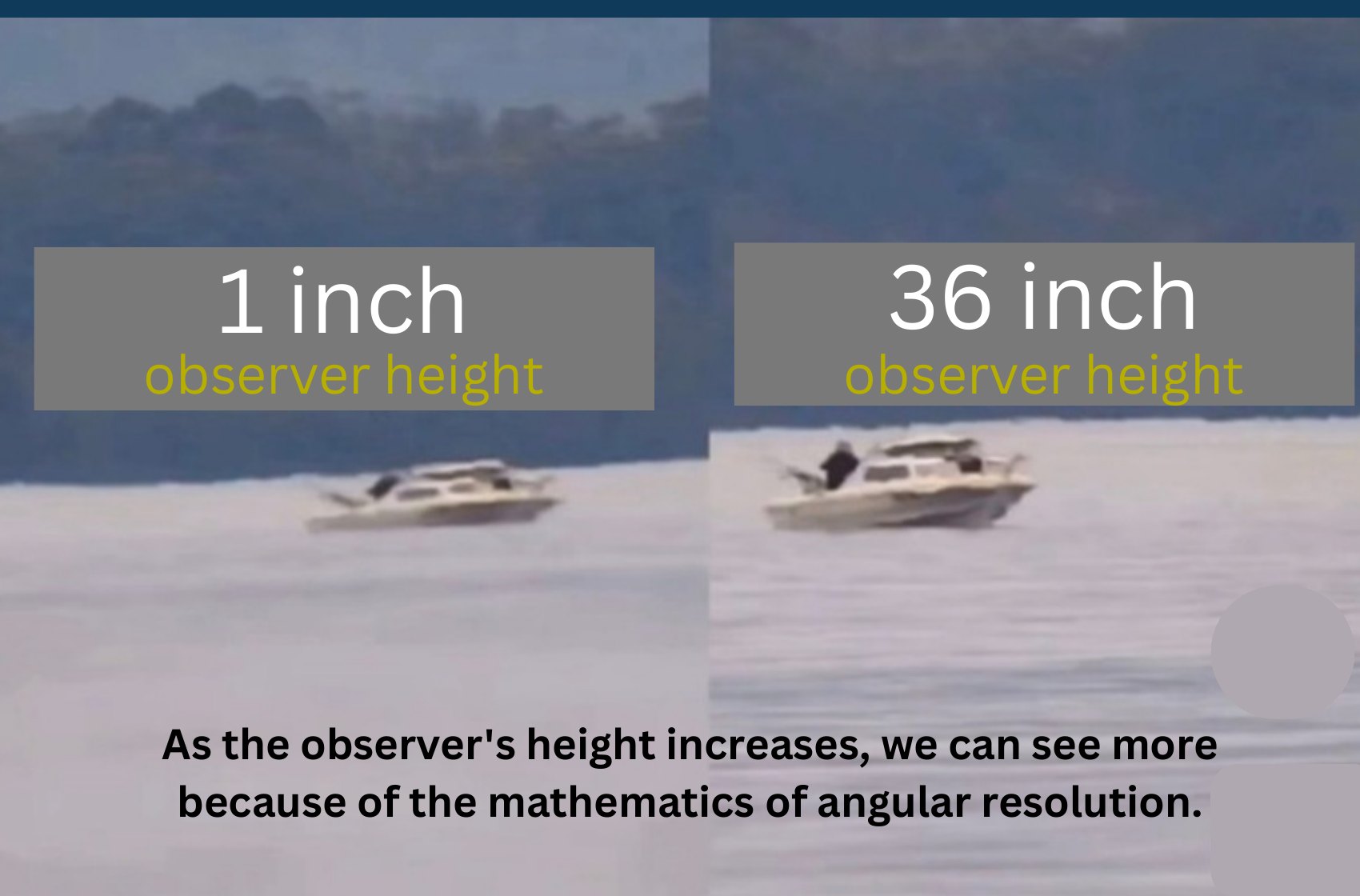
First, the two frames are not scale-matched: the 36 in boat is rendered noticeably larger (Method notes). Either the zoom differs between the frames or the boat's range does, so more than one variable moved, and most of why the right-hand boat looks sharper is magnification rather than eye height. That more hull is visible on the right is real and not in dispute; the comparison is just not the controlled one it is presented as. Take a 6 m hull, about right for the boat pictured, and apply his own 1-arcminute threshold to angle AB:
| Observer height | Beyond this range, angle AB is unresolvable | Angle AB for a boat 1 mile out |
|---|---|---|
| 36 in | ~441 ft | 0.44 arcsec — 1/136 of his limit |
| 1 in | ~66 ft | 0.012 arcsec — 1/4,900 of his limit |
The boat is plainly hundreds of yards out — far past 441 ft on any reading of the frame — so both photographs are taken well beyond the range at which angle AB has already collapsed to nothing.
Three of his own examples have no depth to lose
A ship departing stern-on presents its transom — a flat face with no along-sight depth, so AB is near zero from the outset — and hulls still vanish bottom-first, which is the observation the chapter exists to explain. The night pond test uses a bare torch, a point source for which AB is undefined. The daytime test uses a flat target facing the camera, for which AB is again zero. In all three the quantity said to do the work is zero or meaningless, and the effect happens anyway.
What is right here
Ground-plane foreshortening is real, it scales with eye height, and at an inch above a lake the near water really does compress into a smeared band in which an object's base is hard to separate from the surface. Seeing more of a distant object from a greater height is also real and repeatable. The disagreement is what that indicates: occlusion and resolution both improve with height, but only one of them survives magnification (§5).
Granting his premise rules out curvature — and points at waves
The caption on p. 100 asks why more of the boat is visible from higher up “if the water horizon extends well beyond the boat in both scenarios.” Take that at face value. If the horizon is beyond the boat, the boat is inside the horizon distance — and a globe then predicts no occlusion at all. As at the pond in §2, curvature is excluded by his own image before resolution is even discussed.
So something else is cutting the hull off at 1 in and not at 36 in, and the simplest candidate is waves. A crest occludes whatever lies beyond it as soon as it rises above the eye. At 1 in the eye is 2.54 cm up, so any crest taller than an inch qualifies — on open water, very nearly all of them. A ray grazing a crest of height w at distance x arrives at a target at distance d at a height of e + (w − e)·d/x: the occlusion is amplified by the ratio d/x.
| Intervening crest | Hull hidden, eye at 1 in | Hull hidden, eye at 36 in |
|---|---|---|
| 4 cm crest, 30 m out | 17 cm | none — ray passes above |
| 4 cm crest, 10 m out | 46 cm | none — ray passes above |
| 6 cm crest, 30 m out | 37 cm | none — ray passes above |
Boat taken at 300 m. Lower bounds: they assume a single crest, where real chop presents a succession, the nearest qualifying one dominating. At 36 in the eye sits 91 cm up and no ordinary lake wave reaches it, so the same water occludes nothing.
Which mechanism operates in that pair of frames cannot be settled from the images: waves are the most likely at an inch of eye height, but near-field clutter or a sub-refractive layer (one that bends light upward and hides more than geometry alone) would look similar. Curvature could re-enter only through that atypical refraction — the mirror image of the superior-mirage case in the Rampion wind-farm footage — which, like the gradient in §7, would have to be measured, not assumed.
5 · The theory behind the claim, and the three things that break it
The explanation has a worked source, linked from the raft video’s description as “more in depth analysis”: Angular Resolution and Our World, by LifeIs Short, the creator of the pond footage — three hours and twenty-two minutes of slides and arithmetic, also at shapedebate.com/30. Its thesis, stated in the first three minutes: “the optical angular resolution limit of the human eye was replaced by the physical curvature of the earth”, and the resolution limit can be used to derive a sphere of radius 3,959–3,978 miles — against Earth’s 3,963. The derivation is real: take the eye’s limit as 0.0216°, note that a six-foot person at three miles subtends exactly that, treat the person’s disappearance as unresolvability rather than hiding, and solve for the circle that would produce the same drop.
The agreement holds at one object height, and he chose it
From a resolution limit, an object of height h vanishes at h / θ. From curvature, it begins to hide at √(2Rh). Those are equal only when h = 2Rθ² — with his θ, 5.92 feet. It is the one point where a straight line crosses a square-root curve, and the object picked to stand there is a person. That makes θ load-bearing, because the derived radius goes as 1/θ². His 0.0216° comes from a diffraction calculation using a 666 nm wavelength and a 2.16 mm aperture, and the video says on camera (2:44:50–2:47:00) that those numbers were chosen deliberately.
| Resolution limit used | Where it comes from | Radius it yields from a 6 ft person |
|---|---|---|
| 0.0216° (1.29′) | 666 nm / 2.16 mm, chosen | 4,015 mi |
| 0.0154° (0.92′) | 550 nm / 2.5 mm, a real daylight eye | 7,887 mi |
Radii recomputed here from the stated inputs and a 6 ft person; the video’s own arithmetic lands at 3,959–3,978 mi, and nothing below turns on the difference.
Put a real pupil and the eye’s peak daylight wavelength into the same derivation and it returns twice Earth’s radius. The match to 3,963 follows from the constant, and the constant was selected; a derivation whose input was chosen cannot be evidence that its output is right.
A resolution limit does not hide things bottom-up. It hides them outside-in
Occlusion — a curved surface, a hill, a wave crest, a reed — removes the bottom of an object and leaves the top alone: a horizontal, sharp cut, with what stands above it as crisp as ever. A resolution limit strips fine detail everywhere at once: the object shrinks toward a point, its edges soften on every side, its contrast collapses, and it goes out from the outside in, with no cut line. A single photograph tells the two apart. A ship with a clean waterline edge and a sharp superstructure above it is occluded by something; a ship dimming into a smudge is unresolved. An argument that a resolution limit produced a sharp bottom-up cut has the physics of its own explanation backwards.
You can change the eye. You cannot change the curve
If the loss is optical it belongs to the instrument, and a better instrument removes it; if geometric, no instrument touches it. A 60× telescope improves resolving power sixtyfold: under the angular-resolution account a six-foot figure should stay resolvable to some 234 miles, while under curvature it is still gone at three, whatever the magnification. A P900 at full zoom resolves roughly 2.5 arcseconds, more than twenty times finer than the naked-eye figure the book relies on: if the missing hull on p. 100 is a resolution artifact, that camera restores it; if something is physically in the way, no aperture ever will. That is the oldest and cheapest test there is. Across three hours and twenty-two minutes on the optics of vanishing we could find no discussion of telescopes, zoom or magnification, and the book's chapter never runs it either.
And the two accounts separate as soon as the object changes height
Resolution distance grows linearly with height; curvature onset grows as its square root. They are closest at the height of a person, a factor of 1.3, and part company from there.
| Object | Resolution limit | Curvature onset | Ratio |
|---|---|---|---|
| a person, 6 ft | 3.9 mi | 3.0 mi | 1.3× |
| a ship’s mast, 60 ft | 39.1 mi | 9.5 mi | 4.1× |
| a lighthouse, 200 ft | 130 mi | 17.3 mi | 7.5× |
| Willis Tower, 1,748 ft | 1,138 mi | 51 mi | 22.2× |
His own Chicago slide contains the gap. On the Grand Mere State Park time-lapse at about 57 miles he grants that Chicago “should be hidden behind 2kft of curvature”, then supplies roughly 110 ft from the resolution limit at 0.02° and roughly 300 ft from upward refraction. Both figures are right — 0.02° at 60 mi is 111 ft, and curvature hiding for a six-foot eye at 57 mi is 1,945 ft. But 111 plus 300 is 411. The resolution term accounts for six per cent of what has to be explained, the whole stated budget for about a fifth.
6 · What's actually blocking it — and it's in his own slide
At 0.5in eye height the sightline to the 410ft target skims the water for its entire length — clearing the surface by roughly half an inch near the camera, widening to only about two inches by the far shore. Anything taller than roughly 0.6in in the first 15ft of that path occludes the target outright.
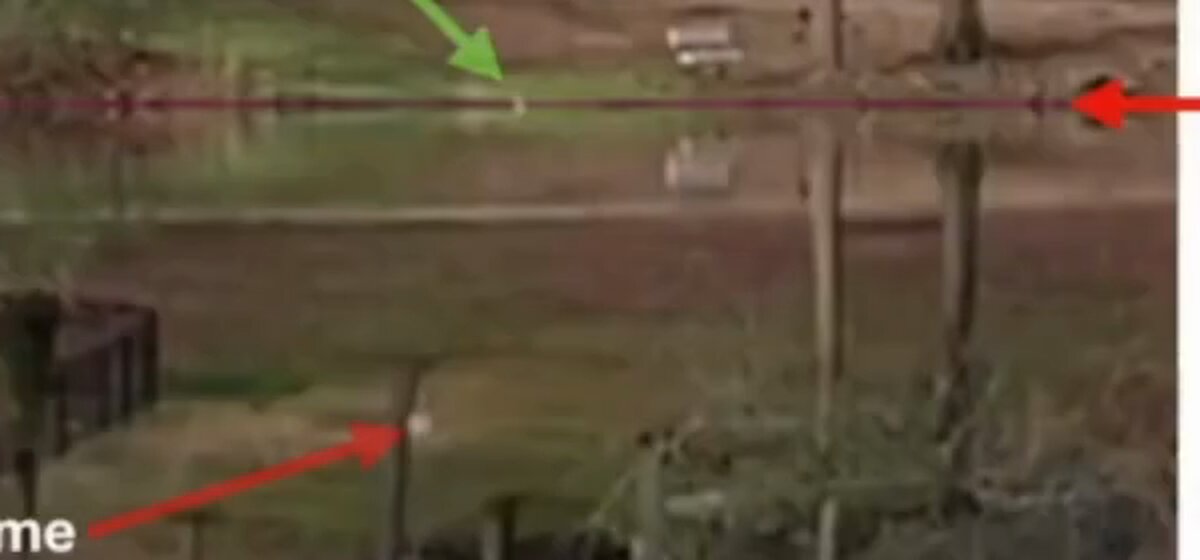
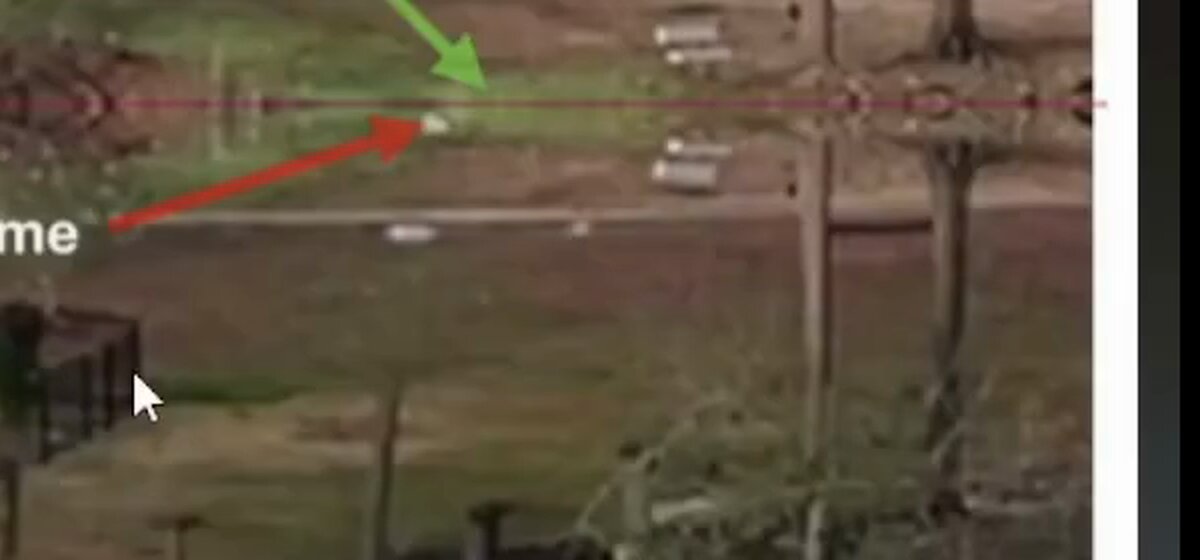
That is his own daytime summary slide, arrow and all: floating debris roughly 15ft from the camera. At 2ft it sits low in frame; at 0.5in it has risen to the far waterline, level with a target 27× further away. That is the conservative reading: if the debris stands even an inch proud of the water at 15ft, its top is around 9 arcminutes above the eyeline, against the torch's 1.4 — six times higher, squarely in front of it. His own caption names the mechanism — the eye “presses” into the gap between the horizon line and the near debris — and draws the wrong conclusion: not “the target dissolves,” but “near-field objects now sit higher in frame than far-field ones, and so can block them.” Ordinary occlusion by something close to the lens.
One caveat that matters: the night clip and the daytime clip are different sessions with different targets, so this piece of debris isn't necessarily what blocked the night light. The slide demonstrates the mechanism; it doesn't identify the night-time occluder, which could equally be a ripple crest, a wake (waterfowl are visible on the sightline in the night frames), floating film, or the meniscus around the phone case itself as it neared the water.
7 · Refraction runs the wrong way here — and it was never measured
The natural objection — “the water and air were about the same temperature” — is an impression, not a measurement, and the relevant quantity is not bulk air temperature but the vertical temperature gradient in the lowest few centimetres above the water, exactly the layer this sightline skims through.
A pond at dusk in cool weather, its water still warmer than the cooling air above it, sets up the opposite of the looming/superior-mirage case (light bent downward, lifting distant things into view): a warm surface under cooler air — a superadiabatic layer, meaning temperature falls with height faster than rising air would cool on its own. That bends light upward (sub-refraction), hiding low targets earlier than geometry predicts, with a sharp mirage cutoff rather than a fade. It does not take much:
| Sightline sags below the straight chord by | Gradient that does it | Temperature difference across the lowest 4cm |
|---|---|---|
| 5 mm | −2.6 °C/m | 0.10 °C |
| 13 mm | −6.8 °C/m | 0.27 °C |
| 25 mm | −13.0 °C/m | 0.52 °C |
| enough to hide the target completely | −17.6 °C/m | 0.70 °C |
The first three rows are how far the sightline bows below the chord, the straight line from lens to torch — which on its own hides nothing, because the torch radiates in every direction and a steeper ray still reaches the lens. The row that matters is the last: the condition under which no ray from a 2.5in source can reach a lens half an inch up without first striking the water. That takes about 0.7 °C across the lowest four centimetres, seven times the first row — an ordinary near-surface gradient on an evening when the water is warmer than the air, routinely measured in the skin layer; not the default, but common enough to need measuring rather than assuming away. It is also why surveyors require a levelling sightline to clear the ground by half a metre; the entire 0.5in test is conducted inside that exclusion zone.
8 · This exact grazing-sightline trap dates to 1838, and it's been run in both directions
In 1838, Samuel Birley Rowbotham (later publishing as “Parallax”) held a telescope 8in above the water of the Old Bedford River and tracked a boat with a 3ft flag receding six miles down a dead-straight canal. The boat stayed visible the whole way — which, by his reasoning, a curved Earth should have prevented. He never accounted for refraction in that lowest layer. In 1870, Alfred Russel Wallace accepted a wager from flat-earther John Hampden to redo it, and his fix was the fix in §10 below: get the sightline out of the near-surface layer. He raised the line of sight to 13ft above the water and added a reference pole at the canal's midpoint. Sighting from Welney bridge, the midpoint disc appeared distinctly above the far marker three miles beyond it — the three did not line up, which a curved surface requires and a flat one forbids. Wallace won the bet. Henry Yule Oldham repeated it in 1901 with three poles at equal height above the water and found the middle one about six feet higher than the end poles.
Rowbotham's run and this one are the same trap producing opposite-looking “proofs.” His grazing sightline kept visible something curvature said should be hidden; this video's makes something disappear that curvature said should stay visible; both are read as disproving the globe. Neither is evidence about the shape of the Earth; both show that a sightline held inches above water cannot be trusted in either direction, and the fix, 132 years apart, is the same: move the line of sight up and out of that layer.
9 · The night clip's “hard line” is an autofocus artifact, not an occlusion edge
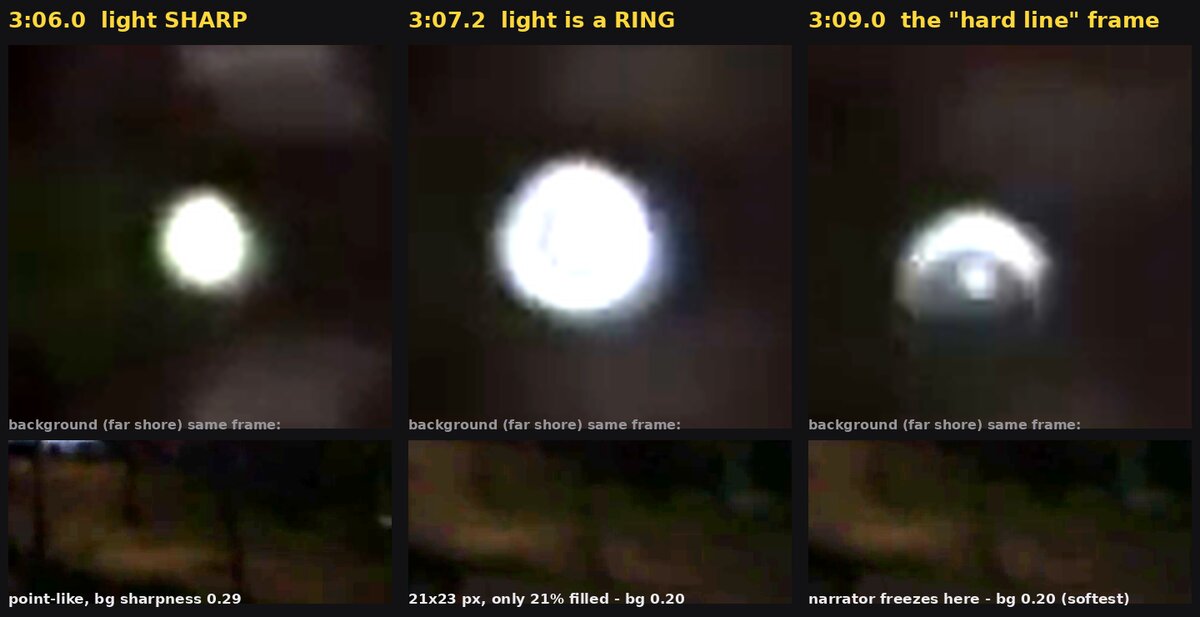
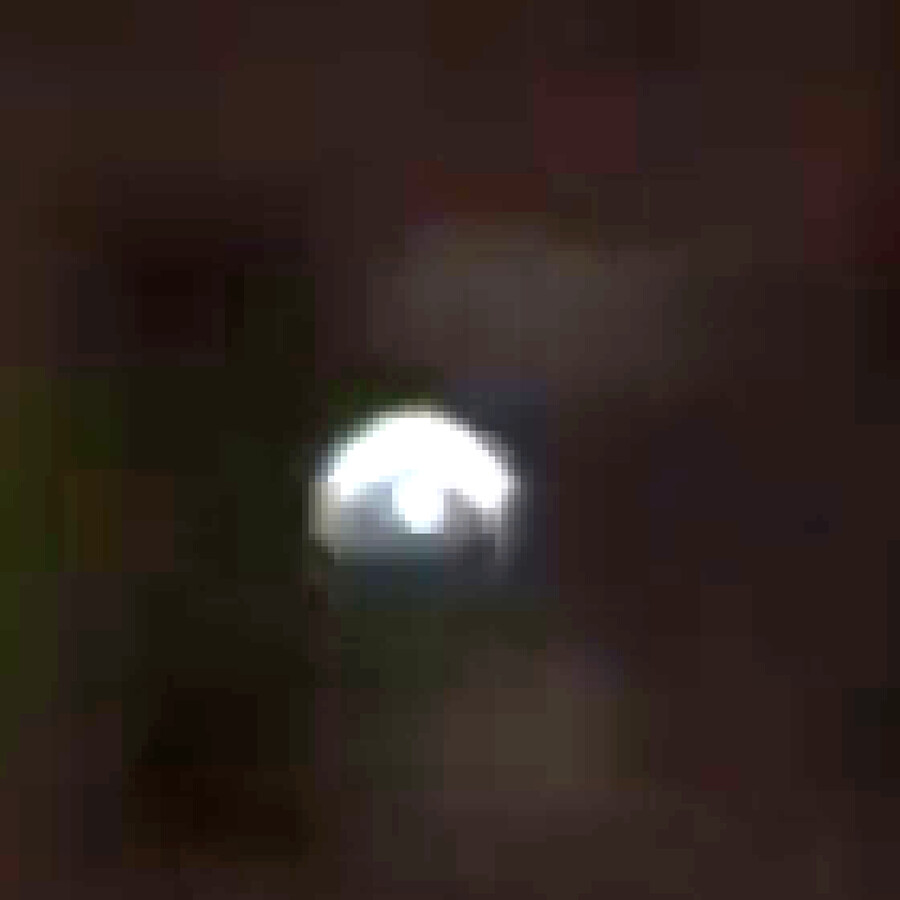
At 3:09 the video freezes on a frame and reads the light as sliced by a hard, straight edge. The frames around that moment tell a simpler story.
10 · Where this page could be wrong, and what would change our mind
The disappearance is real and, by his account, reproducible. But occlusion and sub-refraction are both near-surface, both height-dependent, and both can produce a sharp cutoff; this footage alone cannot separate which was doing the work on any given frame, and the night clip's specific occluder (if any single one exists) is not identifiable from the video. What can be said with confidence is what it isn't: not curvature, and not angular resolution or perspective, which cannot produce a height-dependent effect on a fixed-distance, fixed-size target at all.
“Then your waves-or-debris explanation is unfalsifiable after the fact.” It would be, if it came with no predictions. At 410 ft a flat plane and a globe both predict 0.00 mm hidden, so no result on this pond can separate the two shapes; what the tests below separate is occlusion from resolution, and each can come out against this page.
- — Halve the distance to ~205ft, both eye heights unchanged. An occlusion threshold scales roughly linearly with distance; a curvature effect scales with distance squared.
- — Repeat on a known-flat surface — a long gym floor or corridor, camera at 0.5in. If the same disappearance happens there, that closes off “a flat surface wouldn't do this.”
- — Thermometers at 1cm and 50cm above the water. A gradient near −17.6 °C/m makes sub-refraction the explanation; a gradient near zero rules it out.
- — Tripod, with autofocus and auto-exposure locked. Removes the focus-hunt artifact behind the “hard line” reading.
- — A spotting scope or long lens so the target is resolved rather than sub-pixel — then a truncation, if it happens, is a readable observation instead of a guess about bloom shape.
Method notes
Eye height and distance to the target. The 0.5in eye sits about 2in below the 2.5in target, the ~2ft control eye about 21.5in below it; over 410ft the eye-to-target distances are roughly 4,921.26in and 4,921.31in — the low camera is closer, by about 1.2mm, and a 1.2mm difference over 410ft is roughly five orders of magnitude too small to move a resolution threshold.
The p. 100 boat pair. Cropped to the same window, the 36 in boat renders roughly a third larger than the 1 in boat by the cleanest measurement we could take; the images are low-resolution video stills and repeated automatic measurements disagreed, so no firm figure is given.
Refraction coefficient. This page uses k ≈ 0.17, what Bowditch's terrestrial horizon formula implies (1.17√h against a geometric 1.06√h works out at k ≈ 0.18); the Rampion page uses k ≈ 0.13, Gauss's classical geodetic coefficient. Both are standard; the difference moves hidden heights by a few percent, and nothing on either page turns on it.
Reading of the LifeIs Short video. The passage at 2:44:50–2:47:00 was checked against the audio by independent re-transcription rather than automatic captions; the rest of our reading rests on a condensed caption summary and the slides.
Sources & further reading
- The Bedford Level experiments: Samuel Rowbotham, Zetetic Astronomy: Earth Not a Globe (1865/1881), “Experiment 1”; A. R. Wallace, My Life (1905), vol. 2, on the 1870 wager; H. Yule Oldham's 1901 repetition, reported to the British Association. Wikipedia summary.
- Levelling sightline clearance: Federal Geodetic Control Subcommittee, Standards and Specifications for Geodetic Control Networks (1984) — first-order lines of sight clear the ground by at least half a metre; and Schomaker & Berry, Geodetic Leveling (NOAA/NGS, 1981).
- Near-surface refraction: the standard gradient form k = 503(P/T²)(0.0343 + dT/dz), Bomford, Geodesy; A. B. Fraser, “Simple solution for obtaining a temperature profile from the inferior mirage,” Applied Optics 18 (1979).
- Point-source visibility against resolution: H. R. Blackwell, “Contrast thresholds of the human eye,” JOSA 36 (1946).
- LifeIs Short, Angular Resolution and Our World — YouTube, 3:22:24; also shapedebate.com/30, and linked from the raft video’s description as “more in depth analysis”. The worked source for the angular-resolution explanation, examined in §5.
- Shape Debate (Levi Miller), more flat surface disappearance observations and discussion — YouTube, uploaded 10 July 2026, 27:03. Cited under the title it now carries; bottom up observations is the playlist collecting it, at shapedebate.com/flatsurface, the author’s own canonical pointer to this material. Pond footage and apparatus originally by “LifeIs Short”, credited in the video’s description, which links the original at youtu.be/R2OwcfF3JpE.
- Levi Miller, Globe Deconstruction? (prerelease draft, 2026), pp. 96–115 — the angular-resolution chapter. The resolution threshold is stated on pp. 102 and 107; the two figures discussed in §4 are on pp. 100 and 107.
- NGA, American Practical Navigator — geometric, optical and refracted horizon distance formulas.