Fun With Science / Globe Deconstruction / The Curve at 118,000 Feet
The Curve at 118,000 Feet
Two videos the book sets against each other at pp. 234–237: a rendered horizon, a balloon compilation, and the rocket that “suddenly stops.”
How much a horizon bows in a picture is set by the lens as much as by the height. On a flat plane it is zero through every lens, at every tilt.
Page 234 prints a frame from a high-altitude balloon compilation under the heading This is Earth. Page 235 prints a computer render captioned This is what the curve should look like on the left and right at 118,000 feet, with the horizon visibly lower at the edges than in the middle. Pages 236–237 turn to the GoFast amateur rocket, whose footage the book reads as a vehicle stopping dead in mid-air. The contrast being drawn is plain: the render says the horizon ought to bow, the real footage does not seem to, and a rocket did something no rocket should. This page measures all three on one rule.
Verdict
The still on p. 235 is a frame from a computer simulation of what rising above a globe would look like, rendered for a camera 36 km up with a lens about 100° across. Measured against its own printed dip, it is right for that lens, to two pixels. But how much its horizon bows is a property of the lens as much as of the height: through a 40° lens the same horizon at the same height bows a third as much, and through the GoPro-class fisheye the rocket actually carried, less than half as much. The balloon compilation has no stated lens, no stated height per clip and no eye-level reference, and its frames sit within a few pixels of straight; that is consistent with a lower clip, a flattened lens, or a flat plane, and cannot separate them. The rocket footage can. Because it spins, its horizon sweeps through the centre of the frame in every orientation, and a line through the centre of any ordinary lens is where a flat plane’s horizon must image straight. It bows toward space in every clean frame — twenty of twenty-one traced along the faint outer edge of the glow, twelve of twelve traced along the bright limb — and along the bright limb it bows by a median 26 px over a 700–800 px chord, against 19–26 predicted for a GoPro-class lens at that height and exactly zero for a flat plane. The “sudden stop” at 227 s of the re-upload is the roll stopping, from about a turn a second to nil inside a second; a camera 100 km up cannot see whether it is moving, and at the top of a ballistic arc the vertical motion is zero on every model. And footage accepted for the horizon is accepted for everything else in it: the professional flight the book links burns its second stage from 4 km to 43 km, through air thinning three-hundred-fold to a five-hundredth of sea level, and reaches the speed the whole 253-km arc needs. That is Claim #2 — gas cannot push in a vacuum — answered by the book’s own exhibit.
1 · What pp. 234–237 say
Four pages, three videos. Page 234 is a single frame with the caption CGI, curve, spin, orbit & spacetime sold separately and the question Were you shown videos like this in science class?; the QR code (69) leads to a 22-minute balloon compilation titled Best High Altitude Flat Earth Footage, whose description says its clips were shot “without a fish-eye lens” at over 20 miles up. Page 235 is a still from Movie Vertigo’s Earth horizon curve simulation (QR 70), a POV-Ray render of the globe from 36 km with the dip, horizon distance and fraction of Earth visible printed on it, and two dotted lines the book has added to mark how much lower the horizon sits at the left edge than at the centre. Pages 236–237, headed Speculation of GoFast rocket video, link the re-uploaded on-board footage of the CSXT GoFast flight (QR 71) and ask how a rocket can “suddenly come to a complete stop”; a fourth link (QR 72) goes to DLR’s MAPHEUS-5 sounding-rocket video as an example of a flight where the anti-spin mechanism is easy to see.
The argument the pages make together is a contrast: here is what the globe says a horizon should look like from 118,000 feet; here is what cameras at that height record; they do not match. The book labels the rocket section speculation, and this page keeps to that label for the rocket’s trajectory. The horizon contrast is not labelled speculation. It is a geometric prediction about a camera at a stated height, and it can be checked.
A small mismatch for the errata: the text gives the flight as 2004 and 116 km; the video linked is the 2014 flight, which CSXT reports at 385,800 ft (117.6 km). The two flights are ten years apart and both are real; nothing on this page turns on which.
2 · How much bow there should be
From a height h above a sphere of radius R, the horizon lies the same angle below eye level in every direction: dip = arccos(R/(R+h)), which is 6.08° at 36 km and 10.9° at 118 km. That is the whole of what the globe predicts. Everything else — how many pixels lower the edge of the horizon sits than the middle — is the lens. A circle of constant depression seen through a rectilinear lens of focal length f pixels lands at y = −f tan(dip)/cos a for a point at azimuth a from the direction the camera points, so the edges of a frame of half-width w sit lower than the centre by
bow = f · tan(dip) · (1/cos φ − 1), φ = atan(w/f) — equivalently bow = w · tan(dip) · tan(φ/2)
Three things follow, and each matters below. The bow scales with tan(dip), so doubling the height does not double it, and 118 km gives only 1.8× the bow of 36 km. It scales with the width of the field, so a wide lens shows a great deal of it and a long lens almost none: at 36 km on a 1,280-px frame, 12 px at 40°, 18 at 60°, 28 at 90°, 39 at 120°. And it does not depend on which way the camera tilts — pitching a 90° lens up or down by 20° moves the horizon up and down the frame but changes its bow by half a pixel — so a balloon camera swinging on its line does not gain or lose curve. On a flat plane the dip is zero at every height and so is the bow, through any lens, at any tilt.
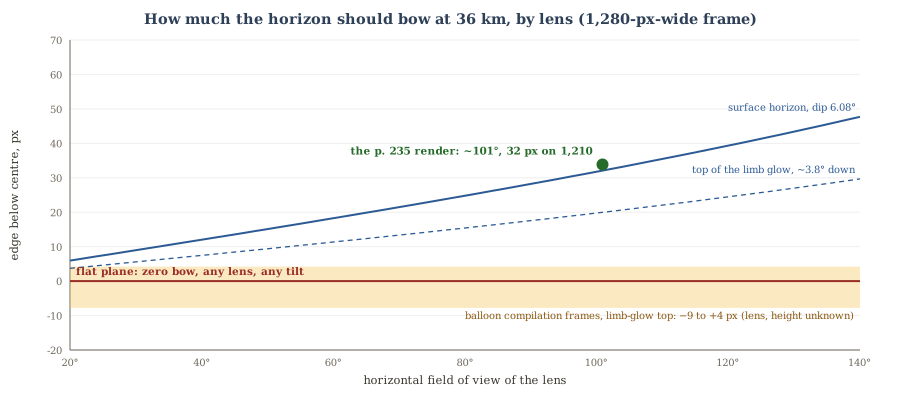
Two refinements. The pitch independence above is a property of rectilinear lenses; fisheye lenses — the GoPro class, which is what balloons and amateur rockets mostly carry — compress the field toward the edges, so through a fisheye the bow at the edge of a level frame is smaller (about 13 px at 36 km for a 118° GoPro, against 39 for a 120° rectilinear lens) and does change with pitch. But every lens with a distortion symmetric about its axis, rectilinear or fisheye, obeys one rule that does not depend on knowing which it is: a straight line through the centre of the frame images as a straight line. A flat plane’s horizon is a great circle of the sky, so wherever it passes through the centre it must come out straight. A globe’s horizon is a small circle, and near the centre of any such lens it curves by tan(dip) per radian of field — the same for every projection, because all of them have the same scale at the centre — so over a chord of length L through the centre it sags by tan(dip) · L² / 8f, where f is the lens’s pixels per radian, for chords short beside f; the exact forms for each projection are in the script. That is the test the rocket footage allows, and it needs only the height and the lens’s central scale, not its projection.
3 · The render, measured
Turn the p. 235 still upright and it carries everything needed to check it: the render’s own Eye level line, the printed dip of 6.07°, and a horizon that can be read off the pixels. The horizon at the centre of the frame is 53 px below the eye-level line, which makes the render 8.7 px per degree, a focal length of 500 px, and a field of about 100° across the 1,210-px width. That lens predicts a bow of 30 px at the edges; the edges measure 32 px lower than the centre, and the book’s own two dotted lines are 30 px apart. The render is right, and it is right for a 100° lens. Nothing in the caption says so.
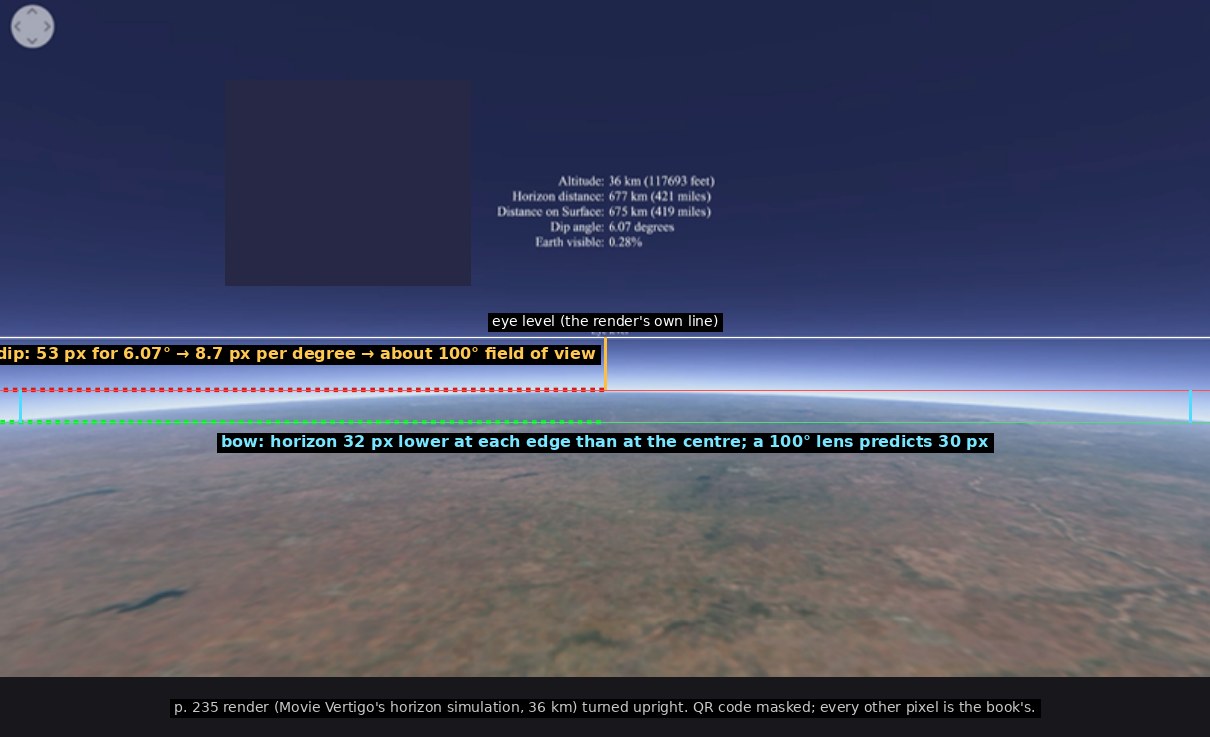
What the render does not say is that the same globe, from the same height, through a phone camera at 70° would bow 20 px, through a 40° lens 11 px, and through a GoPro-class fisheye, level, about 13 px at the frame edge. “What the curve should look like” is not one picture. It is one number, the dip, and a family of pictures that depend on what took them.
4 · The balloon frames cannot decide it
The frame on p. 234 is at 921 s of the compilation. The top edge of its limb glow, fitted across the width with the sun’s glare column excluded, bows 4 px toward space (edges lower than centre) with a scatter of under 2 px; a frame from the first clip, at 60 s, bows −3 px (edges fractionally higher); a frame from a later clip, at 700 s, −9. For a 36-km camera the globe predicts 11 px at the glow top through a 60° rectilinear lens and 20 through the render’s 100°; through a fisheye, 8. The frames show less than any of those, and the p. 234 frame shows the right sign.
That would be interesting if anything about the frames were known. Nothing is. The compilation does not say which balloon, which camera, which lens, or what height each clip was at; its description says no fisheye was used, and its own on-screen content later runs a side-by-side Normal against Fish Eye at the same stated heights, which means at least some of the material has been through a lens correction, and a correction with the wrong model flattens curves or reverses them. The glow top is a proxy for the horizon at a height of 20-odd kilometres, not the surface. And there is no eye-level line: the one measurement that separates the models cleanly — the horizon 6° below level on the globe, at level on a flat plane — cannot be made on footage with no level in it. A few pixels either side of straight, on a frame of unknown height through a lens that may have been de-fished, is not evidence for either surface. The book reads the frame as showing no curve; it shows a small one; neither reading can be pressed further. The footage that can decide the question is the footage the book chose next.
5 · The rocket, through the centre of the frame
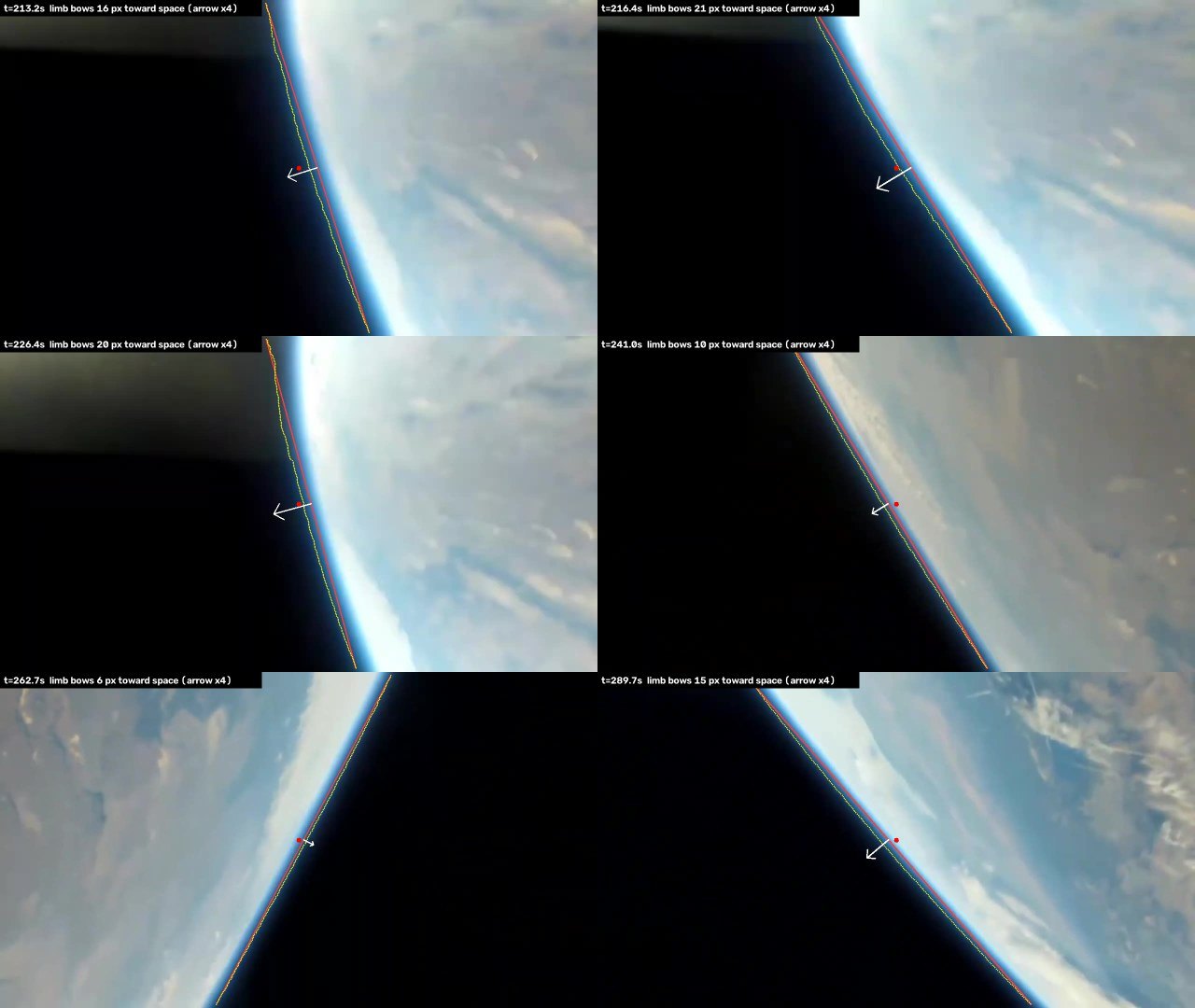
The GoFast footage is one continuous on-board clip from a flight with a published apogee, and for most of its coast the vehicle rolls at about a turn a second. That is a gift, because it sweeps the horizon through the centre of the frame at every orientation, and the through-centre rule of §2 applies without needing to know the lens. In the apogee sequence (172–293 s of the re-upload, at ten frames a second) 89 frames have the limb within 40 px of the frame centre against dark sky; 26 of those have a dark side clean enough to fit (luminance under 20); five of the 26, at 206–225 s, returned sagittas of −245 to −354 px, which no horizon gives — a parabola that deep across a 900-px chord is a circle of radius 300 px — and on inspection the detector had run along the edge of a band of sun glare, not the limb. The other 21 are horizons. That threshold traces the faint outer edge of the atmospheric glow, which stands well above the surface and so sits at a smaller depression than the surface horizon; a second pass at a threshold of 120 traces the bright limb itself, close to the surface horizon, and passes the same screens in 12 frames.
| Through-centre sagitta, toward space | px | Against the GoFast frames |
|---|---|---|
| Measured, bright limb, 12 frames, chords 710–830 px (one at 1,400) | median 26; range 8.5 to 35; positive in 12 of 12 | — |
| Measured, outer edge of the glow, 21 frames, chords 710–930 px, orientations −62° to 83° | median 8.4; range −8 to 26; positive in 20 of 21 | — |
| Globe, GoPro-class lens (118°, 622 px per radian), surface horizon, 118 km, chords 710–830 px | 19–26 | Matches the bright limb: predicted 23 over the typical chord, measured median 26. |
| Globe, same lens, surface horizon, 80 km / 60 km | 19 / 16 | Consistent: frames away from apogee sit lower, inside the measured spread. |
| Globe, same lens, outer edge of the glow (tangent height 60–80 km), 118 km | 13–16 | Same order: measured median 8.4 is low by about half, sign right in 20 of 21; the faint edge is blurred and its tangent height is a guess. |
| Globe, rectilinear 60° / 90° / 120°, surface horizon, 118 km | 13 / 21 / 32 | Consistent: the same globe through non-fisheye lenses brackets the bright-limb range. |
| Flat plane, any lens, any height, any orientation | 0 | Excluded: 32 of 33 traced frames bow toward space; the flat plane predicts none of them. |
In one line: traced along the bright limb, the GoFast footage bows by what the globe predicts for its height and lens; traced along the faint outer glow it bows less, but the same way; a flat plane predicts no bow in either.
In one line: the GoFast footage shows the curve the computer render on p. 235 says it should, scaled for the rocket’s lens and height, and does not show the straight horizon a flat plane requires.
Two features of the measurement carry the weight. The first is the sign. A crop that put the optical axis somewhere other than the frame centre would curve a through-centre line too, but toward the true axis, so its sign would flip as the camera rolled; here the bow is toward space at −62° and at 83° and at every orientation between, and it does not depend on the height at all: the sign is fixed at every altitude, so the test does not lean on the apogee figure. The second is the size, and here the two traced edges have to be kept apart. Along the bright limb the sagitta runs 8.5–35 px with a median of 26, on a prediction of 19–26 for the chords used at 118 km and somewhat less for frames away from apogee; that is agreement to the width of the scatter. Along the faint outer edge of the glow the median is 8.4, about half of the 13–16 the same lens predicts for an edge whose tangent height is 60–80 km, with one frame under zero inside the noise of a fit to a blurred edge. The outer edge is the harder measurement and the softer number; the bright limb is the one to weigh. The lens is inferred, the frames are not all at apogee, and the chord is not the same in each, so the page claims the bright-limb agreement to the factor the method can support, not to the pixel. Against zero, either edge is enough.
So to the question the pages ask — why does the rocket not look like the render? Because the render is a 100° rectilinear view from 36 km with the horizon held 53 px under a level line, and the rocket is a fisheye at up to 118 km rolling once a second with no level in the frame. Put the render at the rocket’s height and its edge bow becomes 55 px; give the level render the rocket’s fisheye and the same horizon bows 21 px at the edge. Neither of those is the through-centre figure, which is the one quantity the two can share, and on it they agree: over the same 780-px chord through the centre, the render’s globe through the rocket’s lens gives 23 px, and the rocket’s bright limb measures 26. The book contrasts a picture with a picture. The geometry contrasts a number with a number, and the number is not zero.
6 · The stop at 227 seconds
The book’s reading of the rocket footage is that the vehicle “suddenly comes to a complete stop,” that a despin mechanism could not do that, and that there is “not a single pixel of evidence” of one. The first sentence is what the footage shows, read carefully. Tracking the direction of the bright half of the frame gives the roll: through the coast it turns at several hundred degrees a second, about a revolution a second with the wobble of a coning vehicle on top; at 226.4–226.8 s the sun sweeps through the field one last time; at 227.2 s the horizon is standing still, and from there to the end of the clip it drifts at a few degrees a second. That is a rotation stopping inside a second. It is not a vehicle stopping, and a camera at that height could not show one: with nothing in the frame nearer than the ground 100 km below, translation at a kilometre a second and translation at zero produce the same picture over any span of seconds. What an on-board camera can see is attitude, and attitude is what changed.
The book is right that a despin does not slow a rocket; spin and flight path are independent, which is why the roll can stop while the arc continues. It is also right that on a ballistic arc the rocket slows gradually toward the top — and at the top, on every model, its vertical speed is zero. A vehicle that has “stopped” at apogee is a vehicle at apogee. The remaining question is what stopped the roll, and a yo-yo despin does exactly this: two weights on cords unwind, take the angular momentum, and release, and the roll goes from its full rate to near nil in about a revolution. That is the signature at 227 s.
As to the pixels: the MAPHEUS-5 camera the book offers as the visible counter-example looks down along its own vehicle, and the body, the stage separation and the hardware are in frame throughout. The GoFast camera at the moment of the stop is looking at sky and Earth; from 180 s to the end there is no part of the vehicle in the picture at all. The clip’s first segment, from a second camera that does look along the body toward the tail, shows the same signature — steady roll, then a stop inside a second at 58 s of the clip — and nothing detaches within its view; but its view is the tail, and a yo-yo sits forward of that, where MAPHEUS carries its own. So the footage is consistent with an anti-spin device in every particular, and the orientation of both cameras is consistent with not seeing it deploy. Hardware that is outside the frame leaves no pixels, and that is a fact about the framing, not about the hardware.
The book’s sentence is that there is not a single pixel of evidence for a despin. It is equally true that there is not a single pixel inconsistent with one, and the second statement is the one that matters, because the book is the party making a claim — that something other than the vehicle’s own hardware stopped it. Scepticism is not a question with no evidence behind it; a doubt that cannot say what it would take to be satisfied is not doing any work. And the alternative the book reaches for has already been ruled out by its own exhibit: whatever is imagined to stop a rocket at 117 km, the book introduces into evidence, on the next page, a rocket that passed through 117 km at about 1,600 m/s, still climbing, and went on to 253. There is no barrier to argue for at that height, on the book’s own footage. The team’s leader has addressed the flight on video; the book declines his account on the ground that he could have been pressured, and this page does not need it. The claim rests on the footage, and the footage records a change of spin, not of motion.
The book files this section under speculation, and the speculation — that “something external caused the rocket to continue” — is left where the book left it. What this page grades is the observation under it, and the observation is misread.
7 · What else the two rocket videos show
The book brings the rocket footage in for one thing, the curve, and treats the rest of the frame as scenery. But a video accepted as genuine is genuine all the way through, and these two flights bear on five separate globe claims besides the horizon, each of them on the book’s own lists: that gas propulsion works where there is almost no air to push against (the book’s Claim #2); that a payload in free fall is weightless, with nothing to float in (Team B #97); that the atmosphere thins to nothing under gravity with no lid above it (#45, #46); that spin and flight path are independent, so a despin costs no altitude (p. 237’s premise); and, more faintly, that gravity weakens with height (#18). A sixth point, the size of the Moon in the frame, is a lens question the book asks and does not answer. None of these was the reason the footage was linked, and that is the useful thing about them: a real flight is not a single fact but a bundle of them, and the same seconds of video that show the curve also show the thrust, the fall, the thinning air and the despin, because on a globe those are not separate claims but one physics seen from different sides. The professional flight in particular comes with a published sequence of events: MAPHEUS-5 flew on a VSB-30, a two-stage vehicle whose nominal profile is tabulated in the open literature, and whose flown figures DLR published the same day — apogee 253 km, weightlessness from 74 s for over six minutes, despin at about 70 km. The table and the press release agree to a kilometre and a few seconds.
| VSB-30 event (nominal) | Time | Altitude | Air density, % of sea level |
|---|---|---|---|
| First stage burnout, separation | 13.5 s | 3.6 km | ~70 |
| Second stage (S30) ignition | 15 s | 4.3 km | 64 |
| “Ascent speed 2000 m/s, Mach 6.5” (the video’s caption) | ~40 s | ~35 km | ~0.7 |
| Second stage burnout | 44 s | 43.1 km | 0.21 |
| Yo-yo despin | 56 s | 66.1 km | 0.011 |
| Payload separation; weightlessness begins (DLR: 74 s) | 59 s | 71.7 km | 0.007 |
| Apogee (DLR flown: 253 km) | 259 s | 252.7 km | ~5 × 10⁻⁹ |
Events and altitudes from the VSB-30 flight-performance paper, Table 1; densities from the U.S. Standard Atmosphere 1976; the caption altitude is read from the video’s own time-stamps against the table. Re-derived in horizon_bow.py.
Claim #2, and Kampf’s Law. The book’s second lead claim is that gas cannot push in a vacuum because it needs an external substrate to compress against (p. 82). The second stage of the rocket in QR 72 ignites at 4 km in air at two-thirds of sea-level density and burns out at 43 km in air at a five-hundredth of it; the video’s own caption reads 2,000 m/s near the end of that burn, and 1,980 m/s vertical is what a coast from 43 km to 253 km requires. So the motor delivered essentially the whole of the flight’s speed while the substrate under it fell three-hundred-fold, and it delivered the last ten seconds of the burn, from about 24 km to 43, in air between one part in thirty and one part in five hundred. If thrust went with the substrate, the stage would have faded in the stratosphere and the vehicle topped out there. It did not; it went to 253 km, and the rocket in QR 71 went to 118 on a ten-second burn and a 130-km ballistic coast (1,600 m/s squared over 2g) with nothing pushing at all. The book asks for “more experiments done like this every year.” This one has been done, on its own recommendation, and it settles the claim it was not brought in to settle. A reader cannot keep both: the footage as evidence about the horizon, and Claim #2.
The despin, again. Page 237 argues that no one would deploy an anti-spin device before the top, since it would cost altitude. The flight the book offers as the visible example deploys it at 66 km, at 56 s, a quarter of the way up a 253-km arc; and it separates the spent motor three seconds later, after which the empty stage and the payload coast on together in the frame, neither falling away from the other, because in free fall with nothing around them there is no reason for one to. A despin costs nothing in altitude because spin and flight path are independent, which is the book’s own point turned the right way up.
Free fall, and how fast things fall (Team B #97, #18). The payload is weightless for six minutes because it is falling, up and then down, with nothing to hold it and nothing to float in: at 250 km there is no medium for buoyancy or density to act through, and the rocket still comes back, 70 km from the pad, fifteen minutes after launch. The timing is the globe’s arithmetic. A coast from 43.1 to 252.7 km takes 214 s under a gravity that weakens as the inverse square of distance from the Earth’s centre, and the table says 215; under a gravity fixed at its surface value of 9.81 it would take 207. The difference is small, and thrust tail-off could account for some of it, so this is a consistency and not a proof; but the sign is the one #18 predicts.
Where the air ends (Team B #45, #46). Both clips reach a black daytime sky above a thin blue shell. The density column in the table is the reason: the air falls a millionfold between the pad and 117 km. The book concedes on p. 237 that there is no solid dome up there — “that would have destroyed the rocket” — and its own Team B list says gravity is what keeps a gas with no lid from leaving. A gas with no lid and no gravity does leave. The hydrostatics page has the pressure curve; these two videos are what its upper end looks like.
“Why is the moon this small?” The caption on the p. 236 still. Because the lens is about 118° across and the Moon is half a degree: five pixels on a 1,280-px frame, from the ground or from 117 km, which is no nearer to it.
8 · What would settle it
The clean measurement is the dip, not the bow. A balloon or rocket that carries a level reference — an inertial unit logging pitch and roll, or a camera calibrated against a plumb line before launch — records where eye level is in every frame, and the globe puts the horizon 6.1° below it at 36 km and 10.9° at 118, while a flat plane keeps it at level from any height. That is a number to two decimal places rather than a bow to a few pixels, it does not care about the lens, and any amateur payload can carry the sensor. Short of that: a stated camera, a stated lens, the raw file rather than a compilation, and one frame with a known straight edge across it for the lens to be calibrated against. Every one of those is missing from the footage on p. 234; every one of them is a choice the next balloon can make.
Where this page could be wrong
The render’s field of view is inferred from its dip and its own eye-level line; if the line does not mark eye level, the 100° figure moves, though the render’s self-consistency (30 predicted, 32 read) would then be a coincidence. The GoFast lens is assumed GoPro-class with a central scale of about 622 px per radian; the through-centre sagitta depends on that scale and not on the projection, but a narrower or wider lens moves the prediction in proportion, and the page claims the bright-limb agreement to the width of its scatter, not better. The two traced edges are set by brightness thresholds, 60 and 120 of 255, and the tangent height assigned to the outer edge is an estimate; a reader who moves the thresholds will move the outer-edge figure more than the limb figure. The luminance screen that removed the glare frames was set at 20 and the five it removed are identified by what the detector fitted, not by hand; a reader can re-run the script with --measure on ten-frame-a-second extracts of the apogee sequence and move the threshold. The roll rate is from the centroid of the bright region, which mixes coning into the figure; the stop is not in doubt, the rate before it is approximate. And the balloon section is deliberately inconclusive: if the compilation’s clips turn out to be at their stated heights through unprocessed rectilinear lenses, its few pixels of bow would be a real shortfall against the globe’s 11–20 and would deserve a page of their own. Nothing available establishes that, and the book does not claim it.
Sources & further reading
- On this site: Extraordinary Evidence, and Who Owes It places pp. 234–237 within the closing chapter; The Black Swan, Answered and Chicago & Pontchartrain are the book’s other curvature footage, measured; What the Globe Actually Claims, claim 1, gives the dip test in the reader-check column.
- The measurement: horizon_bow.py — the bow formula for rectilinear and equidistant lenses, the numerical pitch check, the render’s inferred field, the through-centre detector for the rocket frames, and the figure above.
- Movie Vertigo, Earth horizon curve simulation (With atmosphere, 360° virtual reality), YouTube, 5 June 2018 (the book’s QR 70,
shapedebate.com/70): POV-Ray, Blue Marble texture by Reto Stöckli, NASA Earth Observatory. The still on p. 235 is its 36-km step. - Focozz, Best High Altitude Flat Earth Footage, YouTube, 3 January 2026 (QR 69,
shapedebate.com/69): a 22-minute compilation credited to @FlatEarthEric, described as shot “without a fish-eye lens.” The p. 234 frame is at 921 s. - Unedited Footage of 2014 Go Fast Rocket full, YouTube re-upload on the Flat Earth Sun, Moon & Zodiac Clock channel, 2 September 2022 (QR 71,
shapedebate.com/71), 1280×720 at 30 fps; the apogee sequence analysed is 172–293 s. The clip joins at least two cameras: a body-mounted view from launch to about 135 s, then a second view from launch through coast and descent. - CSXT / Ky Michaelson, “CSXT GO FAST! Rocket Confirms Multiple World Records” (PR Newswire, 2014): apogee 385,800 ft (73.1 mi), 3,580 mph; the 2004 flight to 116 km is the one the book’s text describes. Civilian Space eXploration Team for both flights.
- DLR / VideoFromSpace, Dizzying Up And Down Rocket Flight Captured By On-Board Cam, YouTube, 3 August 2015 (QR 72,
shapedebate.com/72): MAPHEUS-5 from Esrange, 30 June 2015, apogee 253 km by the on-screen card; CC BY 3.0. The camera looks along the vehicle. - VSB-30 flight sequence: A. G. V. Palmerio et al., “VSB-30 sounding rocket: history of flight performance,” J. Aerosp. Technol. Manag. (2011), Table 1 (main events of flight); DLR, “MAPHEUS-5 – liftoff inside the Arctic Circle” (30 June 2015: 253 km, weightlessness from 74 s for over six minutes, recovery 70 km out after about 15 minutes); DLR MORABA, MAPHEUS (despin at about 70 km). Densities: U.S. Standard Atmosphere 1976.
- Yo-yo despin: NASA technical report on yo-yo despin systems (NTRS 19940025142) for the mechanism and its timescale; Wikipedia, “Yo-yo de-spin” for a summary.
- Dip of the horizon: NGA, American Practical Navigator (Bowditch), chapter on sextant altitude corrections, for the dip formula and its refraction correction at low heights (negligible at 36 km).