Fun With Science / Globe Deconstruction / Is the Moon a Ball?
Is the Moon a Ball?
A foundation page. The shape of the Moon, settled from the ground, before any argument about how it is lit.
Several claims in this book turn on the Moon: that its full face is too evenly lit for a sphere, that it tilts the wrong way, that its silhouette is missing before an eclipse. Each is answered on its own page; none of them should have to re-establish that the Moon is a ball, so this page does that once, from things a person can check from their own garden, and from ratios rather than distances wherever it can, because the ratios decide the question and need no scale at all.
Foundation, not a verdictGround-basedAmateur-reproducible
What this page establishes, and what it does not
The question: is the Moon a solid near-sphere, or a flat disc facing the Earth? The answer: a sphere, from five independent lines, four of them ground-based and three doable with a camera and patience. The terminator exists at all, which a facing disc forbids. Shadows diverge where the light grazes, and summits catch it beyond the terminator. Features swing across the middle of the face by a hundred arcseconds a month while the outline stays a circle — the opposite of what a tilting disc must do. A radar echo, timed from the ground in 1965, says the Moon is as deep as it is wide to four parts in ten thousand: depth/width = 1.0004, where a facing disc predicts 0. And the limb has relief that returns to the same place when libration brings it round. None of it depends on how the Moon is lit.
Does not establish: anything about what lights it. Miller’s Q7, that a full Moon is too uniformly bright for a sphere, is a real and well-posed observation, answered on its own page. Conceded: a smooth Lambertian sphere — one that scatters light like matte paper — would darken toward its edge (limb darkening), and the Moon does not. At full phase a sphere of lunar dust and a flat disc facing Earth predict the same picture, so the full Moon cannot decide the shape either way; nothing below rests on it, and §6 says why the uniform face is a prediction of the sphere model rather than a problem for it. Where a figure in kilometres appears it rests on the Earth–Moon distance, which an amateur bouncing a signal off the Moon can time directly (§4).
1 · The terminator, which a facing disc cannot have at all
The lit fraction of the Moon is not a free quantity: it tracks the Sun–Moon–Earth angle α exactly, and the US Naval Observatory has published it for every date from 1700 to 2100 on the strength of that. This section and the next take the Moon to be lit by the Sun; the case that it is — earthshine on the dark limb, the half Moon standing 90° from the Sun, the new Moon covering the Sun — is made once at Why the Full Moon Has No Hotspot, §6, and is not re-argued here.
For a sphere the boundary between day and night is a great circle, which projects to a semi-ellipse with semi-major axis R and semi-minor axis R |cos α|. The lit area is half the disc plus half that ellipse, so
which is exactly the relation the ephemerides use. A disc facing Earth, lit by a distant Sun, presents the same angle of incidence at every point of its surface. It has no terminator anywhere, at any time: it is uniformly lit, its brightness falls as cos α, and it goes dark altogether once α reaches 90°.
| Phase angle α | Sphere: lit fraction | Sphere: terminator bow / R | Facing disc: lit fraction | Facing disc: brightness |
|---|---|---|---|---|
| 0° — full | 1.000 | 1.000 | 1 | 1.000 |
| 45° | 0.854 | 0.707 | 1 | 0.707 |
| 90° — quarter | 0.500 | 0 (straight) | 1 | 0.000 |
| 120° | 0.250 | 0.500 | 0 | 0 |
| 150° — thin crescent | 0.067 | 0.866 | 0 | 0 |
A crescent Moon is a refutation of the facing disc, and it hangs in the afternoon sky about ten days a month. At α = 150° the sphere predicts a disc 6.7 per cent lit. The facing disc predicts no Moon at all, and there is no adjustment available, because its brightness is cos α and cos α is negative there.
The obvious rescue is to move the Sun close, so that its rays fan across the disc and one edge is lit more steeply than the other. Across a disc of the Moon’s radius, a Sun at 20,000 km gives an edge-to-centre difference in incidence angle of 4.96°; at 5,000 km, 19.2°. To drive the solar altitude to zero at one edge — which is what a terminator is — the Sun has to sit within roughly one lunar radius of the surface, far smaller than the Moon, lighting a patch rather than a hemisphere. And nothing in that family gives a straight terminator through the exact centre with exactly half the disc lit, twice a month, on a published schedule.
Check it yourself. A phone on a tripod, eight nights spread across a month. Measure the terminator’s maximum bow as a fraction of the disc radius and compare it with |cos α|, α from any almanac. No telescope, no distance, no trust required.
2 · Shadows that run away at the terminator, and peaks lit beyond it
Galileo’s 1610 observation, and still the best hands-on demonstration on this page. Crater rims near the terminator throw shadows that lengthen enormously as the terminator approaches; near the sub-solar point they shrink to nothing. And past the terminator, in the dark, isolated bright points appear, then grow over the following hours until they merge with the lit region.
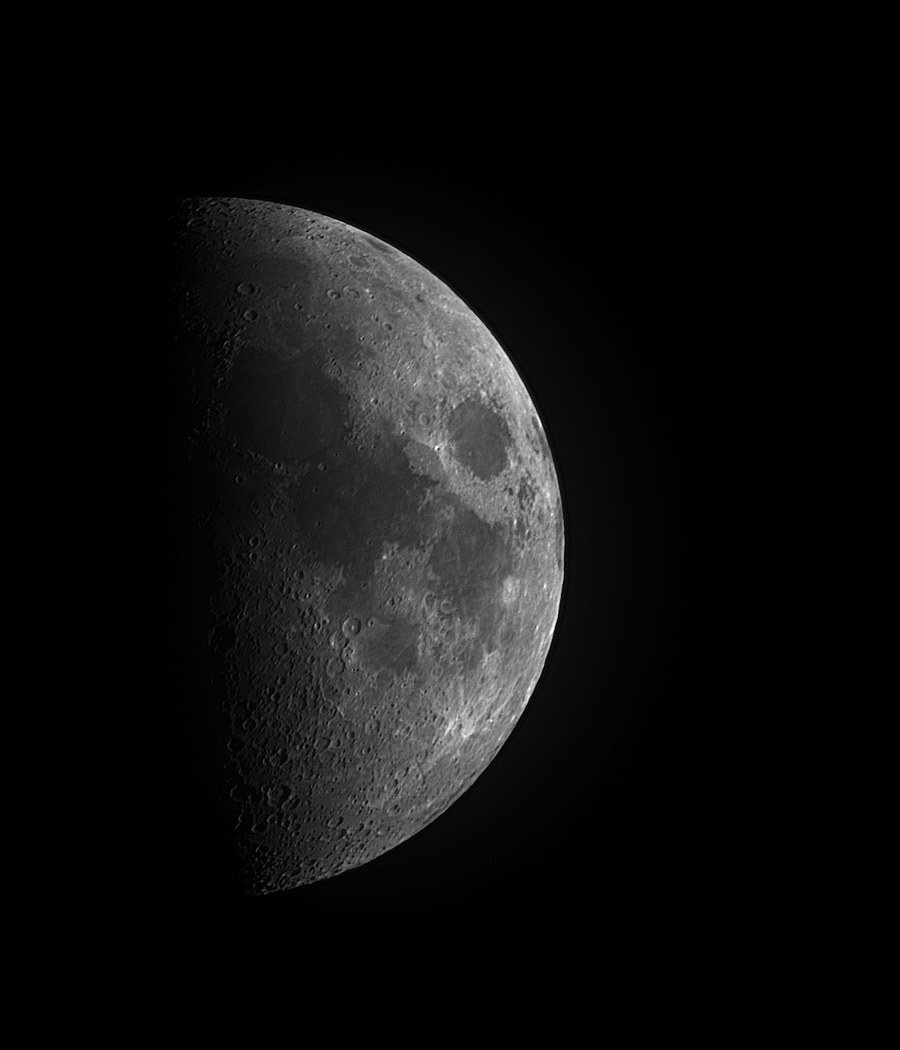
On a sphere the solar altitude at a point is 90° minus its angular distance from the sub-solar point (the spot where the Sun is overhead), so shadow length L = h/tan(altitude) diverges toward the terminator — and a summit of height h stays lit while its base is dark, because its horizon is depressed by √(2h/R).
| Solar altitude at the point | Shadow length / feature height |
|---|---|
| 45° | 1.0× |
| 30° | 1.7× |
| 10° | 5.7× |
| 5° | 11.4× |
| 2° | 28.6× |
| 1° | 57.3× |
The one thing a flat Moon cannot supply is the variation. One distant source over a flat face means one solar altitude at every point of it, so equal rims would cast equal shadows everywhere on the disc at every moment — uniformly stark or uniformly flat, never both in one frame. There is nowhere for shadow length to blow up, and no curvature to put the ground beside a lit summit in shadow. “Those are surface features lit at a grazing angle” does not survive this: grazing light across the whole face cannot coexist with a high sub-solar point on the same face under one light source, and nothing on a flat plane produces detached lit points inside the dark region that later join the lit part. That needs a summit seeing the Sun over a curved horizon while its surroundings do not.
The measurement runs backwards too, and this is what undergraduate labs do with Earth-based images: crater height H = L × D / R at first quarter, where D is the feature’s distance from the terminator. The lunar radius sits in the denominator as the measuring stick, and the method is self-consistent only because sin(solar altitude) = D/R on a sphere. Photograph the same crater on three consecutive nights: the shadow shortens each night, and the height you derive from it does not move.
3 · The Moon rocks, and its outline does not deform
Over a month the Moon nods and rolls — libration — so that features near the limb turn into and out of view. The amplitudes are 7.9° in longitude on a 27.55-day period and 6.68° in latitude on a 27.21-day one, so Earth traces a rectangle roughly 13.4° by 15.8° in the Moon’s sky over a six-year cycle.
This is the sharpest ground-based discriminator available, because the two models differ in where the motion appears and in whether the silhouette changes. Displacements are in arcseconds (″), each 1/3,600 of a degree.
| Under a 7° tilt | Sphere | Flat disc |
|---|---|---|
| Feature at the disc centre | 114″ | 0″ |
| Feature at 30° from centre | 95″ | −3.5″ |
| Feature at 45° | 76″ | −4.9″ |
| Feature at 60° | 51″ | −6.0″ |
| The outline itself | unchanged circle | ellipse, axis ratio 0.9925 |
A sphere moves a feature at longitude λ from R sin λ to R sin(λ+L) — a first-order displacement, largest at the disc centre — while the silhouette is untouched, because a sphere looks like a circle from every direction. A flat disc tilted by L merely multiplies every position by cos L: a second-order squeeze that is zero at the centre, and which compresses the outline into an ellipse, about three-quarters of a per cent on the diameter, the compression axis rotating monthly.
Those two signatures point in opposite directions, and the observed one is the sphere’s. Features near the middle of the face swing by a hundred arcseconds a month; the outline stays a circle. The disc model predicts the exact reverse: a still centre and a breathing rim.
The rocking is also why the familiar “59 per cent” of the Moon is visible over time; that figure is recomputed in the method notes.
Check it yourself. Photograph the Moon at the same phase each month for a year, register the frames on the disc outline, and blink them. Mare Crisium slides visibly toward and away from the limb; the outline does not deform. A single pair of nights at the two extremes is enough.
4 · The Moon is as deep as it is wide
The strongest result on this page, and the only one that measures the dimension a facing disc does not have: extent along the line of sight. Aim a radar pulse at the Moon and the echo does not come back as a single return. It comes back smeared over 11.6 milliseconds — a bright leading edge from the point nearest us, then a decaying tail as echoes from successively wider annuli arrive, ending at the limb. For a sphere that duration is exactly 2R/c: 2 × 1738.1 km / c = 11.595 ms.
Turn it round and use the echo to measure the Moon. The observed 11.6 ms gives a radial half-depth of 1738.8 km. The transverse radius, from the angular diameter, is 1738.1 km.
The obvious objection is that rays to a flat disc’s edge also travel further than rays to its centre. True, and nowhere near enough. For a disc of the Moon’s radius at the Moon’s distance, the extra two-way path to the rim is R²/d = 7.86 km, which is 26 microseconds. The observed echo is 11.6 milliseconds. The two are a factor of 440 apart, and surface roughness of a few kilometres adds tens of microseconds, not milliseconds.
Half of this is amateur, and it is the half people find hardest to believe. Hundreds of radio amateurs bounce signals off the Moon — “EME”, earth-moon-earth — and the libration of a sphere spreads the returned frequency by an amount that should grow linearly with the transmitted frequency. Measured amateur medians: 2.2 Hz at 144 MHz, 7 at 432, 19 at 1296, 35 at 2304, 156 at 10368. Scaling the 144 MHz figure by frequency alone predicts 6.6, 19.8, 35.2 and 158 — agreement to a few per cent across a 72-fold range, from equipment in people’s gardens.
Two things an EME operator hears are worth separating. The round trip takes about 2.56 seconds, and timing it gives the distance straight away — 10 ms of timing error is 1,500 km, or 0.4 per cent. It borrows the speed of light and nothing else, which answers the objection that a surveyed Earth–Moon distance presupposes a globe: this one presupposes only c. The frequency spread measures something different: the rotation of a ball, as a ratio, with no scale involved. The 11.6 ms echo width needs short pulses and real power, so it is professional radar — but entirely ground-based, done at several unaffiliated observatories in different countries, and it predates the space programme.
5 · A hard limb with relief, mapped from the ground before spacecraft
When the Moon passes in front of a star, the star does not fade. It vanishes in about twenty milliseconds — consistent with the Fresnel scale (the width of the diffraction fringe at the Moon’s distance), √(λd) = 14.5 m at 550 nm, swept past the observer at a few hundred metres a second. Along a narrow path on Earth the star instead blinks out and back repeatedly as lunar mountains and valleys cross it, and a line of observers across that path reconstructs the limb in profile. C. B. Watts turned a 1950s photographic survey into limb charts still in use; the relief they record is about ±3 arcseconds, roughly a third of a per cent of the radius.
A flat disc could have a ragged rim too, so a single occultation decides nothing. What decides it is that the same limb feature comes back at the same selenographic position — the same lunar latitude and longitude — when libration brings it round again, and that the profile for a given event depends on the libration at that moment. A fixed rim on a fixed disc has one profile for ever. The silhouette and the visible face are the same object seen from different angles.
This is a live amateur discipline. Total occultations need binoculars and a stopwatch, good to about ±0.05 s; video with GPS time insertion gets residuals inside a tenth of an arcsecond, and those observations feed the professional catalogues. Grazes need a team spread along a predicted line — a weekend of organising rather than a laboratory.
6 · The one thing that looks like a problem, and where it is answered
At full Moon the disc is very nearly uniformly bright out to the edge; what variation there is tracks albedo — dark maria against bright highlands — rather than geometry, and a photograph of it does look remarkably like a flat coin. It refutes exactly one model, and that model is not the sphere. It refutes a Lambertian sphere. The Moon is a bed of dark porous dust, and for that material the appropriate first-order law is Lommel–Seeliger, under which a sphere at zero phase is predicted to be exactly uniform to the limb: the cosine that would darken a Lambertian surface cancels against a cosine in the denominator. The uniform full Moon is a prediction of the sphere model rather than an embarrassment to it.
The derivation is a photometry question, not a shape question, and it lives at Why the Full Moon Has No Hotspot — with the working, the Lambertian comparison, the opposition surge (the extra brightening within a few degrees of full), and the open problems (§8). Two results from it belong here. First, the scattering law was not chosen to fit the Moon: it is measured on the actual soil, in a dish on a bench, where the Moon’s shape cannot be the cause of anything. Second, §4’s radar independently finds the same medium: at wavelengths from a millimetre to ten metres it returns a dielectric constant — the radio-frequency measure of how much solid matter the surface holds — implying that solid material occupies only about thirty per cent of the volume, and a limb scattering law going as cos φ, which is Lommel–Seeliger again, from radio rather than light.
So at full phase a Lommel–Seeliger sphere and a flat disc facing Earth predict the same picture. That is why this page is built on the terminator, the shadows, the libration and the radar echo — and on §1’s crescent, which the facing disc forbids outright and which is therefore worth more than the full Moon ever could be.
7 · What we are deliberately not resting on
Two further lines are strong; both are demoted on purpose, because they run through spacecraft.
Lunar laser ranging. Five retroreflectors on the Moon, ranged from Earth to about 1.4 mm. On a sphere a reflector at angular distance θ from the sub-Earth point lies R(1 − cos θ) further away, which for the five sites predicts extra round-trip delays from 556 microseconds to 4.1 milliseconds; on a coplanar disc they would be nearly equal. Three of the five targets are Apollo hardware and the coordinates come from the same programme, so this is consistency rather than proof — though two targets are Soviet, the stations are in several countries, and the technique requires at least three reflectors to solve the Moon’s orientation, which a flat plane would not need. One number stands on its own: the papers quote one nanoradian of orientation error as 1.7 mm of motion at the lunar surface, a lever arm of 1,700 km — a lunar radius, falling out of a figure quoted for an unrelated purpose.
Laser altimetry. Japan’s Kaguya gives a mean radius of 1737.15 ± 0.01 km with a maximum relief of 0.62 per cent of that, and NASA’s LRO agrees — the figure the Earth-based Watts limb charts of the 1950s already gave to a fraction of a per cent, from ground photography that predates the data. A corroborating footnote, used as no more than that.
8 · Where this page could be wrong
- The kilometre figures rest on the Earth–Moon distance, and the precision of it is professional work: millimetre ranging needs a 3.5 m telescope and a pulsed laser. The distance itself is not institutional (§4), and the shape arguments need neither, because they are ratios.
- We could not find a published measurement of the lunar outline’s circularity as a function of libration angle. This is the weakest link in §3. The geometry is not in doubt — a tilted disc must show a three-quarter-per-cent monthly ellipticity, and stacked amateur images would show it — but geometry is not a citation. If you know of a paper, we want it.
- §6 asserts the limb-darkening answer rather than deriving it. The derivation lives on the full-moon-lighting page, and its known weaknesses travel with it: Lommel–Seeliger is a first-order law where real lunar photometry needs Hapke’s, with roughness, porosity, coherent backscattering and shadow-hiding; there is a porosity tension with the Apollo cores; and no published centre-to-limb radiance profile with error bars could be obtained, so neither page states a tolerance on “uniform”.
- The Earth-based heliometry we are not using would have been the cleanest ground-only result — heliometry being the measurement of small angles on the disc with a split-lens telescope. Kazan measured 32 craters in 429 observations and solved for depth below the tangent plane, which a flat Moon has none of — but the reduction assumed a spherical model from the outset, so it shows that a sphere fits rather than deriving one.
9 · What would change our mind
- — A Moon that dims without ever showing a terminator — uniformly lit across its full outline rather than a crescent. That is the facing disc’s prediction, and one photograph would settle it.
- — A measured monthly ellipticity of the lunar outline of around three-quarters of a per cent in diameter, with the compression axis rotating in step with libration. Stacked images across a year would show it.
- — Features that hold still at the disc centre while the rim moves. The disc’s libration signature, the inverse of the observed one. Blink two frames a fortnight apart.
- — A radar echo from the Moon of a few tens of microseconds rather than 11.6 milliseconds. That is what a facing disc returns; the measurement has been repeated at many observatories since 1946.
- — Crater shadows of the same length regardless of distance from the terminator. Three nights, one telescope, one crater.
Method notes
The swept fraction (§3). We recomputed the fraction of the lunar surface visible from Earth over time numerically, integrating the union of visible caps over the libration rectangle on an equal-area grid: 58.1 per cent from optical libration alone, rising to 59.1 per cent once diurnal libration is included — the extra tilt from standing on the Earth’s surface rather than at its centre, worth 0.951°. The familiar “59 per cent” is right, but about a percentage point of it is contributed by the observer’s own position.
Sources & further reading
- US Naval Observatory, Astronomical Applications Department, ‘Fraction of the Moon Illuminated’ — https://aa.usno.navy.mil/data/MoonFraction, and the phases FAQ at https://aa.usno.navy.mil/faq/moon_phases. Establishes that the lit fraction is a computed function of phase angle, published for every date 1700–2100; the relation derived in §1 reproduces it.
- Department of Physics, University of Hong Kong, ‘Measuring the Height of Lunar Craters’ — https://www.physics.hku.hk/upload/page/86/self/65eed497690b7.pdf. Establishes the Earth-based shadow-height method used in §2, H = LD/R at first quarter and H = L tan(sin⁻¹(D/R)) away from it, with the instrument used (16-inch f/8.4, Apogee U9 CCD, 9 µm pixels).
- M. Wagner et al., Atmospheric Measurement Techniques 16, 1527 (2023) — https://amt.copernicus.org/articles/16/1527/2023/amt-16-1527-2023.pdf. Establishes the libration amplitudes used in §3: 7.9° in longitude on the 27.55-day anomalistic month, 6.68° in latitude on the 27.21-day draconic month, and the 13.4° × 15.8° rectangle traced over six years. The two models’ predicted displacements, the 0.9925 axis ratio, and the swept-fraction integral are computed here.
- ‘Radar Studies of the Moon’, Journal of Research of the National Bureau of Standards 69D — https://nvlpubs.nist.gov/nistpubs/jres/69D/jresv69Dn12p1637_A1b.pdf. Establishes the 11.6 ms echo duration, the sphere mapping φ = cos⁻¹(1 − ct/2a), the mean distance 384,400.2 ± 1.1 km, the cos φ limb scattering law, and the dielectric constants of 2.13–2.79 implying roughly 30 per cent solid packing — the porosity result that §6 relies on. The depth-over-width ratio and the 26 µs flat-disc figure are computed here.
- Radio Society of Great Britain, ‘Moonbounce (EME)’ — https://rsgb.org/main/technical/space-satellites/moonbounce/. The amateur entry point for §4: it gives the round trip as “approximately 2.5 seconds”, names Doppler and libration among the propagation effects, and notes that digital modes have “permitted many more radio amateurs to become involved in EME”. The American Radio Relay League’s beginner’s guide is at https://www.arrl.org/weak-signal-vhf-dx-meteor-scatter-eme-moonbounce.
- J. Taylor (K1JT), ‘Frequency-Dependent Characteristics of the EME Path’, EME 2010 — https://wsjt.sourceforge.io/EME2010_K1JT.pdf. Establishes the amateur Doppler-spread medians quoted in §4 (2.2 Hz at 144 MHz through 156 Hz at 10368 MHz) and states the echo duration 2R/c = 11.6 ms independently. The linearity check across the 72-fold frequency range is computed here.
- NASA Goddard, ‘The Lunar Limb Profile and Eclipse Predictions’ — https://eclipse.gsfc.nasa.gov/SEhelp/limb.html, with NASA/TP-1999-209484 at https://eclipse.gsfc.nasa.gov/SEpubs/20010621/text/lunar-limb-profile.html. Establishes the ±3-arcsecond limb relief, the Watts charts and their systematic errors to 0.4″ from a slightly elliptical datum, and the resulting eclipse-contact accuracies.
- British Astronomical Association, Lunar Occultations — https://britastro.org/section_information_/lunar-section-overview/lunar-occultations/lunar-occultations. Establishes the amateur timing performance in §5: ±0.05 s visually, residuals within a tenth of an arcsecond with video and GPS insertion.
- J. B. Tatum & D. Fairbairn, Planetary Photometry, ch. 3, University of Victoria — https://www.astro.uvic.ca/~tatum/plphot/plphot03.pdf. Establishes the Lommel–Seeliger reflectance law behind §6; the derivation and the Lambertian comparison are on the full-moon-lighting page.
- T. W. Murphy et al., ‘APOLLO: millimeter lunar laser ranging’, Classical and Quantum Gravity 29, 184005 (2012) — http://tmurphy.physics.ucsd.edu/papers/CQG-29-184005.pdf. Establishes the 1.4 mm median nightly uncertainty, the requirement to observe at least three reflectors to solve lunar orientation, and the 1.7 mm-per-nanoradian conversion from which the 1,700 km lever arm in §7 is derived here.
- H. Araki et al., ‘The Lunar Global Topography by the Laser Altimeter (LALT) Onboard Kaguya’, LPSC XL, abstract 1432 — https://www.lpi.usra.edu/meetings/lpsc2009/pdf/1432.pdf. Establishes the Kaguya figure quoted in §7: mean radius 1737.15 ± 0.01 km, relief from −9.06 to +10.75 km, radial accuracy ±4.1 m.
- EclipseWise, ‘Solar Eclipse Predictions and the Mean Lunar Radius’ — https://www.eclipsewise.com/solar/SEhelp/SEradius.html. Source of the IAU value k = 0.2725076 (the Moon’s mean radius as a fraction of the Earth’s equatorial radius) used throughout, and of the note that it derives from Earth-based limb observations averaging peaks and valleys.
- Companion pages on this site: Why the Full Moon Has No Hotspot (Q7, where the photometry is done properly); Where’s the Moon’s Silhouette? (Q9); The Sky Turns at One Rate (Q6). Working notes are in MOON-SPHERE-SPINE.md in the repository.