Fun With Science / Globe Deconstruction / Claim #3 · pages 166, 169
The Selenelion, and the Photograph at p. 169
A lunar eclipse with the Sun already up — what the word actually means, and a photograph whose geometry the model got right before anyone measured it.
The Moon list at p. 166 reads: “A partial lunar eclipse and the Sun can be seen in the sky at the same time. This is called the selenelion eclipse and is conveniently explained away with, you guessed it, REFRACTION.” The emphasis is ours: “partial” is exactly what Santa Fe got — the deep partial, with totality arriving after the Moon had set. It is worked on the facing page: p. 169 is a photograph captioned “taken at sunrise in the Santa Fe area, looking toward Los Alamos,” with the verdict: “The heliocentric model dictates that the ball’s shadow would be on the bottom of the Moon. Here we see the opposite.”
The observation: accurately reportedp. 169: its premise about the heliocentric model is wrongAs a discriminator: decides nothing
Where this lands
The photograph is a frame from moon observations, an unlisted upload on the book’s own Shape Debate channel, carrying Steve Matthews’ footage of the eclipse of 10 December 2011. Its account of the scene is accurate: the shadow was on top, the eastern sky was brightening, and the location is right. We computed the eclipse from JPL’s DE421 ephemeris — the standard table of where the Sun and Moon are at any moment — and then measured the frame: the dark edge cutting the disc fits a circle of 2.52 Moon-radii centred 1.86 radii away, against 2.65 and 1.99 computed for 06:47 MST, with 83% of the diameter covered either way. That is Earth’s umbra — the full shadow, where the Earth blocks the whole Sun — where the ephemeris puts it. What fails is the premise: the heliocentric model does not dictate a side. It computes one per eclipse, from where the Moon crosses the shadow — the top for 10 December 2011, the bottom on other dates from that same spot.
As for the p. 166 entry — that a selenelion is “conveniently explained away” with refraction — the eclipse owes refraction nothing. Refraction buys only the seam: a thin band along the day/night line, present at almost every umbral eclipse, where both bodies clear opposite horizons at once. Standing in that band is all a selenelion is, and the bending that opens it is the ordinary half-degree that ends every sunset: about 25′ per body needed here, against a textbook 34.5′ — roughly three-quarters of it. An arcminute, ′, is a sixtieth of a degree; the Moon is about 30 of them across.
And it settles nothing either way. Where a shadow falls on a disc is a projection effect, identical under any model of the Earth’s shape.
There is no favourite side to be caught contradicting; there is only a date, and an answer.
One thing at the outset: that eclipse did have a selenelion, but neither the p. 169 frame nor the video it comes from caught it. The eclipse ran three and a half hours; the selenelion at Santa Fe was under two minutes at the very end, and the camera was elsewhere for all of it. What the book prints is an eclipsed Moon in a twilight sky — what an umbral eclipse looks like from almost everywhere, and not the thing the word names.

moon observations on the Shape Debate channel, carrying Steve Matthews’ footage. The crop excludes an on-screen ring and cursor the video adds to the left of the Moon; nothing else is altered.
What a selenelion is, and how much refraction it takes
There is no special kind of eclipse behind the word. A lunar eclipse is the Moon passing through Earth’s shadow, 380,000 km away, and it runs identically for everyone who can see the Moon at all. In a solar eclipse the Moon’s shadow falls on the Earth, in a strip barely a hundred kilometres wide, and you have to be standing in it. In a lunar eclipse the shadow falls on the Moon and you need only line of sight — and since a full Moon stands opposite the Sun, that means standing in the night. A lunar eclipse visibility map is a map of night.
Because the eclipsed Moon is nearly opposite the Sun, if the Sun is coming up on your eastern horizon the Moon is going down on your western one. If “opposite” were exact, the two were points, and there were no air, the Moon would set at the instant the Sun rose and you would never see both at once. Three things give slack, none of them to do with the eclipse: the Moon runs a degree or so off exact opposition; both discs are half a degree wide; and near the horizon the air lifts every image by about another half-degree. Together they leave a thin strip of the planet, a degree or two wide, along the day/night line, where the two just overlap — a few minutes out of three and a half hours. Standing in that strip is a selenelion. It is a property of where you stood, not of the eclipse. Counted properly, on that day:
| Quantity | Value on 10 December 2011 |
|---|---|
| Where the Sun’s upper limb — its top edge — is up: cap radius, the distance from the point directly under the Sun | 90.843° from the sub-solar point |
| Where the Moon’s upper limb is up — cap radius | 89.906° from the sub-lunar point |
| How far apart those two centres were | 178.4° to 179.6° |
| So the overlap was | 1.1° to 2.3° wide — never zero, and narrower than most, because a total eclipse is a central one across the whole run, first penumbral contact to last — the penumbra being the outer, partial shadow around the umbra; the widest figure is at the ends and the narrowest at greatest eclipse |
The Moon’s cap is the smaller of the two because of parallax: standing on the surface rather than at the centre of the Earth costs the Moon 0.92° of altitude, more than its semidiameter — half its width — and refraction together give back. The Sun, four hundred times further off, loses nothing worth counting.
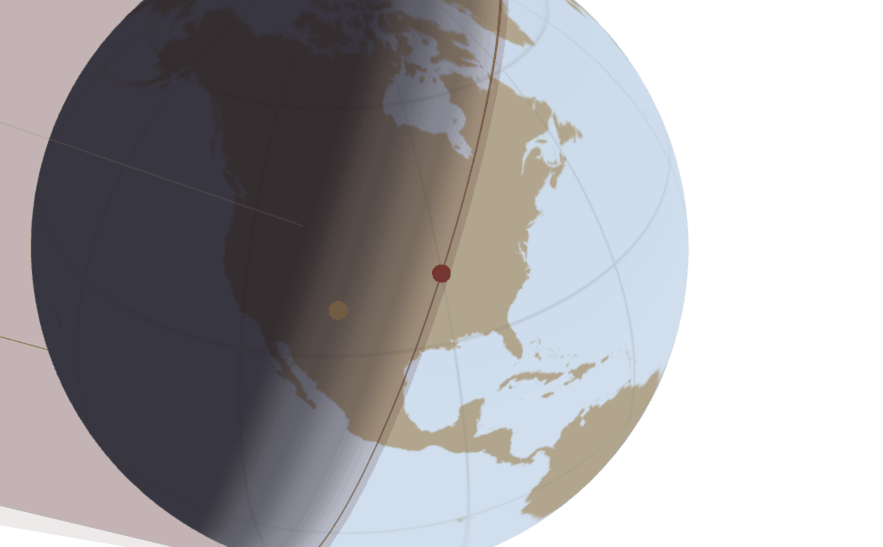
Every umbral eclipse has one. The overlap never goes to zero; at greatest eclipse on 10 December 2011 it was still 1.1°. A perfectly central pass, with the Moon dead on the anti-solar point, leaves the two cap radii added together less 180° — about three quarters of a degree at this lunar distance and two thirds at perigee. Lower, but never zero. And the Earth turns underneath it. At any single minute the band is a hairline; over the three and a half hours between first and last umbral contact the planet rotates 53°, and the hairline sweeps. Two places are marked on the map: Santa Fe, where the frame at p. 169 was shot, and Cahokia in Illinois, where the same video’s second observer set up 1,443 km east. The band’s eastern edge runs between them.

selenelion_band_map.py; conventions in Method notes.
twilight_band_map.py.So how much bending does the explanation need? At Santa Fe, without refraction there would have been no simultaneous view: at the moment their true altitudes crossed, the Sun and Moon were both 0.675° below the horizontal. That is a fact about the spot, not the eclipse. The discs’ own width opens a band without any refraction — up to 1.18° of it, over roughly seven eighths of the morning, closing only for about three quarters of an hour either side of greatest eclipse. Refraction roughly doubles the seam; it does not create it. At Santa Fe it decided whether that hillside fell inside the band or just outside.
| Quantity | Value | As a share of the ordinary horizon lift |
|---|---|---|
| What the air actually gives a body at the horizon, standard atmosphere | 34.5′ — a little over half a degree, 0.58° | 100% — the everyday amount, and the yardstick for every row below |
| Lift the two disc centres would have needed | 40.5′ each — 0.68° | 117% — more than the air gives, so at this site the two centres never both cleared |
| Lift the two upper limbs needed — which is what an eye actually sees | 25.5′ Moon, 24.3′ Sun — 0.42° and 0.41° | 74% and 70% — about three-quarters of it |
| So the margin, on the limbs that matter | about 9′ to spare — 0.15° | 26% left over |
The reason to work in upper limbs is that a limb is what an eye sees: the Sun “rises” when its top edge clears the horizon, not when its middle does, and the same goes for the Moon still setting behind you. Centre-to-centre was possible that morning too, just not at Santa Fe — see Method notes.

refraction_figure.py.The shadow is lifted too, by nearly the same amount. Its place in the sky is fixed by the Sun, so Moon and shadow run together all the way down: 5′ and 5′ at ten degrees up, 12′ and 13′ at four degrees, 30′ and 32′ near the horizon, where the shadow’s edge, hanging below the Moon in thicker air, is lifted 2.3′ more. That difference is the entire effect of refraction on the eclipse itself: two arcminutes on a 30′ disc, under 8% of its width, at the very end. Refraction cannot move a shadow from one side of the Moon to the other. refraction_tracks.py. It turns up once more, doing a smaller job: air at the edge of the planet bends light into the shadow, so the umbra arrives at the Moon about 2% wider than pure geometry gives — Danjon’s rule, in every eclipse prediction since the 1950s, and the outer of the two rings in the animation below. It changes coverage by a couple of per cent, and which side by nothing.
So the ordinary textbook number does it with room left over. The band is not merely possible; it is required. A spinning globe with an atmosphere has to lay it down at every umbral eclipse, and all that is uncommon is where it happens to fall.
Where the photograph comes from
It is not a photograph. It is a frame from a video — and the footage is not Miller’s, though the upload the book links is. Put the book’s crop beside a frame from the upload its p. 167 QR code led to and it is plainly the same footage: the same snow-streaked peak with the same shoulder, the same secondary summit to its right, the same strung-out town lights below. The book uses a tighter, brighter crop, which is also why the image is soft. The upload’s title card credits Steve Matthews, whose observation this is; Sources has the paperwork. The upload sits on Shape Debate, the book’s own channel, and its description is where the p. 169 claim is written out:
“Forgot to include the biggest debunk of all, the impossible ‘selenelion’ eclipse. Sun is rising in the east, looking at moon towards the west, the ‘shadow’ is on the top instead of the bottom! How?????”
The conclusion is also drawn in the narration: at 19:34 Matthews says the footage “definitely proves this is not caused by the so-called ball.” p. 169 then prints the same claim with a premise attached — that the heliocentric model requires the shadow on the bottom. Nothing here is a case of anybody seeing badly; the error is in that sentence about what the model requires, and that sentence is the book’s own.
What a lunar eclipse looks like from the ground, and from anywhere else
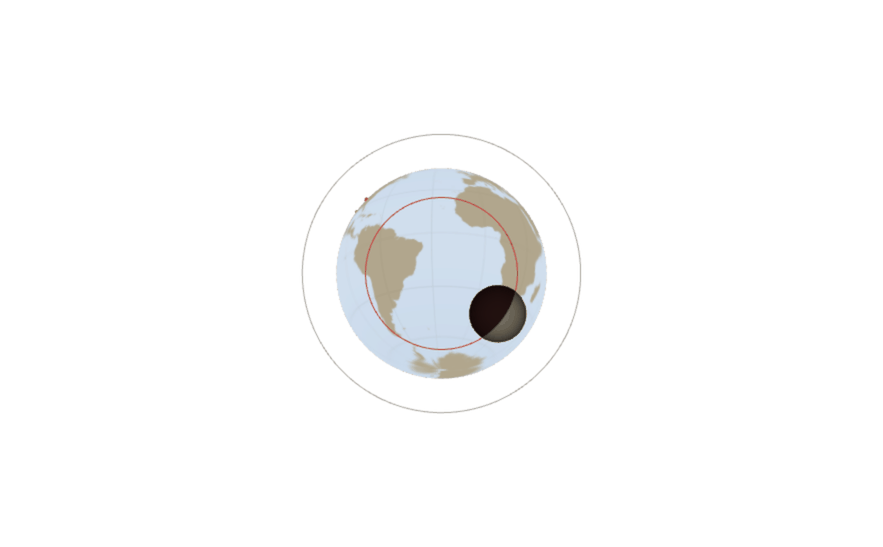
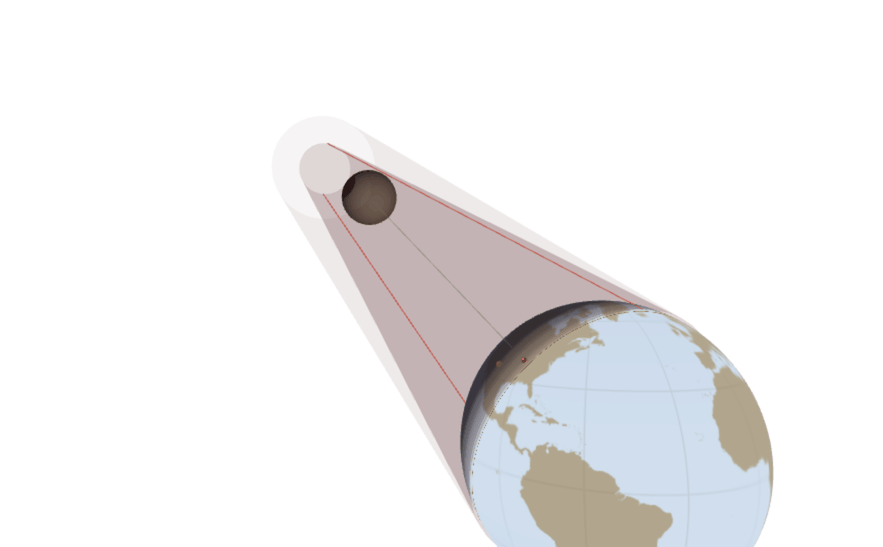
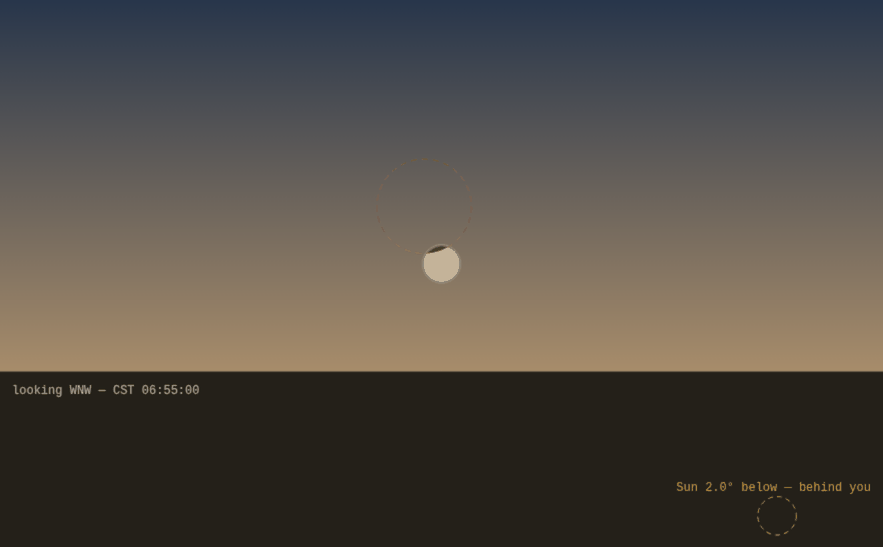
From the ground you cannot see that the Moon is entering a shadow. You see a dark edge creeping across a disc. The cone and the alignment are invisible, and the diagrams meant to help are drawn from a viewpoint nobody has ever occupied. That is a real complaint, so here are both at once, from the same numbers.
10 December 2011 over Santa Fe, every frame computed from JPL’s DE421 — three views of one instant. From the side is the textbook diagram, with the stick figure where the camera was, the dashed line from his feet marking his “up” and the angle at his feet the Moon’s altitude (distance-compressed, so the arc points rather than measures). Notice what this view cannot tell you: which side of the Moon goes dark. His sky is the same instant as he saw it, where the bite on top stops being a claim. Refraction off is the same sum with one term removed; the altitude axis is stretched near the horizon because all of this is a fraction of a degree, and the hollow markers show where each body would have been without the air.
Run it once. Between the side view and the sky view the geometry has not changed by a hair; only the direction you are looking from, and which way is up.
The one-line rule that settles which side
Earth’s shadow points directly away from the Sun, so its centre, projected on the sky, is the point exactly opposite the Sun. If the Sun is a degree below your horizon, the centre of Earth’s shadow is a degree above it, in the opposite direction. There is no more to the calculation than that. Strictly the rule is written from Earth’s centre, and standing on the surface docks the Moon 0.92° — but the shadow’s centre sits at the Moon’s distance and is displaced by the same 0.92°, so the offset between them is untouched; the table below computes both in one frame.

shadow_track_figure.py.The whole eclipse, as it stood over Santa Fe
The umbral phase began at 05:46 MST. The Sun’s upper limb cleared the horizon at 07:02:23, and the Moon’s upper limb dropped below it at 07:04:22 — one minute fifty-nine seconds with both bodies in the sky at once, on a level horizon with standard refraction. That overlap is the selenelion. The Moon was 98% swallowed when the Sun came up; totality began at 07:06, after the Moon had set, so northern New Mexico saw the deep partial and missed the red phase.
| MST | Moon alt / az apparent | Sun alt / az geometric | Shadow centre, from the Moon’s centre | Tilt from straight up | Diameter covered |
|---|---|---|---|---|---|
| 04:40 | 26.00° / 279.6° | −28.15° / 99.2° | 1.414° | 15.4° left | — |
| 05:46 | 13.41° / 287.8° | −15.13° / 107.6° | 0.913° | 10.3° left | 1% — first contact |
| 06:15 | 8.08° / 291.5° | −9.58° / 111.4° | 0.706° | 5.0° left | 42% |
| 06:40 | 3.66° / 294.8° | −4.92° / 114.8° | 0.544° | 3.6° right | 74% |
| 06:54 | 1.34° / 296.7° | −2.36° / 116.8° | 0.466° | 11.3° right | 90% |
| 07:02:23 | 0.08° / 297.8° | −0.85° / 117.9° | 0.426° | 17.4° right | 98% — the Sun rises |
| 07:04:22 | −0.20° / 298.1° | −0.49° / 118.2° | 0.418° | 19.0° right | 99% — the Moon sets |
Altitudes are of the disc centres. The Moon’s are apparent — refraction included — because the question is where it was seen; in the last row its centre is just under the horizon while its upper half is still showing. The Sun’s are geometric, because for most of the morning it was below the horizon, where the refraction formula is not defined. That is why the Sun is still 0.85° below the horizon in the row where it rises — 34.5′ of refraction lifts the disc and its own 16′ radius does the rest. Tilts are in the observer’s own frame: straight up in the photograph is straight up in the table. Limb conventions in Method notes.
The umbra crosses the Moon from the top throughout. Its centre never departs from the vertical by more than 20° while the Moon is up, so at no point in the eclipse, from that place, could the shadow have been on the bottom.
The photograph at p. 169, reduced
The geometry was fixed by the date, and everything above was computed without reference to the picture: the umbra covered the Moon from the top all morning, leaving a thin bright rim along the bottom. Now the picture. We fitted circles to the two edges of that rim — twice, off two renderings of the same photograph, so that the measurement carries its own error bar.
| Quantity | Measured — 300 dpi page render | Measured — the book’s own embedded image | Computed for 06:47 MST ±3 min — see the bloom note | A phase would give |
|---|---|---|---|---|
| Radius of the dark edge cutting the disc | 2.52 × the Moon’s radius | 2.13 | 2.651 | 1.00 — a half-ellipse on the disc itself |
| Its centre, from the Moon’s centre | 1.86 Moon-radii | 1.44 | 1.991 | 0 — the Moon’s own centre |
| Its position angle from straight up | +4.6° | +5.3° | +7.6° | — |
| How much of the diameter is covered | 83% | 85% | 83% | — |
| How far the lit rim runs around the edge | 105.5° | 101.2° | 117.6° | exactly 180° — the horns of a phase are a diameter |
Two measurements by the same script, differing only in what was fed to it: the page render is what a reader of the printed book sees; the embedded image is the raster the file actually contains. They differ by about a fifth on the two circle quantities and by two to four per cent on the coverage and the arc, because the Moon in that raster is about sixty-six pixels across and the bright rim’s bloom is a large fraction of it. That spread is the error bar, and it is nowhere near wide enough to matter: every reading in both columns is a large circle centred well outside the disc, and the thing being ruled out sits at 1.00 and 0 and 180°. The bloom is the largest error on the page; see Where this page could be wrong.
Four quantities, computed before they were measured, agreeing to within a few per cent. The dark edge is a circle two and a half times the size of the Moon, centred just under two Moon-widths away, almost exactly above it: Earth’s umbra, at the size and in the place the ephemeris puts it, which is not a shape any phase of the Moon produces.
And round is doing more work than it looks, because a circular shadow is only automatic when the thing casting it is a ball. On 10 December 2011 the anti-solar point — the direction Earth’s shadow points — stood 67° from the celestial pole. A flat Earth turning about that pole was being lit from well off to one side, and would have laid down an ellipse roughly two-fifths as tall as it is wide. The edge in this frame fits a circle to better than one per cent. That is one comparison against one flat-plane model — a disc lit from the side — and the photograph the book prints, on the date the book chose, is consistent with the round occulter and not with the ellipse.
Nor can something else be standing in for the Earth — the “shadow object” or anti-Moon that flat-plane accounts sometimes offer as the occulter. At an umbral eclipse the line from the Sun to the Moon passes through the Earth: that morning it missed Earth’s centre by 0.39 of an Earth radius. Sunlight heading for the Moon runs into the Earth, and the shadow lands whether anything else is present or not. A rival occulter would have to sit where the Earth already is and intercept that sunlight first — which is to say, stand between us and the Sun and cause a solar eclipse instead.
Claim #3’s stated conclusion is that “the Sun is not the source of illumination.” The book does not say what is, but the photograph meets that conclusion directly. If the Moon made its own light, an eclipse would be the Moon dimming, not a shadow — a dimming that would have to be circular; sized to Earth’s cross-section at the Moon’s distance; entered from the edge facing away from the Sun and left by the other; timed to the exact instants of full Moon; and, as the survey table below shows, landing on the top of the disc in December 2011 and the bottom in June 2012, from the same back garden in New Mexico, for no reason available to a lamp. Every one of those is a free parameter under a self-luminous Moon and a consequence under a shadow.
The model does not merely accommodate this photograph. It predicted its geometry — including the part the caption calls impossible.
The rest of the caption checks too. “The ball’s shadow” means Earth’s shadow, the reading the book’s usage supports. “Taken at sunrise in the Santa Fe area, looking toward Los Alamos” is right: Los Alamos bears 303.5° from Santa Fe, the Moon was at azimuth 296°, and at 06:47 the Sun stood 3.6° below the eastern horizon in bright civil twilight — the sky in the frame. The footage carries its own on-screen caption, “View is towards Los Alamos, New Mexico — Vantage point is just north of Santa Fe”. And the frame carries its own longitude: how deeply the Moon is eclipsed depends only on the clock, but how far the Sun has climbed depends on where you stand. At 83% covered the Sun is 3.6° down at Santa Fe and 12.3° down at Los Angeles — near darkness, not this; and by the time Los Angeles had the Sun up, the Moon there was totally eclipsed, with no bright rim left. The single thing that does not check is “the heliocentric model dictates that the ball’s shadow would be on the bottom of the Moon.” It computes which side from where the Moon crosses the shadow, and for 10 December 2011 it says the top — which is what the photograph shows, to within a few degrees.
The model has no favourite side
The underlying idea — that the model commits to one side and can be caught out — is testable and false. Which side goes dark is set by where the Moon crosses the shadow, and it changes from eclipse to eclipse. Here is every morning selenelion visible from Santa Fe between 1995 and 2030, and where the shadow sat in each.
The list is swept, not assembled by hand: selenelion_survey.py walks every full Moon in the window, keeps the ones where Earth’s umbra touches the disc, and asks whether Santa Fe ever had the Sun’s upper limb and the eclipsed Moon’s above opposite horizons at the same instant. It finds twelve events; the four not shown are evening ones, the same seam with the roles swapped. The tilt is measured at the middle of each window — the sequence table above gives 19.0° for 10 December 2011 because it is quoting the very last instant, at moonset, by which time the shadow has rotated a further degree. One near-miss shows how fine the edge is. On 15 April 1995 the Sun’s upper limb cleared Santa Fe’s eastern horizon and the eclipsed Moon’s dropped below the western one in the same second — a computed overlap of about a tenth of a second the wrong way, the script’s raw output and far inside any real uncertainty, since the limb convention and the morning’s refraction are each worth thousands of times that — with a tenth of the Moon in shadow. On a slightly kinder morning it would have been in.
| Date | Moon azimuth | How long both were up at once | How much of the Moon was covered in that time | Where the shadow sat |
|---|---|---|---|---|
| 28 Jul 1999 | 246.8° | 7 min 30 s | 30% of its width | lower left |
| 16 Jul 2000 | 243.4° | 18 seconds | 6% | upper left |
| 26 Jun 2010 | 239.7° | 2 min 45 s | 53% | upper right |
| 10 Dec 2011 | 298.0° | 1 min 59 s | 99% — a rim still lit | the top — 18.2° from vertical |
| 4 Jun 2012 | 242.2° | 9 min 01 s | 18% | the bottom |
| 4 Apr 2015 | 262.9° | 6 min 33 s | 73% | the bottom |
| 31 Jan 2018 | 290.7° | 3 min 42 s | all of it — total | the right side — but total, so no bite |
| 26 May 2021 | 243.4° | 7 min 08 s | 84% | the bottom |
Look down the time column first. Twenty-two years of eclipses, and this spot’s entire allowance of simultaneous Sun and eclipsed Moon comes to about thirty-nine minutes — the longest single event managed nine, and one lasted eighteen seconds. That is the width of the band, felt as a clock. Three of the eight put the shadow squarely on the bottom, the appearance p. 169 says the model requires. The model produces that too — on other dates, from the same spot, with the same arithmetic — along with the top, the sides and both diagonals.
The second observer, and the window neither camera caught
Later in the video a second observer’s footage from the same morning is shown — an independent second test. He is on top of Monks Mound at Cahokia, just east of St Louis, 1,443 km east of Santa Fe, and narrates the clock as he films; his segment runs from 20:03 to 21:56.
| At | What he says | What the ephemeris gives for that spot |
|---|---|---|
| 20:22 | 06:30 — “a full moon which will soon be going into a… eclipse as it sets” | the umbra has not touched it; first contact 06:46 CST |
| 20:31 | “at the same time behind us, the sun is already [rising]” | Sun 7.3° below the horizon — nautical twilight, the Sun 6° to 12° down. The glow is rising; the Sun is not |
| 20:40 | 06:55 — “a little bit brighter out here… you can see the shadow right across the moon” | 13% of the diameter covered; Sun 2.9° down, civil twilight |
| 21:20 | 07:04 — “you can hardly see anything, but… we can just barely make out a little bit of the moon” | Sun’s upper limb 0.4° below the horizon; Moon’s 0.4° above |
| 21:34 | “it’s about two-thirds the way covered with earth’s shadow, and it’s turning a pale orange, pinkish colour” | 26% covered — his one overestimate |
| 21:40 | “with the bright morning sun coming up, there’s not enough contrast to be able to see the moon there” | — |
Two of those are quantities rather than impressions — not yet touched at 6:30, a bite at 6:55 — and both land. The third does not: at 7:04 he calls the Moon two-thirds covered when the umbra had taken a quarter of it, which is what happens when the disc has become a bright smudge in a brightening sky — as he says in the next breath.
The shadow is on top for him too — he says so, with the same surprise. But it is tilted the other way. At any moment when both men could see the Moon, the umbra’s centre sits to the left of Cahokia’s vertical and to the right of Santa Fe’s: same Moon, same shadow, same minute, and about eight degrees of difference in tilt, purely because their verticals point in different directions. On a flat plane that difference would be exactly zero, because there every vertical is parallel to every other and a distant object shows the same tilt from everywhere. Each man’s own footage differs by nearer thirty degrees, but the two clips are three quarters of an hour apart, so most of that is the eclipse advancing. Eight degrees is the part that is purely about where you stand.

shadow_track_figure.py.That is the whole of the moon-tilt idea, arriving unbidden inside the exhibit meant to refute it: how a thing in the sky is tilted depends on where you are standing.
Be careful about what has been measured. The qualitative prediction is tested at two stations and passes at both: the shadow is on top for each man, and each says so. The eight degrees is what the geometry predicts, not something read off the footage: Cahokia’s camera is hand-held and pans between the presenter and the sky, and a hand-held frame cannot fix which way is up. A tripod there would have let us check it. A model that merely accommodated the first clip would have nothing to say about why the second should be rotated at all; this one says eight degrees, before you look.
Now the window itself. At Santa Fe it opened at 07:02:23. The frame the book prints is fixed at 06:47 by its own eclipse phase — a quarter of an hour earlier, with the Sun still 3.6° below the horizon. At Cahokia the Sun’s upper limb cleared the horizon at 07:06:58 and the Moon’s dropped below it at 07:07:04: an overlap of under six seconds, which is to say none. He was standing on the seam and fell on the wrong side of it.
| Santa Fe | Cahokia | |
|---|---|---|
| The footage we are actually shown | 06:47, Sun 3.6° below | 06:30 to 07:04, Sun 7.3° to 1.4° below |
| So the sky in it is | civil twilight | nautical twilight, then civil |
| And the camera’s own skyline | mountains — Moon gone from 06:54 | flat floodplain west, bluffs east — see the note below |
| Where the umbra sat, from his own vertical | 7.6° right of straight up | 19° to 15° left of straight up |
At Santa Fe the window was behind a mountain. The Moon in the frame is its own ruler: its angular diameter that morning is known to four decimals, so a circle fitted to the lit outer arc calibrates the picture in degrees per pixel with no camera data assumed. The fitted disc is 183 pixels across; the skyline directly beneath it is 323 pixels lower. That is 0.885°, and the Moon has to fall all of it plus its own radius before the disc is gone: about seven minutes of Moon left in the shot. Dating the frame at 06:47 from its eclipse phase, it was behind the ridge by 06:54 — and the Sun did not clear even a flat horizon until 07:02:23. He stood inside the band and could not have seen it from where he stood.

santafe_ridge.py; frame from moon observations on the Shape Debate channel. What the seven-minute figure depends on is in Method notes.
Both men describe the eastern sky getting brighter, and both are right. But a brightening eastern sky is dawn, available to anyone facing east on any clear morning; it is not the Sun. The second observer says so himself, at 21:40: “with the bright morning sun coming up, there’s not enough contrast to be able to see the moon there.” By the time his sky was bright enough to argue about, his Moon had gone. The shadow really was on top in both clips, and that is the thing worth explaining; but the selenelion is not what either camera recorded.
Both figures are for a level, sea-level horizon, and at Cahokia the real one leans the wrong way to help. Monks Mound does not stand on a bluff: it stands on the American Bottom, the Mississippi floodplain, and the bluffs — the Collinsville escarpment — are four or five kilometres to the east, where he needed the Sun to come from. On published elevations rather than a survey, they put the sunrise skyline something like a quarter of a degree above level, delaying his sunrise by a minute and a half; his western horizon is flat bottomland, so the mound’s own thirty metres depress it by 0.16° and hold the Moon up about a minute longer. Run together: sunrise 07:08:27, moonset 07:08:15 — the six seconds do not widen, they close. Anything above a fifth of a degree of bluff does that. And by then his Moon was four tenths of a degree up, a quarter covered, and on his own account invisible.
The photograph people most often reach for when “selenelion” comes up — Michael Zeiler’s multiple-exposure chain of ten moons dropping toward a ridge, published here — is of this same eclipse, from this same corner of New Mexico. Its own caption says the Sun had not yet come up: “the moon was setting in Los Alamos, N.M., the sun was just about to rise.” So none of its exposures caught the selenelion either. The photographer and the publication reported it accurately; what does not survive being shared is the caption.
A selenelion photograph measures the refraction it disputes
This turns the objection into an experiment. Refraction is strongest right at the horizon and falls off fast with altitude, so it lifts the bottom of a low disc more than the top. That squashes the disc — vertically only — by an amount that is not adjustable; it follows from the same standard-atmosphere curve used above.
| What you photograph | Predicted shape |
|---|---|
| The Sun sitting on the horizon | 32.0′ wide, about 25.9′ tall — flattened by a fifth |
| A typical 31′ Moon at 0.5° altitude | squashed by 5.0′, 16% |
| A typical 31′ Moon at 1° altitude | squashed by 3.9′, 12.5% |
| A typical 31′ Moon at 5° altitude | squashed by 0.8′, 2.6% |
Any selenelion photograph shows a Moon within a degree or two of the horizon, so its disc should be visibly oval, by a stated amount. Measure it and you have measured the refraction the objection says is being invented to cover a gap. Anyone can run the same check on any sunset. If the setting Sun is a circle, the standard refraction curve is wrong and so are we — and a good deal of surveying and navigation goes with us.
If you do run it on the Sun, use a proper solar filter, and do not look at the Sun through any lens without one. That is first a matter of your eyes, and second of the measurement: an unfiltered image of the Sun is mostly bloom, and bloom is round, so it hides the very flattening you are measuring — an unfiltered phone shot is not a null result, it is no result. A certified solar film or eclipse-viewing filter over the lens gives a clean disc. The Moon needs no filter, and a low full Moon is flattened by the same air in the same way — 16% at half a degree up. To do this safely with no equipment, do it on the Moon.
What would change our mind
- A full-resolution, timestamped frame of the footage. The book’s raster puts the Moon about sixty-six pixels across; our own capture from the footage puts it at 183. Re-fitting the rim on that would tighten every number in the comparison table and could move the agreement either way, and we will publish whatever it says.
- An eclipse whose shadow lands on the wrong side. The rule is public and the arithmetic is short: compute the antisolar point, compare with the Moon, take the difference. One clear counter-example retires the method.
- A selenelion needing more lift than refraction supplies. A documented case with the Sun and Moon more than about 1.7° from opposite, both seen at once over a level horizon.
- A round Moon at the horizon. If a low Moon photographs circular rather than flattened by roughly an eighth, the refraction account is in trouble, because the same curve produces both numbers.
Where this page could be wrong
- Scope. This page is about Earth’s shadow falling on the Moon. The same entry at p. 166 carries a second Moon complaint — that “the moon-tilt illusion explanation is not satisfactory” — worked at p. 168. That is a different mechanism, the Moon’s own shadow on itself rather than ours on it, and running the two together is what makes the spread hard to answer; it is answered separately at The Moon-Tilt Illusion.
- The bloom is real, and it is the largest error on the page. The book prints a soft, low-resolution frame lifted from video: the raster it embeds is 799 × 470, with the Moon about sixty-six pixels across, and the 300 dpi page render upsamples that about three-fold, to about 213 px, adding no information. The bright rim spreads outward into the dark. That is why both measured arc spans, 105.5° and 101.2°, sit below the computed 117.6°, and why the two runs disagree by about a fifth on the radius and the offset. The circle fits are tight — 0.50 px rms on the Moon’s outer edge and 0.68 px on the dark one, against a 107 px radius on the render — but that is a fit statistic, not an accuracy: a rim that blooms shifts where the edge is. The coverage and the arc span are steadier, at two and four per cent. A better original exists — the footage itself, at 183 pixels — and we have not re-fitted the rim on it, because the printed page is what the printed claim is about.
- The identification rests on the inner edge, not the outer one. A circle fitted to the outer edge of the bright sliver proves nothing, because that edge is the Moon’s own whether the dark part is night or shadow. Everything turns on the inner edge and the horn span; if either is wrong, so is the conclusion.
- Horizon refraction genuinely varies. The 34.5′ figure is a standard atmosphere; real values at the horizon swing by tens of arcminutes with the temperature profile. Our claim is only that the standard value suffices, not that no morning ever falls short. A morning with anomalously low refraction would simply have given Santa Fe no simultaneous view — the band would have fallen a little further west and missed that hillside. It would not have moved the eclipse, the shadow, or which side of the Moon went dark, which are the things p. 169 is about.
- Terrain is unmodelled. Santa Fe looks east at the Sangre de Cristos and west toward the Jemez; both shift the visible window, and neither is in our numbers. The site is also 2,130 m up, which on a level horizon would depress it a further 1.35° and widen the window considerably; we have not counted that, because those horizons are mountains rather than sea and the correction could go either way.
- The band map is convention-dependent at its pale edge, and only there. The 27% figure counts anywhere with more than ten seconds of overlap, on upper limbs with a sea-level horizon. Tighten the criterion to whole discs, or to a full minute, and the outer fringe moves; the median of five minutes and the shape of the swath do not.
- The second observer is placed from what he says, not from a fix. “On top of Monks Mound… just east of St Louis” puts him within a kilometre or so — plenty for the thirty-degree tilt difference between the clips, which changes by under two degrees over a hundred kilometres; not plenty for his six-second window, which sits exactly on the footprint’s edge and is far more sensitive to his horizon than to his coordinates. The safer statement is that he did not get a selenelion worth the name, and that his own footage shows why.
How to check this yourself
The script that produced every eclipse number on this page, and the frame table the animation is driven from, is in the repository at selenelion_2011.py. It needs skyfield and downloads JPL’s DE421 ephemeris on first run. It prints the sequence table, the refraction budget, the disc-flattening predictions, the survey of morning selenelions, and four cross-checks against published eclipse elements it did not use:
| Quantity | Ours, from DE421 | Published |
|---|---|---|
| Greatest eclipse | 14:32 UT | 14:33 TD (EclipseWise) |
| Gamma — the Moon’s closest approach to the shadow’s axis, in Earth radii | 0.3875 | −0.3882 (EclipseWise) |
| Umbral magnitude at greatest | 1.1159 | 1.1061 (EclipseWise) |
| Magnitude visible at 06:54 MST | 0.896 | 0.890 (timeanddate) |
The sign of gamma is a convention — negative means the Moon passed south of the shadow’s axis, which is what our computation also finds. The small residual in umbral magnitude is the umbra-enlargement rule, where different sources use slightly different conventions. The picture measurements are checkable too; the two commands are in the method notes below.
Method notes
Reproducing the picture measurements. measure_p169_moon.py fits the two edges of the rim in whatever image you hand it, so the only difference between the two measured columns is what you feed it:
# the page as printed, rasterised
pdftoppm -f 196 -l 196 -r 300 -png book.pdf page
python3 measure_p169_moon.py page-196.png

# the raster the file actually embeds, at its own resolution
pdfimages -f 196 -l 196 -png book.pdf p169
python3 measure_p169_moon.py p169-000.png
Mind the page number. Book folio 169 is page 196 to pdftoppm and pdfimages — an offset of 27, constant through this chapter and checked at four landmarks — in the copy these commands were run against: the 500-page Canva export of 3 August 2026, MD5 0182065c1fc8cddb431dcaa67d64c8f1. Two cautions. The prerelease circulates in renders whose leading pages differ, so anyone working from another copy should find folio 169 by eye rather than trust 196. And our own text dump of this same file numbers its pages one lower than poppler does, which is where the landing page’s offset of 26 comes from — same copy, two counting tools, one page apart. The folio is the citation; the index is a command-line argument. The second command writes a single 799 × 470 image, which is the whole of what the book has. We are not reproducing that file here — it is the book’s, and anyone with the prerelease can pull it in a second.
Limb conventions in the sequence table. Each limb is refracted at its own altitude, and positions are apparent — light-time and aberration included — because the question is where each body was seen. Refracting the disc’s centre and then adding the semidiameter, which treats the disc as rigid, would put each upper limb about 2.2′ too high near the horizon, since refraction is weaker up there than at the centre; that convention would lengthen the Santa Fe window by about forty seconds. Dropping aberration would shorten it by a further two.
Centre-to-centre. The 117% row in the refraction budget is about Santa Fe, not about the eclipse. Because the discs bring their own half-degree to the sum, a centre-to-centre band existed at every moment of the eclipse somewhere on Earth: 0.6° to 1.8° wide, narrower than the limb band but never closed.
The band map. Sun and Moon upper limbs, 34.5′ horizon refraction, lunar parallax removed, sea-level horizon, no terrain. Computed on a quarter-degree grid at ten-second steps from JPL DE421 by selenelion_band_map.py, reading the sub-solar point, the sub-lunar point and both cap radii from docs/selenelion/data/eclipse-2011-12-10-3d.json. The twilight-band figure and the 3-D reconstruction read the same file, and every window readout in the reconstruction is computed live from it.
The two descent strips. Frames were extracted from the Santa Fe segment and composited at their real positions in the locked-off frame; times were matched to each frame’s eclipse phase against the JPL DE421 table, good to a few minutes rather than to the second. Method and caveats are in notes/REPORT-descent-figure-video-build-2026-08-31.md. The Cahokia camera is handheld and pans between the presenter and the sky, so that strip’s layout is designed rather than positional, and no clean frame of the Moon survives at the times of discs 5 and 6.
The ridge figure. The footage frame is a different image at a different scale from the p. 169 measurement: the Moon is 183 px across in our capture and about 213 px on the 300 dpi book render, which is why the two quote different pixel counts for the same Moon. The seven-minute figure needs no timestamp — it is a distance to fall divided by a known rate of falling — and holds across every plausible dating of the frame, which put the Moon behind the ridge between 06:52 and 06:59. Two things are deliberately not claimed: the crescent’s thickness would date the frame independently, but the umbra’s edge is diffuse enough that the answer swings five minutes on the choice of threshold; and the ridge’s height in metres needs a range the frame cannot supply, so no summit is named. Neither affects the result.
The survey. selenelion_survey.py filters nothing by judgement. The two shadow-track figures share shadow_track_figure.py and one set of conventions.
Sources & further reading
- The footage at p. 169 is by Steve Matthews, YouTube channel Teeth of the Lamb (
youtube.com/teethofthelamb), as credited on the title card of the upload the book’s own QR link led to; consulted 31 August 2026. That upload is onShape Debate, the book’s own channel, posted unlisted on 25 June 2026 under the generic title moon observations (shapedebate.com/55), with Matthews’ title card intact; the narration quoted above is at 19:34. Frames from that upload are reproduced here, cropped, for criticism and review: one scene frame, nine Moons from the Santa Fe segment, and four from the Cahokia segment; nothing inside a crop is altered. The p. 169 comparison measurements were taken from the book page, not from the video, so that the measurement answers the printed claim: once off a 300 dpi render of the page, and once off the raster the file embeds. The upload is unlisted and could be withdrawn at any time; anyone checking later should expect to need an archived copy. - Levi Miller, Globe Deconstruction? (prerelease) — p. 166 (the moon-tilt and selenelion entries in the Moon-observations list), p. 168 (“Moon-tilt = illusion?”, Examples 1 and 2, and
shapedebate.com/moontilt), p. 169 (the Santa Fe photograph). The visual-geometry passages quoted above are pp. 129, 141, 143 and 145. - Eclipse elements for 10 December 2011 — EclipseWise (Saros 135; the elements compared in the cross-check table above).
- Local circumstances for northern New Mexico — timeanddate.com.
- Positions computed from JPL’s DE421 ephemeris via Skyfield. Refraction from Bennett’s 1982 formula, the standard-atmosphere approximation used in almanac work.
- Cross-references on this site: Self-Test Protocol (Test 3 sets up the lamp-and-ball version of the tilt), Chicago & Pontchartrain (where refraction is the hard case rather than the easy one), Where’s the Moon’s Silhouette? and Full-Moon Lighting (the other Claim #3 strands), Is the Moon a Ball? (the shape this argument assumes), and Mislabels, Not Arguments — the p. 167 QR codes ran one position out of step when we first resolved them, so the code headed SUN reached the lunar-eclipse upload this page works from. That has since been corrected, and the codes now resolve to their printed labels. Nothing here turned on it either way: the upload is identified above by its contents, its title card and its description, not by which code points at it.