Fun With Science / Globe Deconstruction / Q9 · page 52
Where’s the Moon’s Silhouette?
Levi Miller's Globe Deconstruction asks why we never see the Moon's full circular silhouette approaching the Sun before a solar eclipse. Here is what a new moon actually looks like, and what the same calculation computed, months ahead, for one city.
The new moon is not darker than the sky around it. It is about one part in ten thousand brighter — and the eye needs roughly one part in a hundred to notice anything at all.
Question 9 of Levi Miller's Globe Deconstruction (p. 52) reads in full:
“Why do we never observe the entire circular silhouette of the Moon when approaching a solar eclipse? Photo manipulation always fails to detect evidence of the Moon.”
— Levi Miller, Globe Deconstruction, Question 9 (review draft, p. 52)
A solar eclipse can only happen at new moon, the one phase that reflects essentially no sunlight toward Earth — there is no missing photograph, because there is nothing to photograph. The blue of the daytime sky is in front of the Moon, not behind it; an unlit disc with only space behind it is not a hole in the sky but a patch about 0.01% brighter than its surroundings. “We never see the silhouette beforehand” is what the standard model predicts.
The same geometry produces a dated, falsifiable claim about one city's sky: maximum eclipse over Reykjavík on 12 August 2026 at 17:48:38 UTC, Sun altitude 24.6°, computed months ahead with Astronomy Engine. An independently written calculator (sunpoint.org.uk) put it at about 17:48:48 and 24.5° — agreement to ten seconds and a tenth of a degree. One concession governs what that shows: both descend from the same JPL ephemerides (the tables of computed positions), so the comparison tests the implementations, not the physics. The eclipse took place on that date along the computed track; no timestamped observation from Reykjavík itself is cited here.
The same objection appears, in different words, in shapedebate.com's Claim #3, which names four celestial “red flags”. Three have pages of their own — Full-Moon Lighting, Jupiter’s Shadows, The Moon-Tilt Illusion — and the fourth, “failed trajectory alignment during a solar eclipse,” is a different argument from Question 9, about the direction the Moon approaches from, answered at The Eclipse Came In From the Wrong Side.
1 · Why a new moon has nothing to show you
The Moon emits no visible light of its own; what you see of it is sunlight bounced off its surface, and how much reaches you depends on its position relative to the Sun and Earth — its phase. A solar eclipse can only happen at new moon, when the Moon sits between Earth and the Sun: not a special alignment laid on for the eclipse but the definition of new moon, recurring roughly every 29.5 days whether or not the line-up is exact enough to cast a shadow on Earth. At new moon the hemisphere facing Earth is the hemisphere facing away from the Sun — not dim but unlit, the way the back of your head is unlit at noon. Nor is there a new moon in the sky the night before: it rises and sets within about an hour of the Sun.
The blue is in front of the Moon, not behind it
The claim assumes a dark, opaque circle should be visible against blue sky before it reaches the Sun. The obvious defence of the standard model — “the daytime sky is much brighter than an unlit Moon” — predicts precisely what the claim says we should see. Something much darker than its background is a hole, and a black disc drifting across blue sky would be about as conspicuous as an object gets. If that were the situation, the claim would be a good one.
It is not the situation. The blue of a daytime sky is sunlight scattered by the air column between your eye and the Moon — the whole hundred kilometres of it sits in the foreground. The Moon is a quarter of a million miles further out and can only block what lies behind it, and behind it is space, which contributes essentially nothing to that patch of sky.
So the patch where the new moon sits carries all the foreground scattering, unchanged, plus whatever faint light the Moon itself sends you. That second term is not quite zero — the Moon's night side is lit by earthshine, the full Earth in its sky — but it is small, and it points the wrong way for the claim:
- — Sunlight at the Moon is about 130,000 lux (lux measures light arriving on a surface); a full Earth delivers roughly 10–15 lux. Earthshine is around one ten-thousandth of sunlight.
- — Sunlit lunar rock has a surface brightness of a few thousand candela per square metre (cd/m², the brightness of a surface as seen). Earthlit lunar rock is therefore about 0.3 cd/m².
- — Clear daytime sky runs 3,000–8,000 cd/m² well away from the Sun, and ten to a hundred times that in the glare within a few degrees of it — which is exactly where the new moon is.
There is a check on this you may have made without noticing. A daytime quarter moon is easy to see, pale against a blue afternoon sky, because sunlit rock at a few thousand cd/m² is comparable to the sky's own brightness; the earthlit face is ten thousand times fainter. Same object, same sky: one crosses the contrast threshold, the other misses it by two orders of magnitude. That also disposes of the argument that image processing ought to pull the disc out: there is no dark disc in the data to stretch, only a patch of sky 0.01% off its surroundings, in the brightest, most turbulent part of the frame.
What you do see, once the Moon's near edge overlaps the Sun's disk, is exactly the silhouette the claim asks about — a growing black bite out of the Sun, deepening to totality and then reversing. That is the one moment a new moon can be seen at all: for those few hours it is not relying on reflected light but blocking light, silhouetted against the one thing in the sky bright enough to outline it.
If the Moon made its own light
Claim #3's stated conclusion is not that the Moon is flat but that “the Sun is not the source of illumination” — a self-luminous Moon. The eclipse is the hardest case for that reading. A self-luminous Moon would have to switch itself off on the one occasion its face is turned fully toward us and away from the Sun: beside the Sun it is below the eye's one-in-a-hundred threshold, and in front of the Sun it is a black disc. And a body not lit from outside has no reason to keep a thin sunward crescent — 1.4% on the 11th, 0.006% at maximum eclipse — that thins and regrows on the schedule the Sun–Moon angle sets. The site's answer to the self-luminous Moon is at Full-Moon Lighting, §6, and is not re-argued here.
2 · A falsifiable prediction, made months ahead
If new-moon geometry is the real explanation, it should be possible to calculate — independently of any photograph, footage or claimed observation — exactly when the Moon will be in that position, from any point on Earth, arbitrarily far in advance: known orbital elements for the Earth–Moon–Sun system, run forward in time.
The visualization below does that for Reykjavík, Iceland, across the nine days around the total solar eclipse of 12 August 2026: nine daily Moon paths plotted by azimuth (compass bearing) and altitude (height above the horizon), with two sets of reference dots at 17:50 UTC, the eclipse's own clock time. The Moon's nine march across the sky at about fourteen degrees a day; the Sun's nine sit almost on top of each other, sliding down about a quarter of a degree a day as August wears on. Pick a day and press play; then step from the 8th to the 16th and watch the Moon at that fixed hour close on the Sun day after day, land on it on the 12th, and keep going at the same pace. Nothing is fitted after the fact — the ephemeris (Astronomy Engine, cross-checked against JPL Horizons and NOVAS) computes positions the same way whichever day you look at.
The calculation places maximum eclipse at 17:48:38 UTC, Sun altitude 24.6° above Reykjavík's horizon, Moon illumination 0.006%. The second calculator (sunpoint.org.uk, not affiliated with this page or with Astronomy Engine) puts local maximum at approximately 17:48:48 with the Sun at about 24.5°; Iceland keeps UTC year-round, so that is a direct ten-second, 0.1° agreement between two independently written programs on the same sixty-second window, months before it happened. The eclipse duly took place on 12 August 2026 along a track from the North Atlantic across Iceland to Spain; NASA's Astronomy Picture of the Day carried totality over Zaragoza the following morning.
3 · Finding the Moon without using sunlight
§1 explains why there is nothing to see; §2 that the position can be calculated in advance. A third answer is the most direct: the Moon's position near new moon can be measured, by methods that do not rely on reflected sunlight at all. None of them produces a dark disc against blue sky — that image is impossible, for the reason already given. They establish where the Moon is when you cannot see it.
The one you can photograph yourself
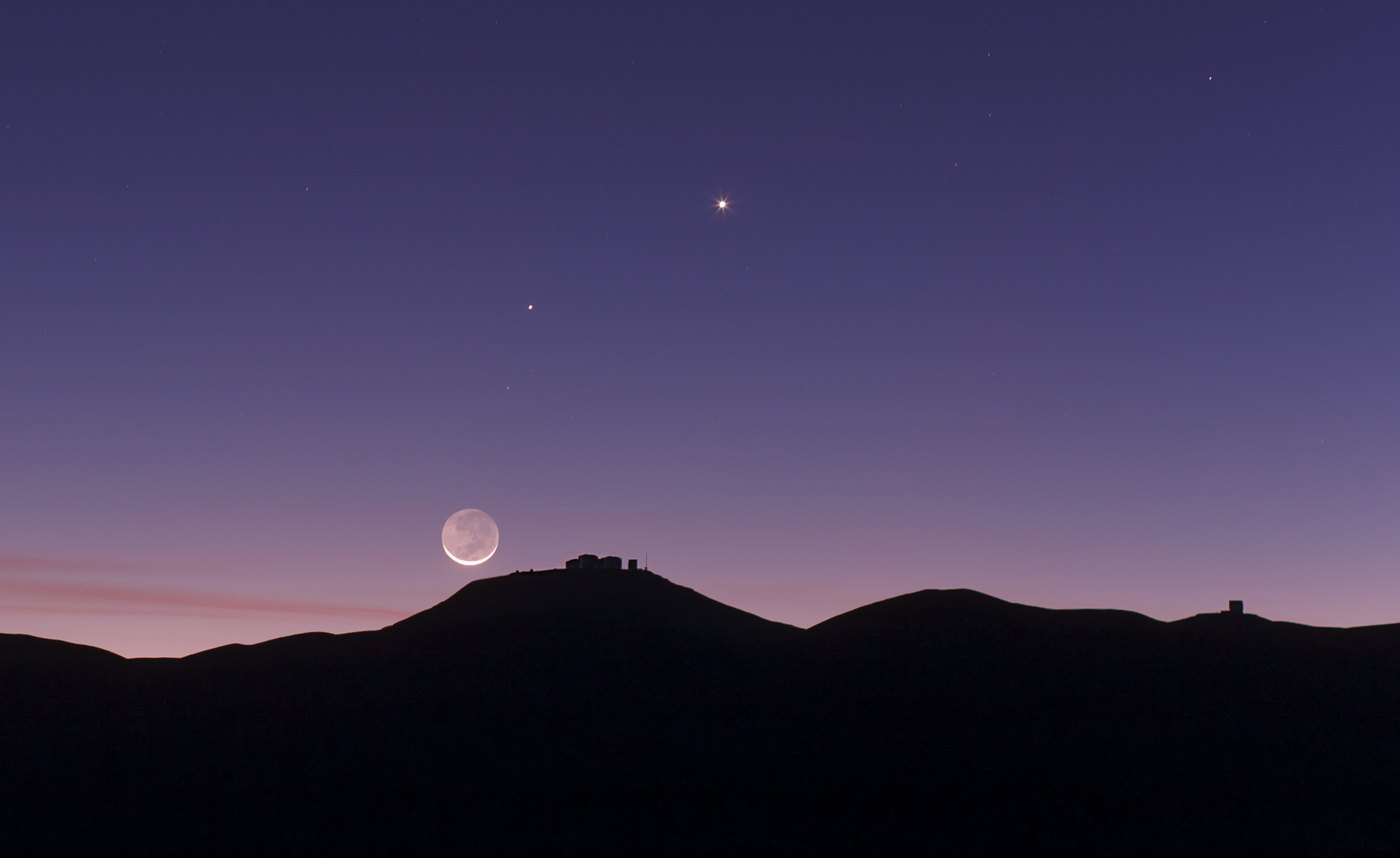
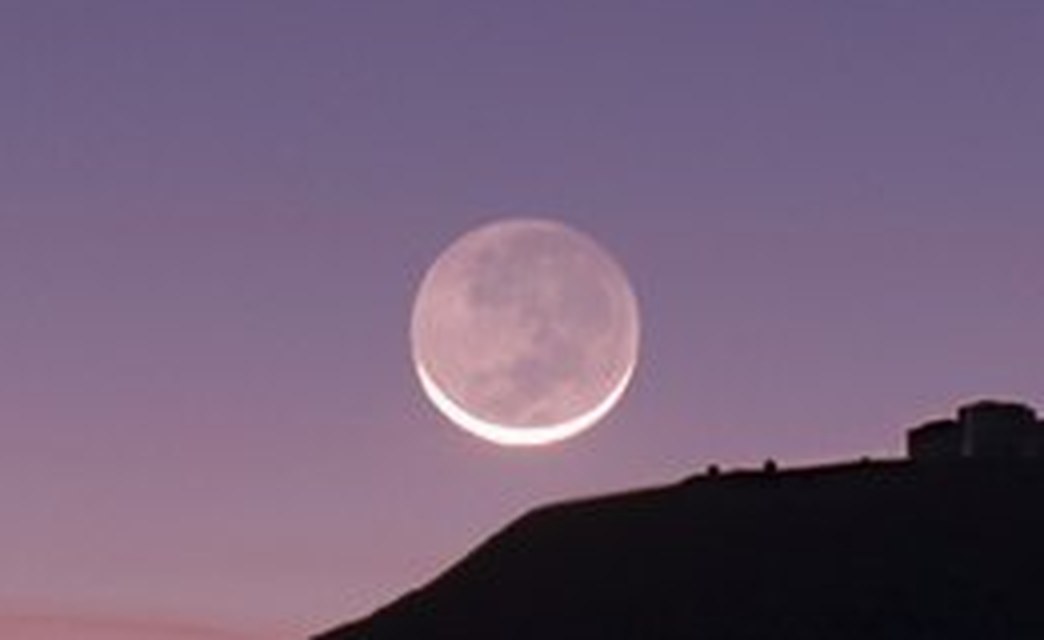
This is earthshine: sunlight strikes Earth, bounces mostly off cloud tops, travels to the Moon, lights the hemisphere the Sun is not lighting, and returns to us. Earth is a far larger and more reflective object in the Moon's sky than the Moon is in ours, so the lunar “night” side is never truly black — only faint beside the crescent. Leonardo da Vinci explained it in the Codex Leicester around 1510; the old name is the old Moon in the new Moon's arms. No telescope is needed: a camera allowing a one-to-two second exposure at a wide aperture, resting on anything solid, records it a day or two either side of new moon, the dim disc coming out clearly while the crescent blows out to white.
Detecting the new Moon itself, at 10 GHz
The Moon's invisibility beside the Sun is a contrast problem specific to visible light, and contrast problems can be engineered around by changing wavelength. Optically the Sun outshines even a full Moon by a factor of order 105, and the earthlit face of a new moon by more like 109. In the microwave band that ratio collapses.
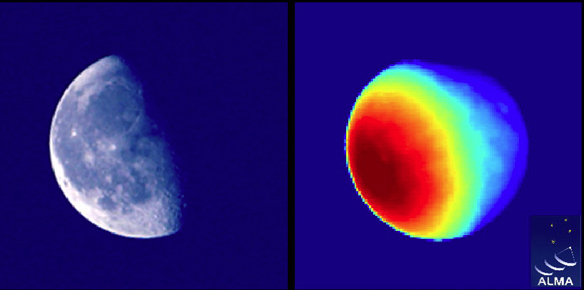
That answers the claim on its own terms. The Moon can be detected beside the Sun at new moon — just not with an instrument that responds only to visible light, which is what an eye is.
The silhouette, photographed — and predicted months ahead
NASA's Solar Dynamics Observatory watches the Sun continuously from Earth orbit. Two to five times a year the Moon passes between spacecraft and Sun, and SDO records a crisp black disc crossing the solar surface in extreme ultraviolet, the edge sharp because the Moon has no atmosphere to soften it — necessarily at new moon. On 29 March 2025 SDO's project scientist published the year's upcoming transits, including 25 July 2025 at 62% of the solar disc covered. The transit duly occurred, covering 62%, lasting about fifty minutes: a prediction four months early, matching to the stated percentage, from the same ephemeris as §2.
The Moon that has no phases at all
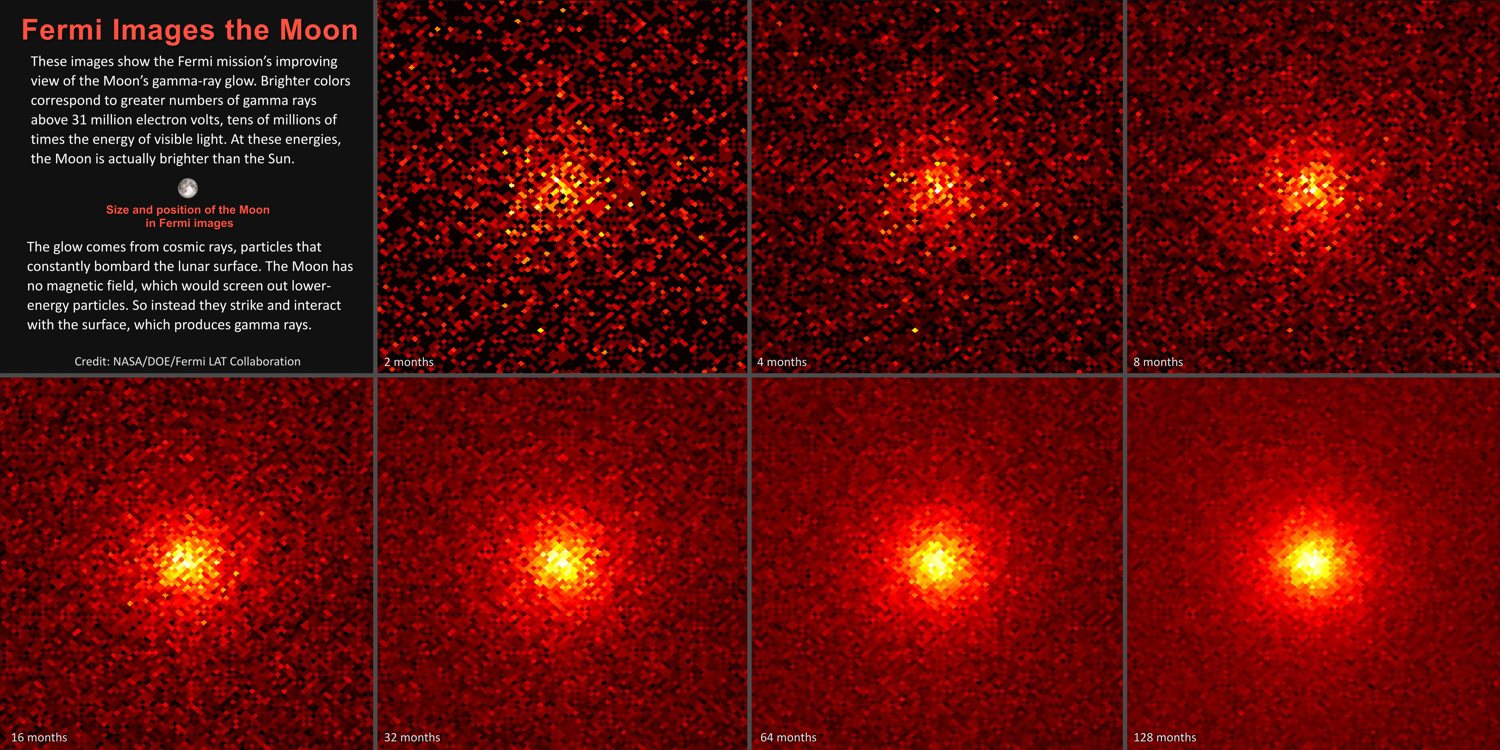
Two methods dispense with light entirely. Cosmic rays hitting the lunar surface produce gamma rays, and NASA's Fermi telescope images the Moon in them; above about 31 MeV the Moon is brighter than the Sun. Because that emission has nothing to do with illumination, the gamma-ray Moon shows no phases — in NASA's phrasing, at these energies it would always look full. The flux varies with the solar cycle's modulation of cosmic rays, not with phase.
Better still, the Moon can be located by what fails to arrive: it blocks incoming cosmic rays, so detectors see a Moon-shaped hole in the sky. IceCube — buried beneath the South Pole, receiving no lunar light of any kind — has observed this shadow at better than 6σ (six standard deviations above what noise alone would give) and places its centre within 0.2° of the predicted position once the geomagnetic deflection of charged cosmic rays is accounted for. The Moon blocks cosmic rays at new moon exactly as at full.
The sky maps are not reproduced here (reuse terms could not be established): HAWC's science page shows the Moon-shaped deficit, and IceCube's writeup on the companion Sun shadow explains why the Moon shadow is a routine pointing check — in their words, its reliability shows the angular resolution is well below one degree. The measurement is arXiv:1305.6811.
Every method after earthshine would work identically if the Moon emitted no light and reflected none. The claim that the Moon cannot be located before an eclipse turns out to be a claim about one narrow band of the spectrum and one instrument — the eye. Three weaker methods (tide tables, amateur moonbounce, GoTo mounts) are in the notes at the end.
4 · What would actually count against this
What would break it: totality over Reykjavík at a meaningfully different time or sky position than the computed 17:48 UTC / 24.6° altitude, or the Moon's phase in the lead-up failing to thin on the computed schedule — 21% on the 8th, 5.6% on the 10th, 1.4% on the 11th, and 0.006% at 17:48 on the 12th. Either would be a real problem for the model, not a rounding error. The cross-check in hand is the independent calculator of §2; the check not in hand is a timestamped Reykjavík frame, which would settle it either way — if you have one, send it.
Two objections. The first: ancient astronomers predicted eclipses without a globe, so prediction proves nothing. The Saros cycle does predict eclipse dates, from the arithmetic of repeating intervals, and the Babylonians had it. What it cannot give is which city, at what minute, with the Sun at what altitude, for how many seconds — sixty-five at Reykjavík and none a few hundred miles inland. Local circumstances come out of three-dimensional geometry and the figure of the Earth; there is no pattern-matching route to them.
The second: you have only shown this for an eclipse day. The opposite — the invisibility is a property of new moon, not of eclipses. The Moon's orbit is tilted about 5.1° to Earth's, so in a typical year eleven or twelve of the twelve or thirteen new moons pass above or below the Sun and produce no eclipse. Every one of them is exactly as invisible as this one. The eclipse is the rare month when the geometry lets you see the object that is always there.
Method notes — three weaker ways of finding the Moon
Tide tables. Spring tides, the largest of the month, fall at new and full moon, when the Sun's and Moon's tidal axes line up; neap tides at the quarters. Port authorities publish tables years ahead. The weakest method, and the book (p. 166) disputes lunar tides anyway: operational tables are harmonic fits to past gauge readings, so amplitudes and phases are empirical, though the frequencies fitted are the Moon's orbital periods; and aligned axes do not say whether the Moon is between Earth and Sun or opposite. Still, if the lunar clock were wrong, spring tides would slide off new and full moon at every port.
Moonbounce (EME). Radio amateurs bounce signals off the Moon: transmit a tone and about two and a half seconds later hear it return, at any phase, because it reflects off rock, not sunlight. Station software predicts the Doppler shift (the frequency change from the Moon's motion toward or away from you) from the ephemeris — up to roughly ±440 Hz at 144 MHz — and the echo arrives at that offset. Not casual: own-echo work on 2 m usually wants four or more long yagi antennas and a kilowatt-class amplifier, and near new moon solar radio noise degrades reception, so it is not a clean eclipse-day demonstration.
GoTo mounts. A computerised mount slewing to the Moon is not independent evidence of its position; it shows the mount and the eclipse prediction use the same lunar theory. The force is consistency: one body of solar-system dynamics underwrites eclipse canons, the Astronomical Almanac, planetarium software, occultation timings, tide tables and spacecraft navigation, and for the Moon to be missing before an eclipse it would have to fail in a way that spoils eclipse predictions while leaving everything else intact.
Sources & further reading
- Levi Miller, Globe Deconstruction (review draft), Question 9, p. 52.
- Shape Debate, Claim #3 (shapedebate.com) — its four red flags are answered on the pages linked in the introduction; the moon-tilt test also appears on the Self-Test Protocol page.
- Don Cross, Astronomy Engine (MIT licence) — the ephemeris library behind every Sun/Moon position on this page.
- sunpoint.org.uk, Reykjavík Solar Eclipse 12 August 2026 — independent second calculation used as a cross-check in §2.
- Earthshine photograph: ESO/B. Tafreshi (eso1210a), CC BY 4.0. Leonardo da Vinci's account is in the Codex Leicester, c. 1510.
- A. Hafez et al., “A radio determination of the time of the New Moon,” Monthly Notices of the Royal Astronomical Society 439, 2271 (2014); arXiv:1312.5956.
- NASA, Solar Dynamics Observatory — the April–July 2025 transit predictions, mission blog, 29 March 2025.
- NASA, “Moon Glows Brighter Than Sun in Images From NASA's Fermi” — the phase-independent gamma-ray Moon.
- Radio image of the Moon: ALMA (ESO/NAOJ/NRAO), NRAO gallery, CC BY 4.0.
- IceCube Collaboration, observation of the cosmic-ray Moon shadow, arXiv:1305.6811.
- HAWC science pages and IceCube, “The Sun also casts a shadow on IceCube” (2018) — cosmic-ray shadow sky maps.
- NOAA, spring and neap tides — spring tides at new and full moon (method notes).