Fun With Science / Globe Deconstruction / The Black Swan
The Black Swan, Answered
Visible turbine bases at the Rampion Wind Farm, and what they actually show.
Choosing the flattest-looking day and choosing the strongest-inversion day are the same act.
A widely-shared flat-earth video, The Black Swan (Dr John D., YouTube; the book’s link 26), films the Rampion Wind Farm from Worthing Beach and argues that visible turbine bases and distant ships — which spherical geometry says should be partly hidden — disprove Earth's curvature. Globe Deconstruction? adopts it at pp. 91–95. It is careful work, and it gets a careful answer.
Curvature intactClaim does not follow
Where this lands
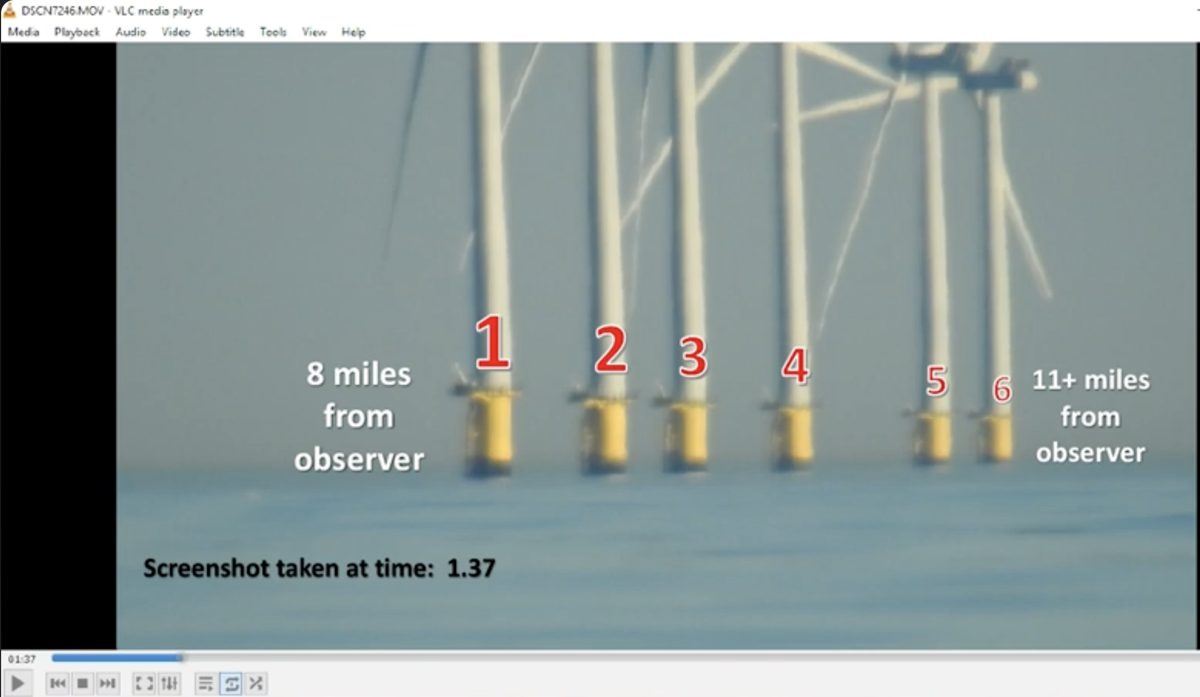
The claim. From a 2-ft eye on Worthing Beach, curvature should hide 26 ft (8 m) of the nearest turbine at 8 miles and 57.3 ft (17.5 m) of the sixth at 11; the bases are seen meeting the sea, so there is no curve.
Conceded. The footage is real, the vacuum geometry is right, and on a strong-inversion day the looming — distant objects lifted into view by air that bends light downward — genuinely is striking, which is why the video persuades.
Verdict. “Impossible on a globe” is drawn against an airless globe, on a day whose own frames show a mirage band and looming, smeared bases, and on which the film-maker himself reports a superior mirage — an inverted image above the real one — of a ship (§4). The video never establishes the true horizon, the temperature profile along the sightline, or the refraction of each object; and its one novel optics argument rests on a mirage rule found in neither of the two scientists it cites (§§2–3).
The numbers. Taken at its word — a 2-ft eye, 8 miles, an 8 m base seen at the waterline — the video’s claim needs a refraction coefficient of k ≈ 0.95 in the lowest two feet of air on a globe (k is the ray’s curvature as a fraction of the Earth’s; ordinary air is 0.13–0.17): a +120 °C/km inversion in that layer, which warm still air over a 13–15 °C sea produces exactly there. The flat plane, handed the same claim, needs k′ = k − 1 ≈ −0.05: air cooling upward at about −42 °C/km along the whole path, past the −34.2 °C/km at which a layer is denser above than below and overturns, and of the wrong sign for the day (§5). But the frame does not show what the voice-over says. Measured across all six turbines, the picture records k ≈ 0.7 — about 2 m of the near base and 5 m of the far one below the sea — and for that scene the flat plane needs about −90 °C/km (§6). The chapter’s own differential, the dark band one-third as tall at 11 miles as at 8 where perspective predicts 0.73, is that same measurement, and it runs against the chapter.
1 · The argument, stated fairly
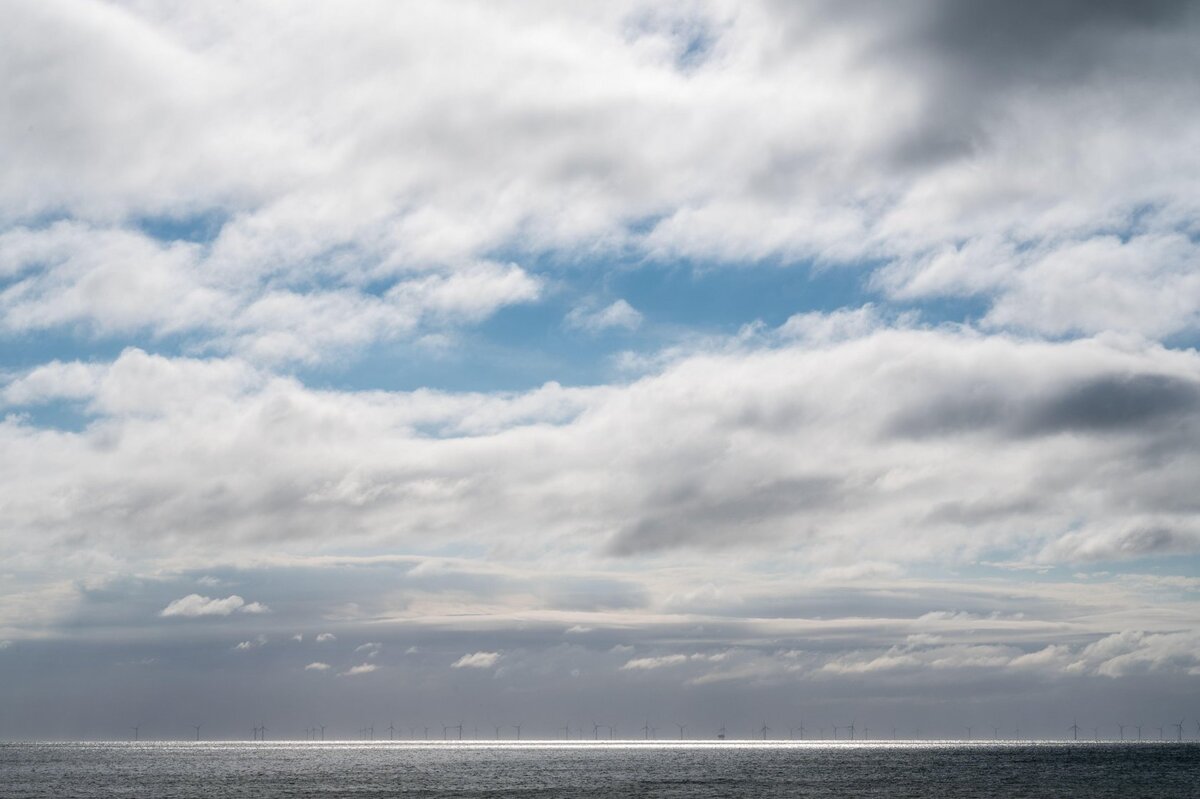
The video defines a “Black Swan” as any observation in which the sea-sky horizon appears behind an object beyond the calculated geometric horizon. From Worthing Beach, with a Nikon P900 about 2–3.5 ft above the tide, it films six Rampion turbines at 8–11 miles, the substation, and three ships out to ~21 miles; using an Earth radius of 3,959 miles it computes the “hidden height” curvature should bury at each range, then shows bases, legs and hulls apparently meeting the sea anyway.
The video anticipates the refraction rebuttal and tries to close it with an optics argument: any mirage, inferior or superior, requires the observer to see the real object by a direct, straight, unobstructed ray, plus a bent ray for the inverted image; a globe hides the real ship behind the curve, so the observed “erect ship with an inverted image above it” is impossible on a globe. That is a real argument. It fails at one identifiable step.
2 · The one load-bearing error
The case rests on equating “the erect image” with “a direct straight-line view of the real object.” Under an inversion light travels along continuously curved paths, and whether an image is erect or inverted is set by whether the mapping from true height to apparent height has a positive or negative slope — not by whether the ray is bending downward as it reaches the eye. A single inversion layer generically produces a stack of images: the lowest, erect image can be a loomed view of an object below the geometric horizon with no straight-line path to the eye at all, and above it sits the inverted image. “Erect object with an inverted image above it, both about the same size” is the signature of a long-range superior mirage, not a refutation of one.
3 · The scientists the video cites say otherwise
The video is emphatic, and correct, that the analysis must obey “the known and accepted laws and principles of light.” So consult the two atmospheric-optics scientists it names in its own sources.
“A superior mirage requires a direct straight ray to the real object” is the rule the argument needs. It appears in neither man's work.
Walter Lehn spent a career ray-tracing exactly these events: “Long-range superior mirages” (Applied Optics, 1998) models mirages that lift ships and coastlines far beyond the geometric horizon, and his 1983 paper reconstructs the temperature profile from the mirage itself. In both, the real object is hidden below the horizon and imaged by continuous curved rays, often as several images, erect and inverted — the mechanism the video calls impossible. Robert Greenler (Rainbows, Halos, and Glories) did it in a tank: “Laboratory simulation of inferior and superior mirages” (1987) reproduces both mirage types, erect and inverted images included, with no straight ray anywhere in the apparatus. By the video's own standard its central premise fails.
4 · The video's own footage shows the refraction it rules out
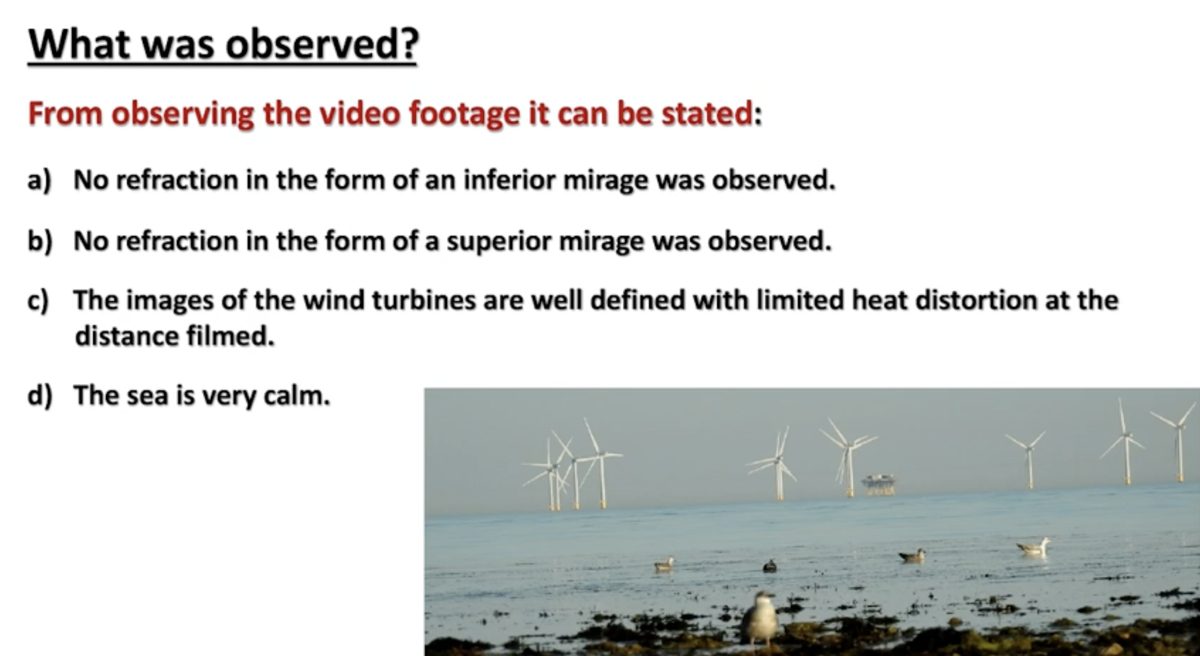
The video's summary slide asserts no inferior mirage, no superior mirage, images “well-defined with limited heat distortion,” and a very calm sea. The frames beside it, and the narration around it, show otherwise; the film-maker expressly invites viewers to grab the screenshots and check.
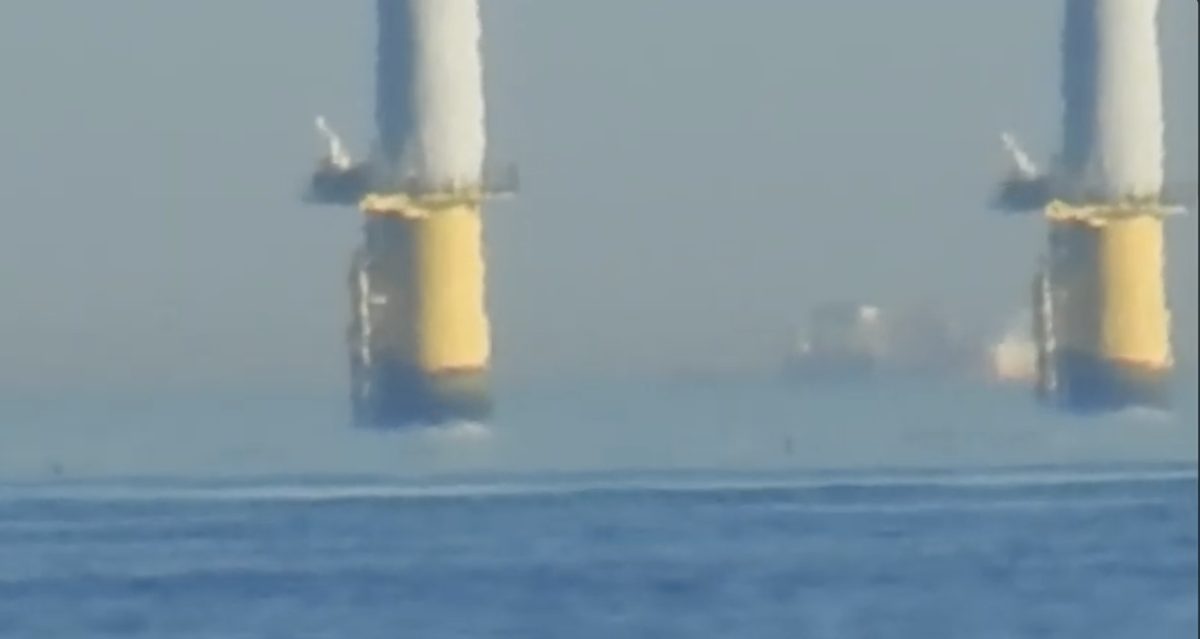
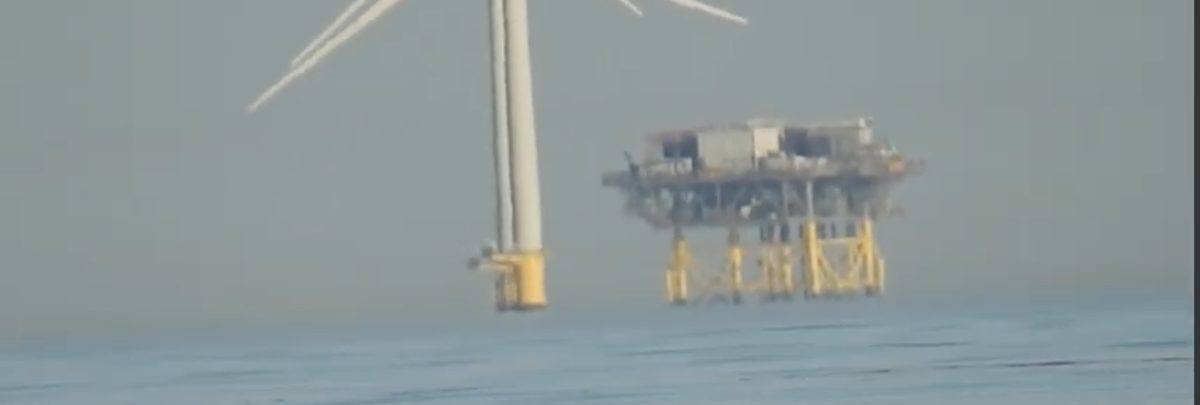
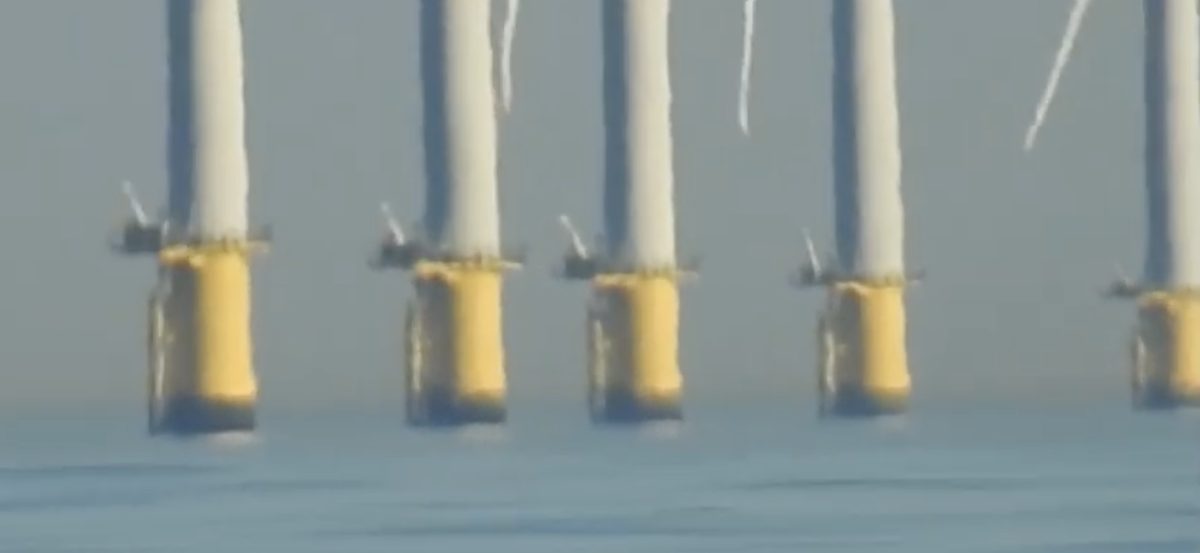
The narration says the same in its own voice:
- 22:52 States that no superior mirage was observed, and that the images show “no refraction”.
- 43:22 Reports a superior mirage of a ship in the same session.
- 50:30 Identifies the Shetland Trader's inverted image as a superior mirage.
“Well-defined images = no refraction” rejects curvature, and the same images then diagnose an inversion and a mirage; both cannot be true of one frame. Once a superior mirage is present the atmosphere is bending light, and the bending that lifts the inverted image lifts the hidden bases and hulls too.
5 · The numbers are right — the physics is missing
The video's no-refraction hidden-height figures check out:
| Target | Distance | Observer height | Hidden height (no refraction) |
|---|---|---|---|
| Nearest turbines | 8 miles | 2 ft | ~26 ft (8 m) |
| Shetland Trader | 13.9 miles | 3.5 ft | ~90 ft (27 m) |
| Eagle Kinabalu | 20.8 miles | 3.5 ft | ~228 ft (70 m) |
These reproduce the video's own figures and are arithmetically fine — for a vacuum. They are the hidden heights on a globe with no atmosphere.
The real prediction is Earth geometry plus the day's refractive-index field, which the video never measures or applies. A standard atmosphere (k ≈ 0.13) already trims those hidden heights by ~13–15%; a visible superior mirage — which the video itself diagnoses on the Shetland Trader — means k > 1 in the affected layer, enough to lift the lower parts of distant objects fully into view. The tens of metres on the far ships are what strong ducting over cold water does; the video's own narration leaves those frames to the viewer (“your call”).
Pricing both branches
“Refraction is your rescue — state the k you need” is the standard reply, and it deserves arithmetic. The standing method applies: geometry alone cannot separate curvature from refraction, because a flat plane at k′ = k − 1 reproduces every sightline of a globe at k; so hand both models the same inputs and price what each needs the air to do. The inputs are the video's own: 8 miles (12,875 m), a 2-ft (0.61 m) eye, a 3,959-mile (6,371 km) radius, and a base seen at the waterline.
Globe. The base clears the horizon when the refracted horizon reaches it, which sets 1 − k = 2hR/D² = (2 × 0.61 m × 6,371,000 m) / (12,875 m)² = 0.047, so k ≈ 0.95. On the method page's scale (k = 0.17 at −6 °C/km, k = 0 at the −34.2 °C/km where air overturns: about 0.006 per °C/km) that is a gradient of roughly +120 °C/km. The ray between a 2-ft eye and a base 8 miles off never rises above the eye, so only the lowest two feet of air have to carry it — and in still warm air over a colder sea most of the air–sea contrast sits in the lowest metre or two, exactly where this ray lives. Filmed near low water, so that the high-tide mark needs only 3 m of looming rather than 8 (the tide note in §6), the demand falls to k ≈ 0.3, a +15 °C/km inversion. Either is within what a surface inversion over cold water supplies, with the right sign.
Flat plane. The same inputs give k′ = 0.95 − 1 = −0.05 (or −0.7 at the low-water reading): light bending upward, a gradient of about −42 °C/km (−150 °C/km), past the −34.2 °C/km at which a layer is denser above than below and simply overturns. Even k′ = 0 — the “no refraction” the video asserts — is not free on a flat plane: it is that overturning gradient itself, held along the whole path. And the sign is wrong for the day: warm still air over a 13–15 °C sea makes the gradient positive, not negative. The globe needs the day's air to do what such air does; the flat plane needs the opposite.
Both of those price the claim — a base at the waterline. The next section prices the frame, which shows something milder, and the flat plane fares worse on it, not better.
6 · Miller's own differential measurement points the other way
The chapter carries a number of its own that runs against it. Miller anticipates an objection about the dark band at the waterline:
“Debunkers that never took an art class will point out that the dark part is ⅓ of the height at support 6 compared to turbine #1. This is due to perspective. As objects move away, they get smaller.”
— Levi Miller, Globe Deconstruction, p. 95 (review draft)
Perspective is real and it does shrink things; the question is by how much. Turbine #1 sits at 8.0 miles and support 6 at 11.0 — the distances from his own p. 92 table; the p. 94 slide gives 8.4 and 11.2, which changes nothing — so anything of fixed physical height at the further one subtends
8.0 ÷ 11.0 = 0.73 of its angular height at the nearer one (8.4÷11.2 = 0.75)
Perspective predicts the far band should be about three-quarters as tall. He reports one-third. On his own figure, perspective accounts for roughly half of the reduction and something else has removed the rest — and that something else grows with distance.
The ⅓ is his visual estimate. It is also measurable, because the video’s own six-turbine slide (a screenshot of its footage at 1:37, distances 8.4 to 11.2 miles by its own table) gives every base to read in pixels — and the turbines are one design, so each yellow transition piece and the dark intertidal strip beneath it stand the same real height on all six. Take every height in units of the piece’s own width and perspective cancels exactly: if the sea hid nothing, the six bases would then be identical top to bottom.
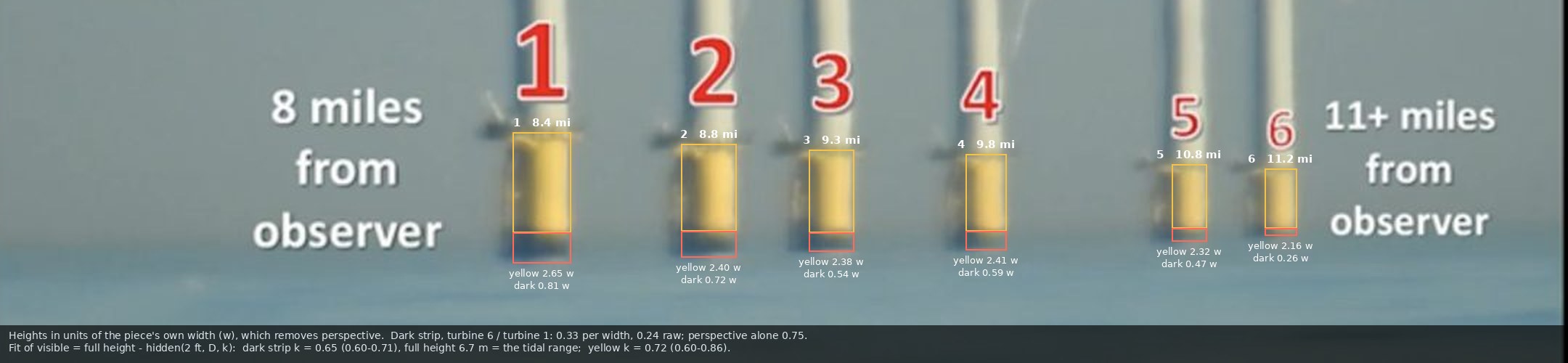
Fitting all six to visible = full height − hidden(2 ft, D, k) with the solver’s own hiding formula gives one coefficient for the one column of air: k ≈ 0.65 from the dark strip (0.60–0.71 allowing a pixel and a half of noise and a 5.5–6.5 m piece) and 0.72 from the yellow, agreeing to a third of a metre. The dark strip’s fitted full height comes out at 6.7 m — Worthing’s spring range, which is what the strip is. At that k the sea hides about 2 m of turbine 1 and 5 m of turbine 6: not the 9 and 18 m of an airless globe, and not the nothing the voice-over asserts. As temperature it is a +70 °C/km inversion in the lowest layer, the looming day of §4; on a flat plane the same six bases need k′ ≈ −0.35, about −90 °C/km, well past the −34.2 at which air overturns. So the video never states a coefficient, but its words — bases meeting the sea — describe a scene that would take k ≈ 0.95, while its camera records a k ≈ 0.7 one; the metres between the two are the bright band of §4 that the video reads as “the sea.”
The slide is a 1,200-pixel screenshot of a screenshot at raised contrast; the pieces are 19–26 pixels wide, and the far turbine’s dark strip is five pixels tall, which is both the lever and the weak point. The bands above reflect that. A read from the original footage would tighten them, and “hidden” here is an effective figure — the mirage’s compression of the lowest metres is folded into it.
7 · The test that would settle it
Geometry does not change from day to day; the atmosphere does. So there is a clean, pre-registerable test:
A second test needs only one day: change your eye height. On a globe the buried bases climb back into view as the observer rises — the whole 8-mile base is exposed with no refraction at all from an eye D²/2R = 8² / (2 × 3,959) miles = 13 m (43 ft) up, about 11 m in standard air. On a flat plane the view is height-independent — and observer height is precisely the variable the “stand at the water's edge” framing avoids.
Sources & further reading
- The video under review: Dr John D., “The Black Swan – An observation and its implications for a globe model”, YouTube; linked from the book as
shapedebate.com/26(QR 26, pp. 91–95). Timestamps on this page refer to that upload. - On this site: Two Photographs That Have Been Argued to Death runs the same method on the book’s Chicago time-lapse and the Pontchartrain towers, with the evening’s weather attached, and puts every long-path picture on one temperature scale.
- The six-turbine measurement: rampion_bands.py reads the video’s own slide (footage DSCN7246.MOV at 1:37; turbine distances 8.4, 8.8, 9.3, 9.8, 10.8, 11.2 miles by its own table at 24:29) and fits k with the hiding formula of the Reverse Refraction Solver, which prices occlusion on both surfaces. Transition-piece diameter bounded by the Rampion Offshore Wind Farm Order 2014, Sch. 1 para. 5 (monopiles at most 6.5 m); pieces about 20 m above sea level (Rampion Offshore Wind Farm, About the windfarm).
- W. H. Lehn (1998), “Long-range superior mirages,” Applied Optics 37(9), 1489–1494.
- W. H. Lehn (1983), “Inversion of superior mirage data to compute temperature profiles,” J. Opt. Soc. Am. 73(12), 1622–1625.
- R. G. Greenler (1987), “Laboratory simulation of inferior and superior mirages,” J. Opt. Soc. Am. A 4(3), 589–590.
- Met Office — special phenomena (mirages and refraction); NGA, American Practical Navigator (geometric, optical and refracted horizons).
- W. Latham (1798), “Account of a Singular Instance of Atmospherical Refraction,” Philosophical Transactions of the Royal Society of London 88.
- “A description of some remarkable effects of unequal refraction observed at Bridlington Quay in the summer of 1826,” Transactions of the Royal Society of Edinburgh.
- UK Met Office / BBC (March 2021), on the Fata Morgana photographed at Gillan, Cornwall.