Two Disks, One Sky
A flat-earth demo gets counter-rotating star trails by projecting two spinning light disks onto one dome and filming from outside. The trick is real, but it is a camera trick. The question that matters is what two disks look like from underneath, and whether they can ever produce the straight trails we photograph at the equator.
Both disks spin the same way. From outside you look at field A's back (through the dome shell) and at field B's front (the inside surface, seen across the dome). A rotation seen from behind is mirrored, so A appears to counter-rotate against B. Slide the camera inside the dome, where any observer on a flat plane would actually be, and both fields turn the same way.
A flat earther can skip the camera trick entirely and simply spin the second disk the other way. Press Reverse disk B to grant that. It fixes the direction, so counter-rotation on its own is not the problem. Tab 2 shows what is.
This is the whole sky seen from underneath, zenith in the centre, horizon at the rim (north up, east left, as on a star chart). Grow the radius and the two fields have to overlap. In the overlap you get two sets of trails crossing through each other, going opposite ways or the same way with opposite curvature. No photograph has ever shown that.
The real equatorial sky shows something two disks can never make: straight trails running east–west through the zenith, bending one way toward the north horizon and the other way toward the south. Press Globe sky to see what that takes: the second pole has to be the exact antipode of the first, which puts it below a flat earth, not on a dome above it.
"Keep the disks small, so they never overlap." Then each disk covers at most half the angular distance between the poles, and everything between them is a starless band. Yet Orion, Sirius and the whole zodiac are seen from both hemispheres on the same night. The stars they share are precisely the ones that must sit in both disks at once.
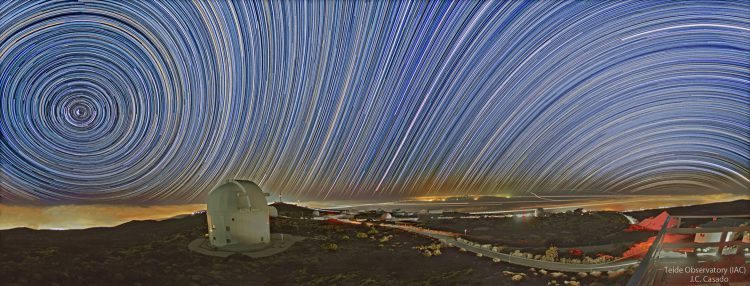
Turn to face north and the trails spiral anticlockwise around a point 28° above the horizon. Turn east and they run as nearly straight, tilted lines. Turn south and they bow the other way, around a pole that is 28° below the southern horizon. One axis, one rotation, seen from a tilted ball. Switch the model to Two disks, one centred over each pole of the flat earth, and grow the radius: the same tour shows what the dome version would have to look like instead.