Source Reference — Kell's Book Excerpts
This section contains the original pages from Corey Kell's book alongside transcriptions of key content, including his theoretical framework, methodology, original data tables, and conclusions. Click any image to enlarge.
Fair Use Notice
The excerpts reproduced below are included for purposes of criticism, comment, scholarship, and research, as expressly permitted under the fair use doctrine codified at 17 U.S.C. § 107. Our use is non-commercial and transformative: we reproduce only the specific pages necessary to verify quoted claims, data tables, and methodology, and we accompany each excerpt with substantive commentary, independent calculation, and critical analysis. We reproduce no more of the work than is reasonably necessary to support that analysis, and our use has no adverse effect on the potential market for the original work — readers interested in the complete argument are encouraged to obtain the book directly from the author.
Copyright in the underlying text and figures remains with Corey Kell. No claim of ownership is made or implied. If you are the rights holder and have concerns about any specific excerpt, please open an issue on GitHub and we will respond promptly.
1. Kell's Theoretical Framework
The 45-Degree Sector Model
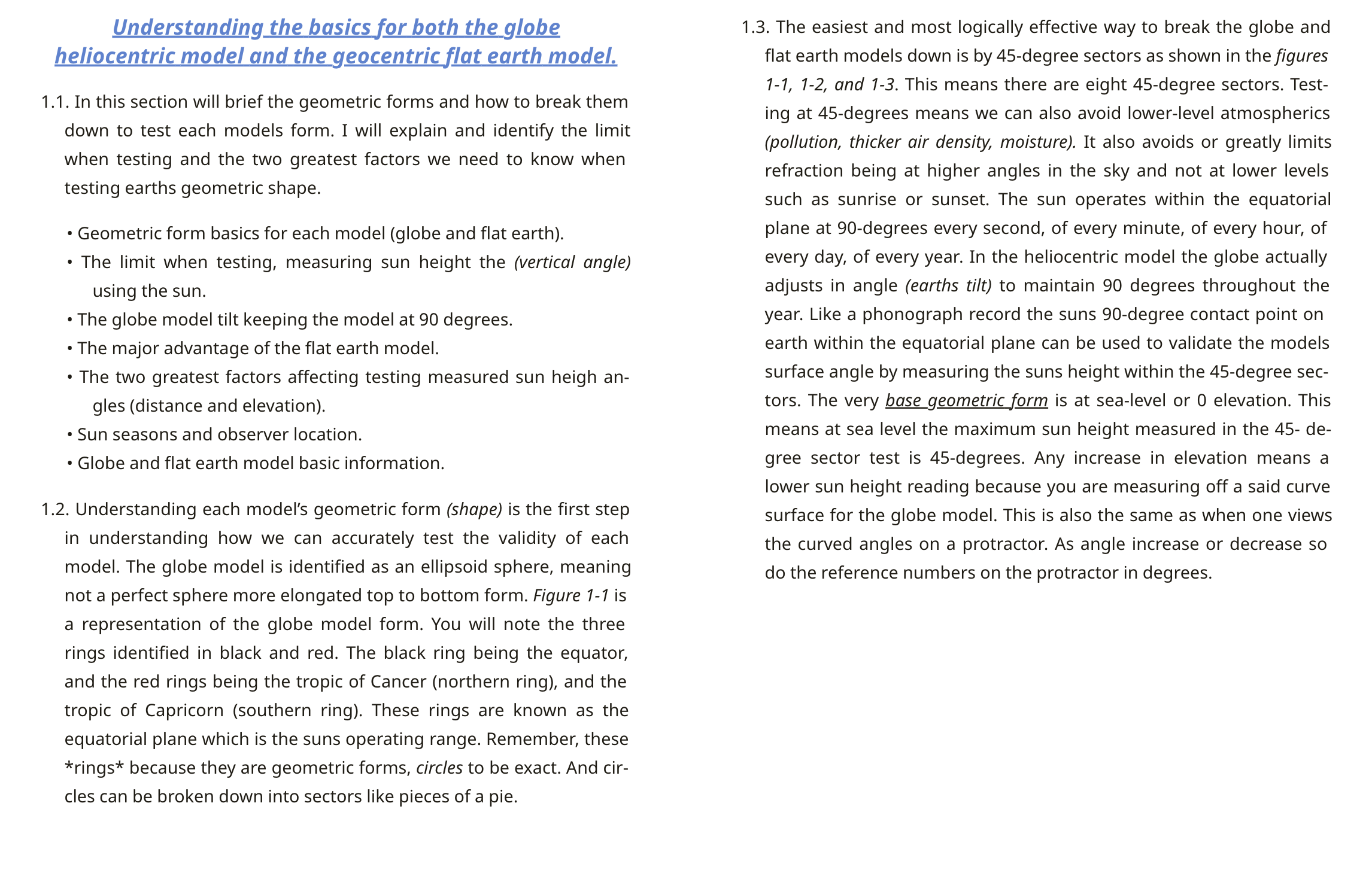
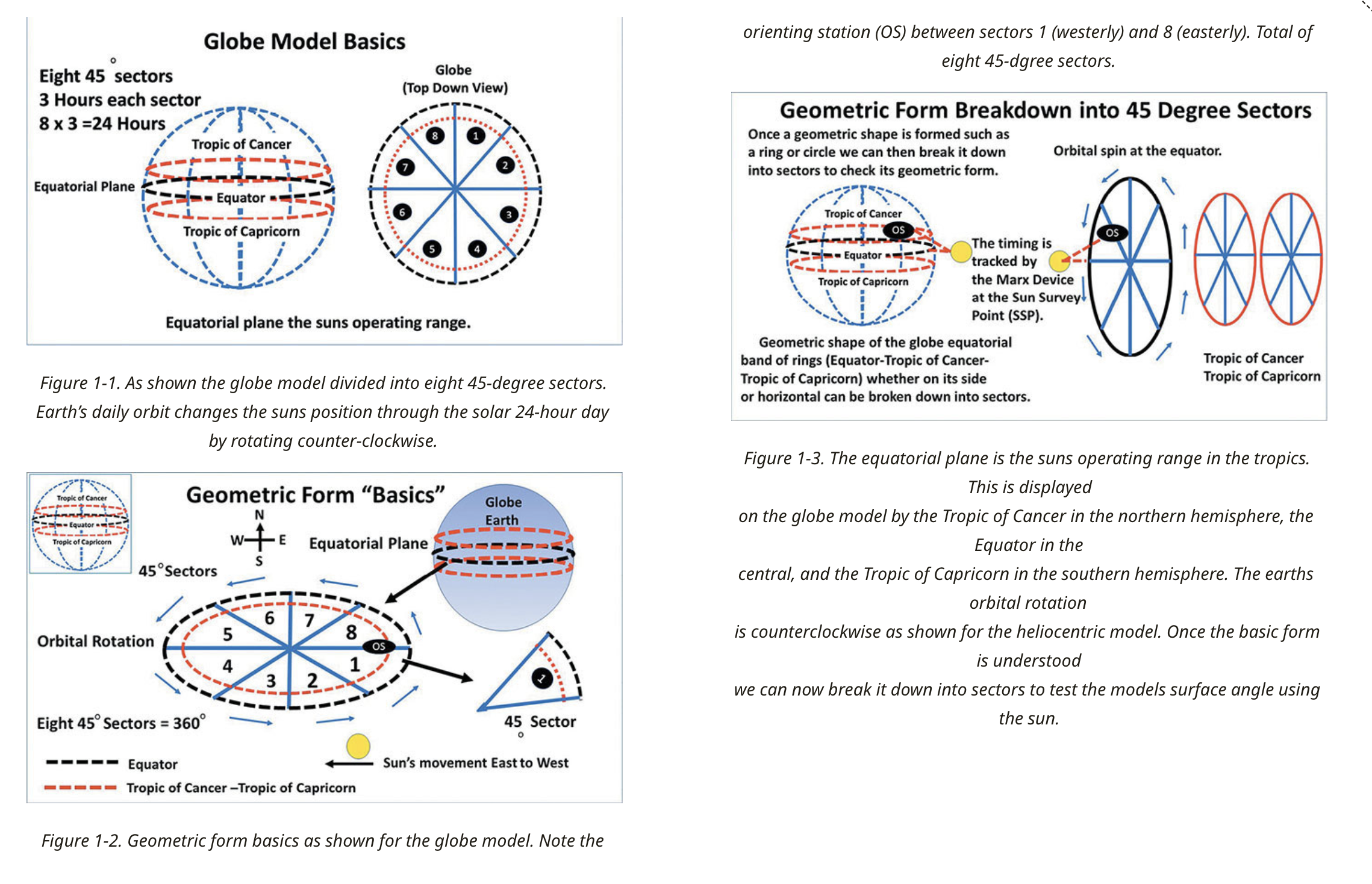
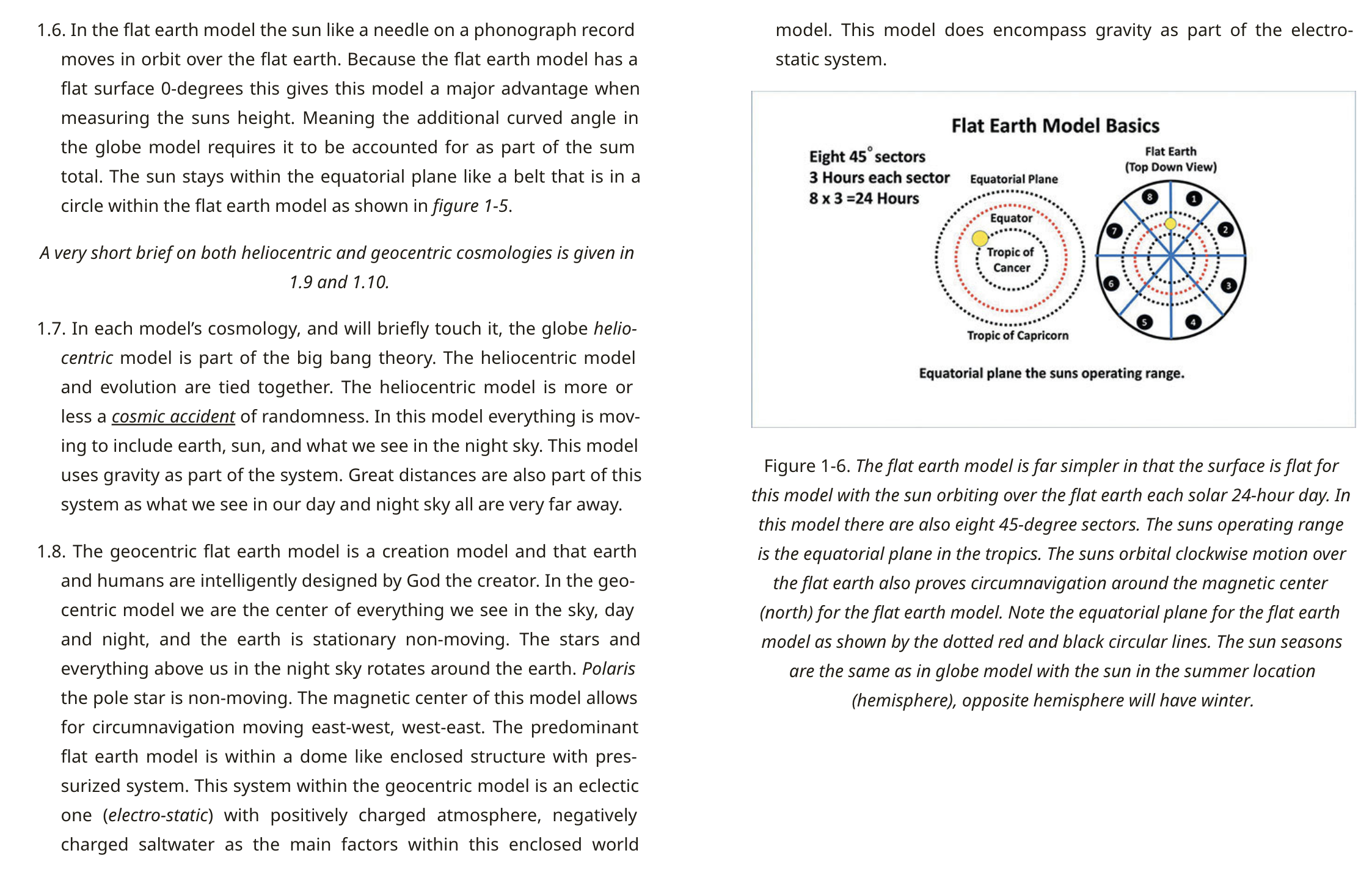
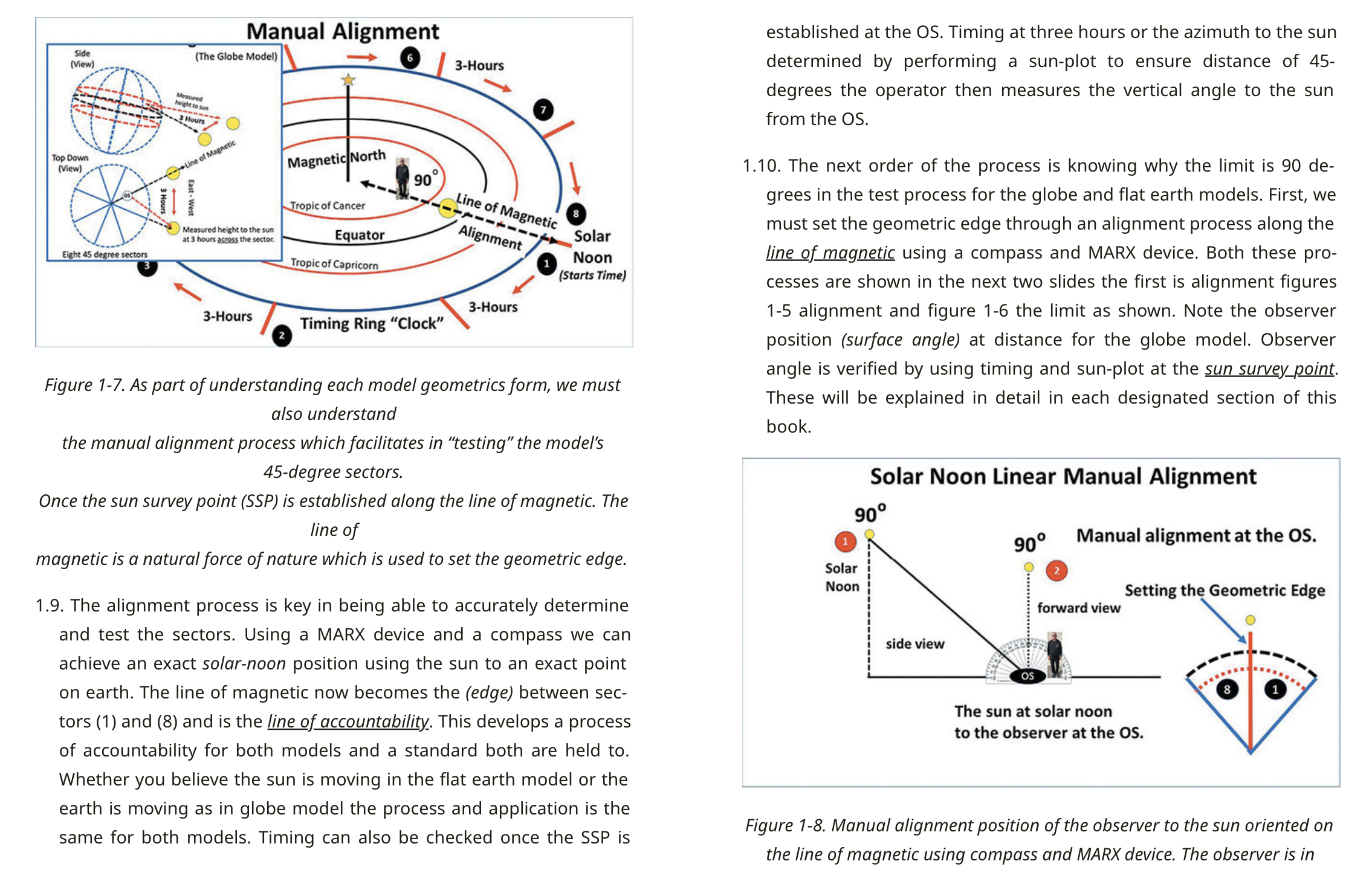
Kell divides the 360° solar day into eight 45-degree sectors, each representing 3 hours. He argues both the globe and flat earth models can be tested by measuring the sun's vertical angle (elevation) at the 3-hour marks from solar noon.
The "90-Degree Limit" Claim
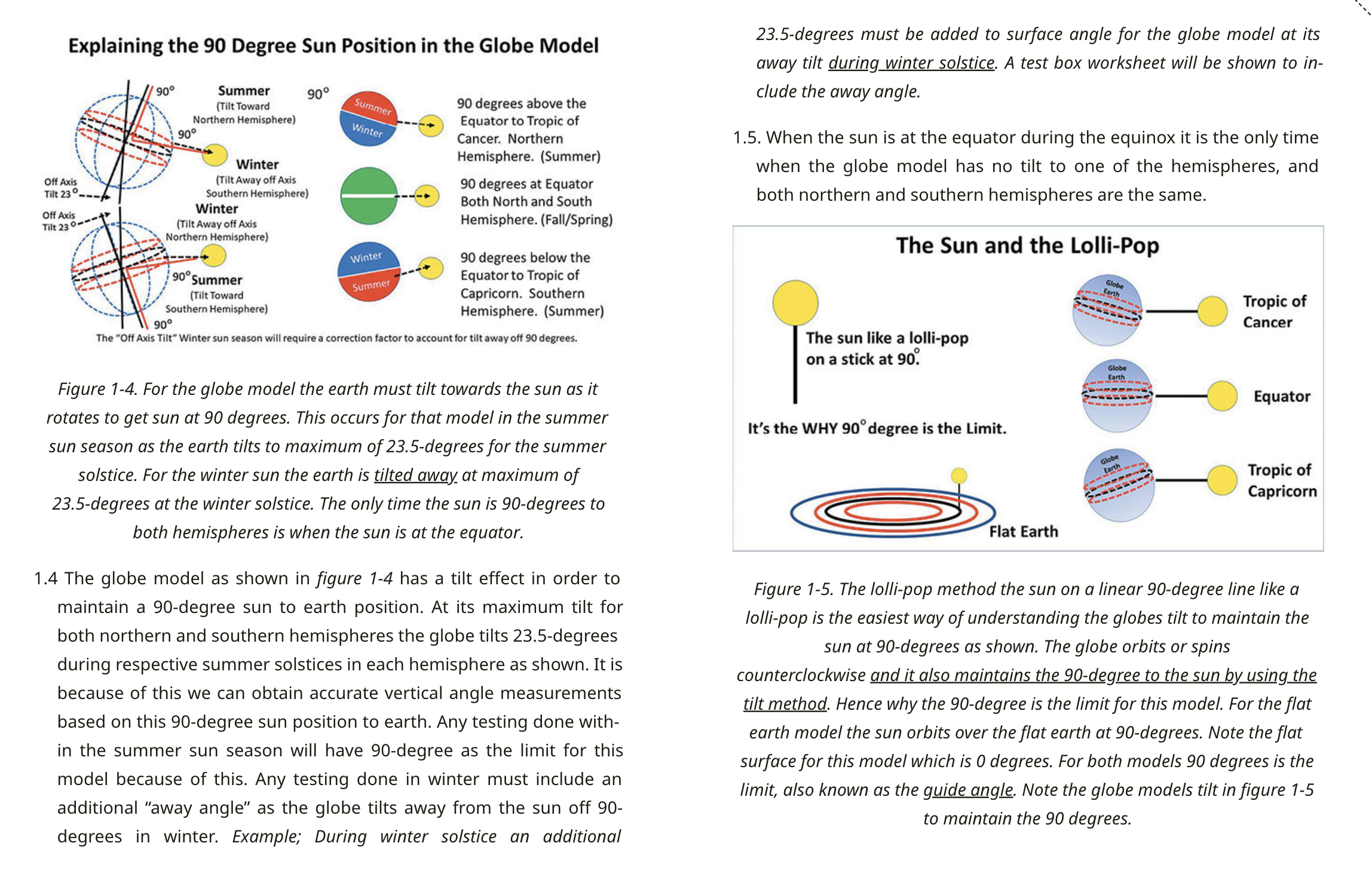
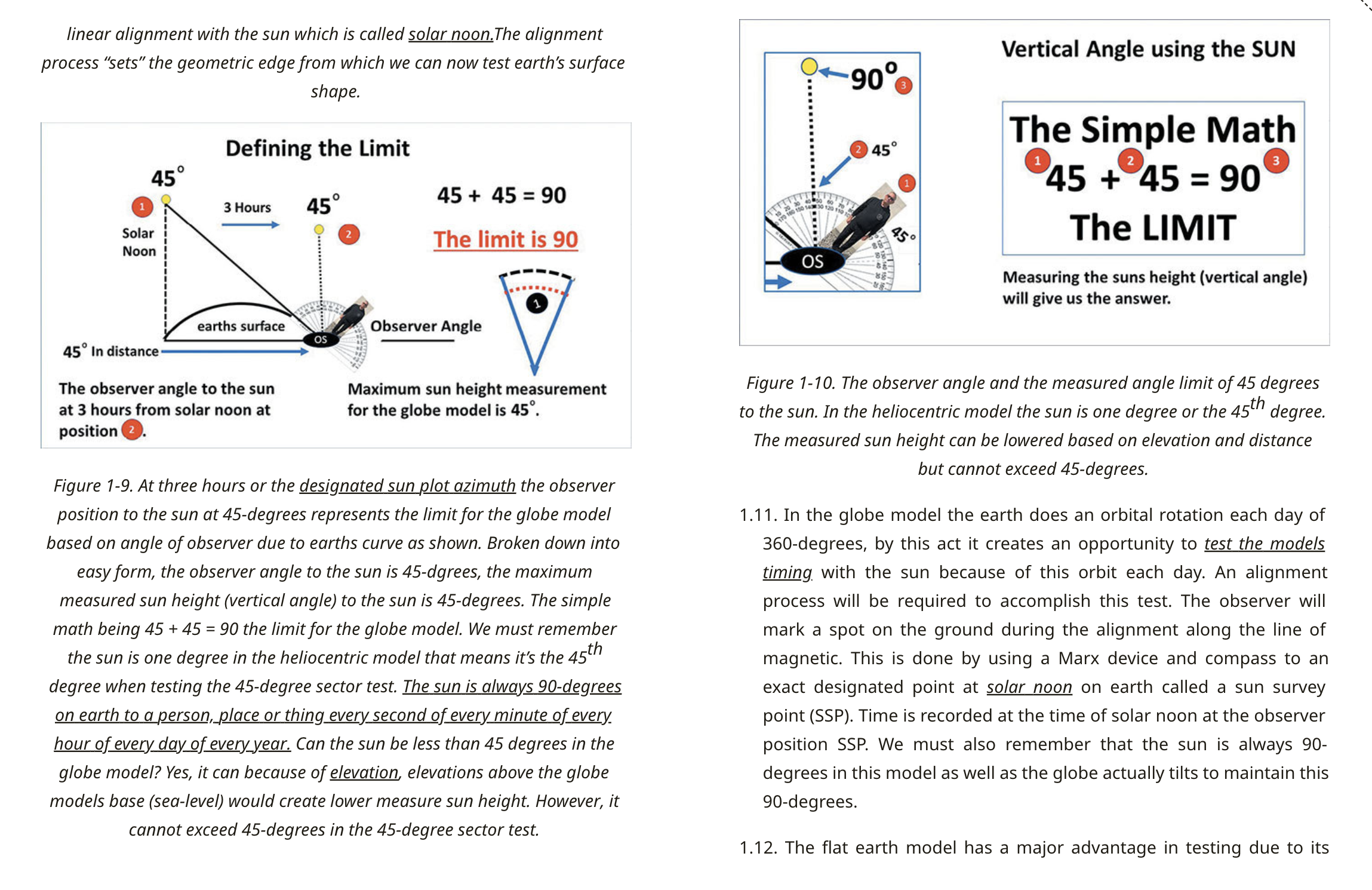
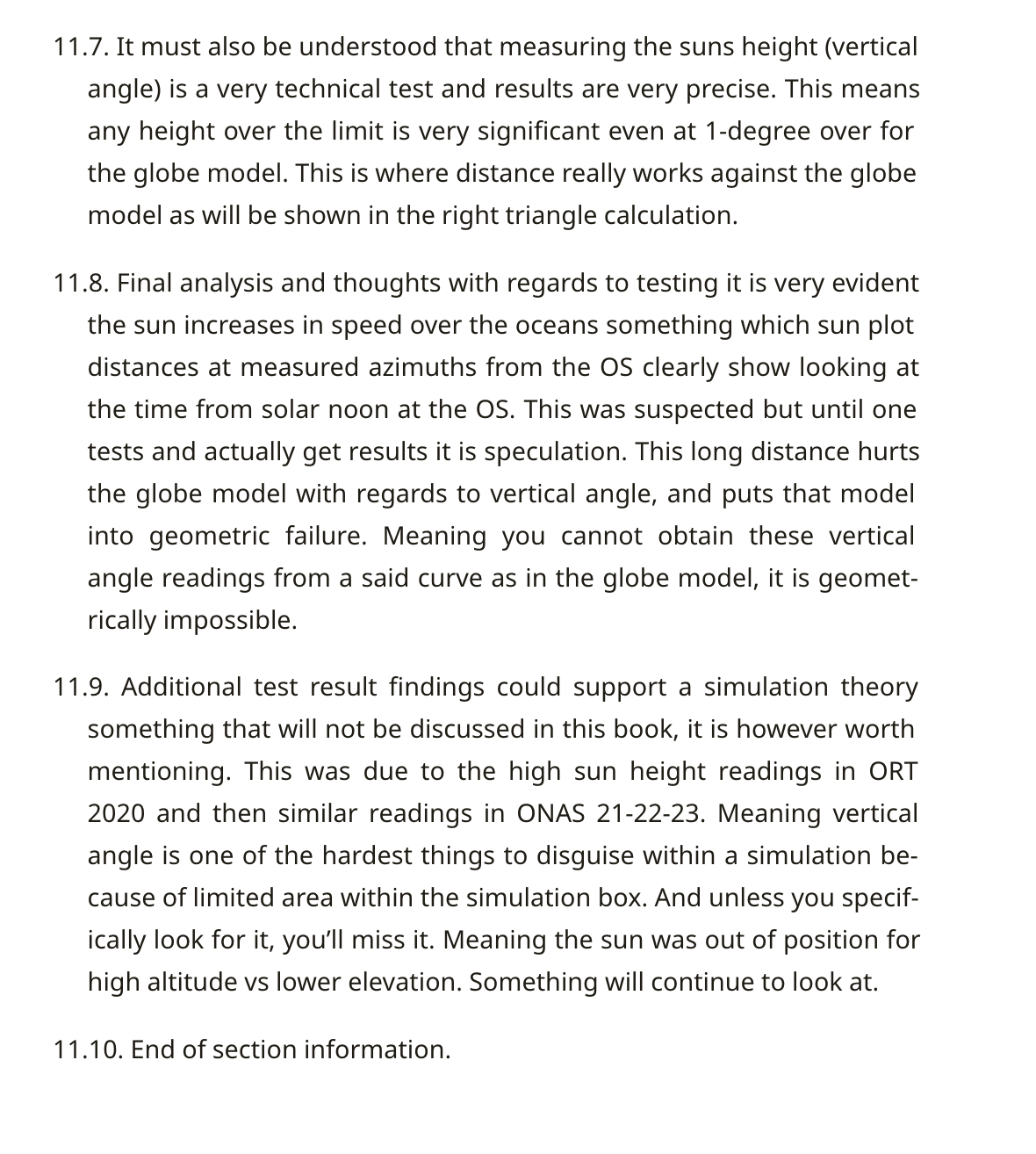
Kell's central claim is that the sun is always at 90 degrees to the observer in both models, and therefore the maximum measurable sun height at 3 hours from noon (one 45° sector) is 45°. His math: 45 + 45 = 90, therefore 45° is "the limit."
The Geometric Error
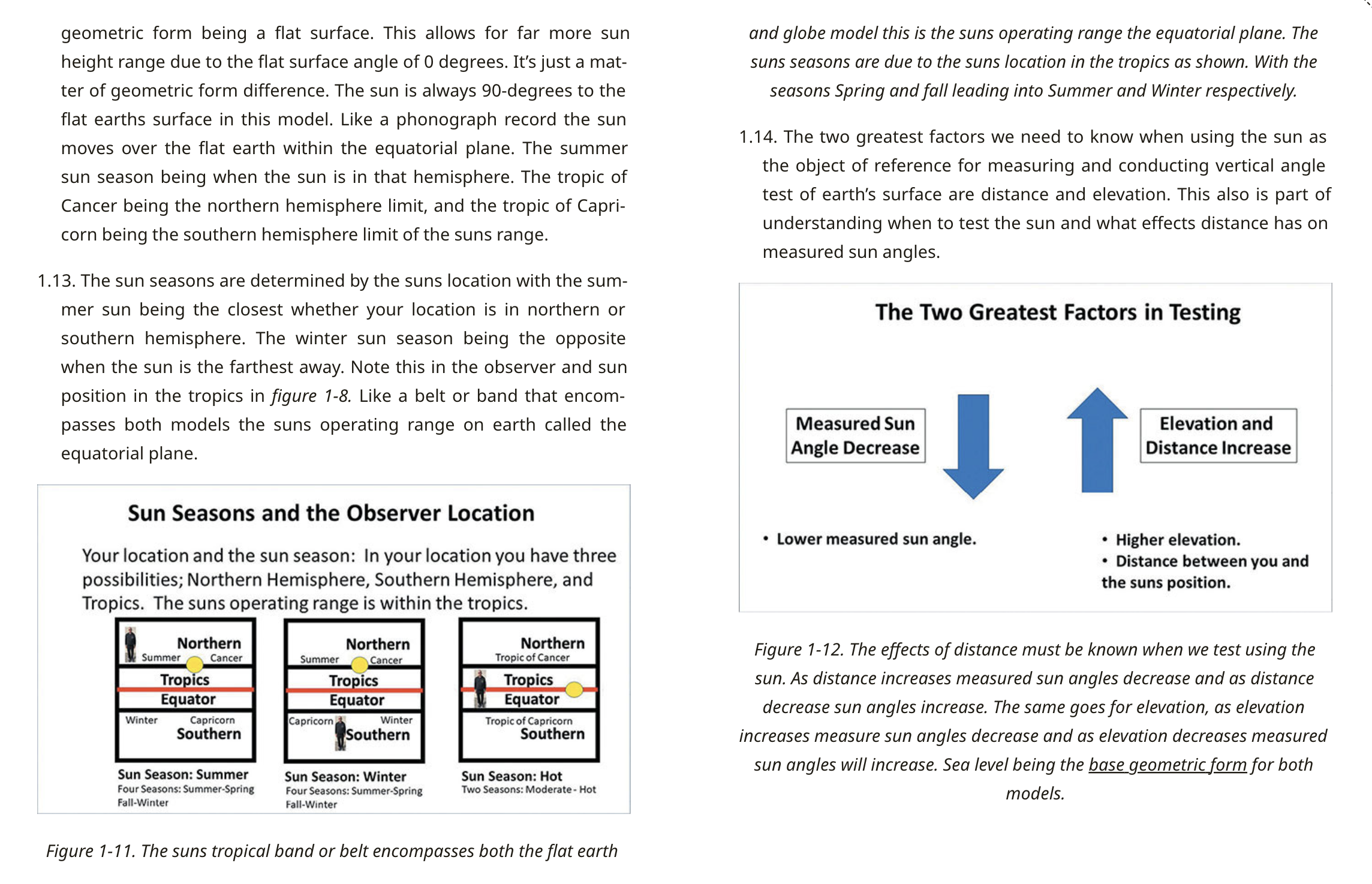
This reasoning treats the hour angle as if it directly determines the elevation — which would only be true if the sun were on the celestial equator AND the observer were at the equator AND the surface were a flat plane. In reality, solar elevation depends on three variables together: latitude, declination, and hour angle. At 34–35°N during summer (declination ~+23°), the sun's elevation at a 45° hour angle routinely exceeds 50°.
2. ORT 2020 — Operation Resolute Time
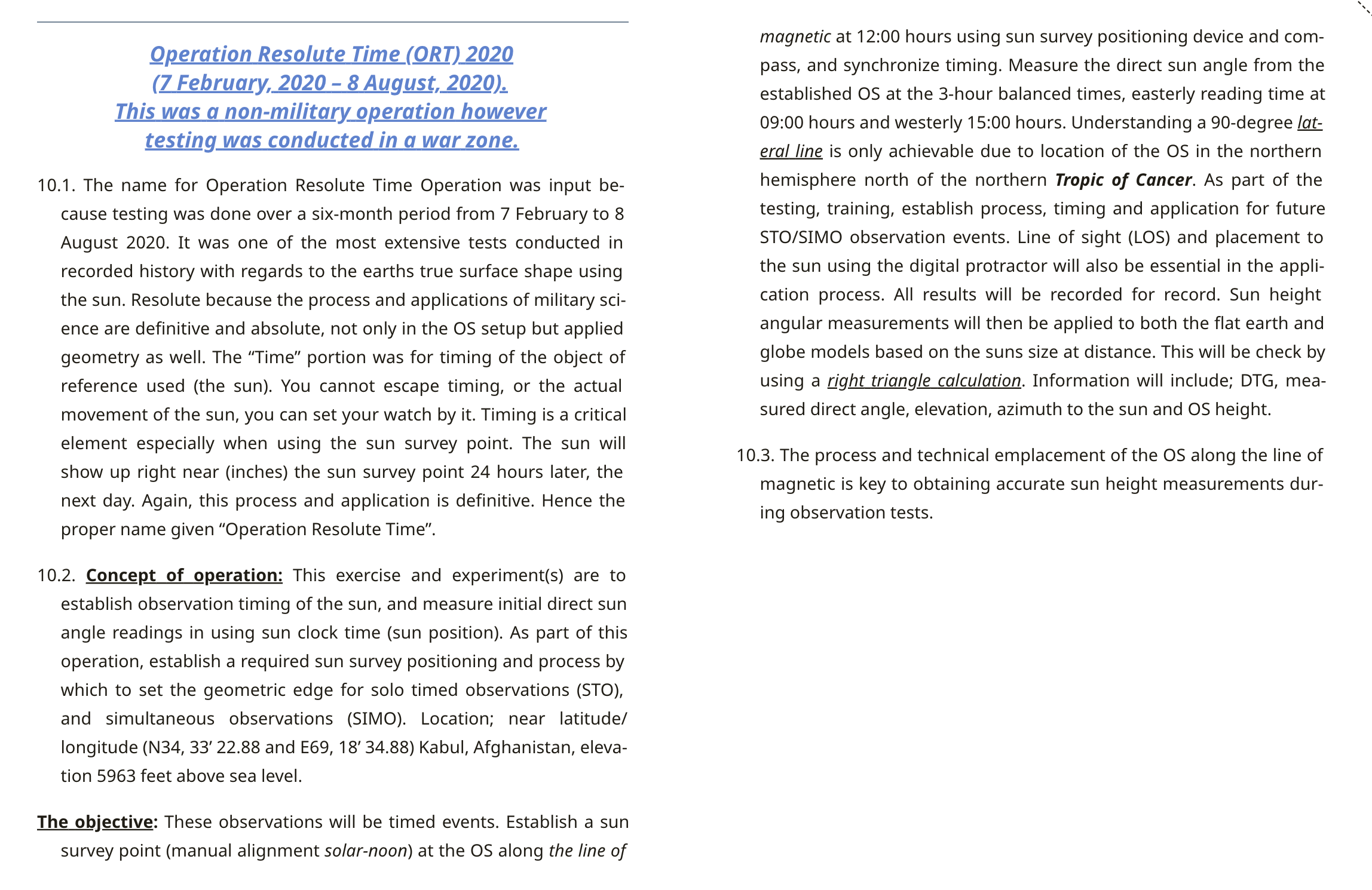
Operation Details
Period: 7 February – 8 August 2020
Location: Kabul, Afghanistan — N34°33'22.88", E69°18'34.88"
Elevation: 5,963 feet above sea level
GPS: 42S WD 29946 23898
This was described as a non-military operation conducted in a war zone. Testing ended on 7 August 2020 partly due to events within Afghanistan during the on-going war.
Equipment & Setup
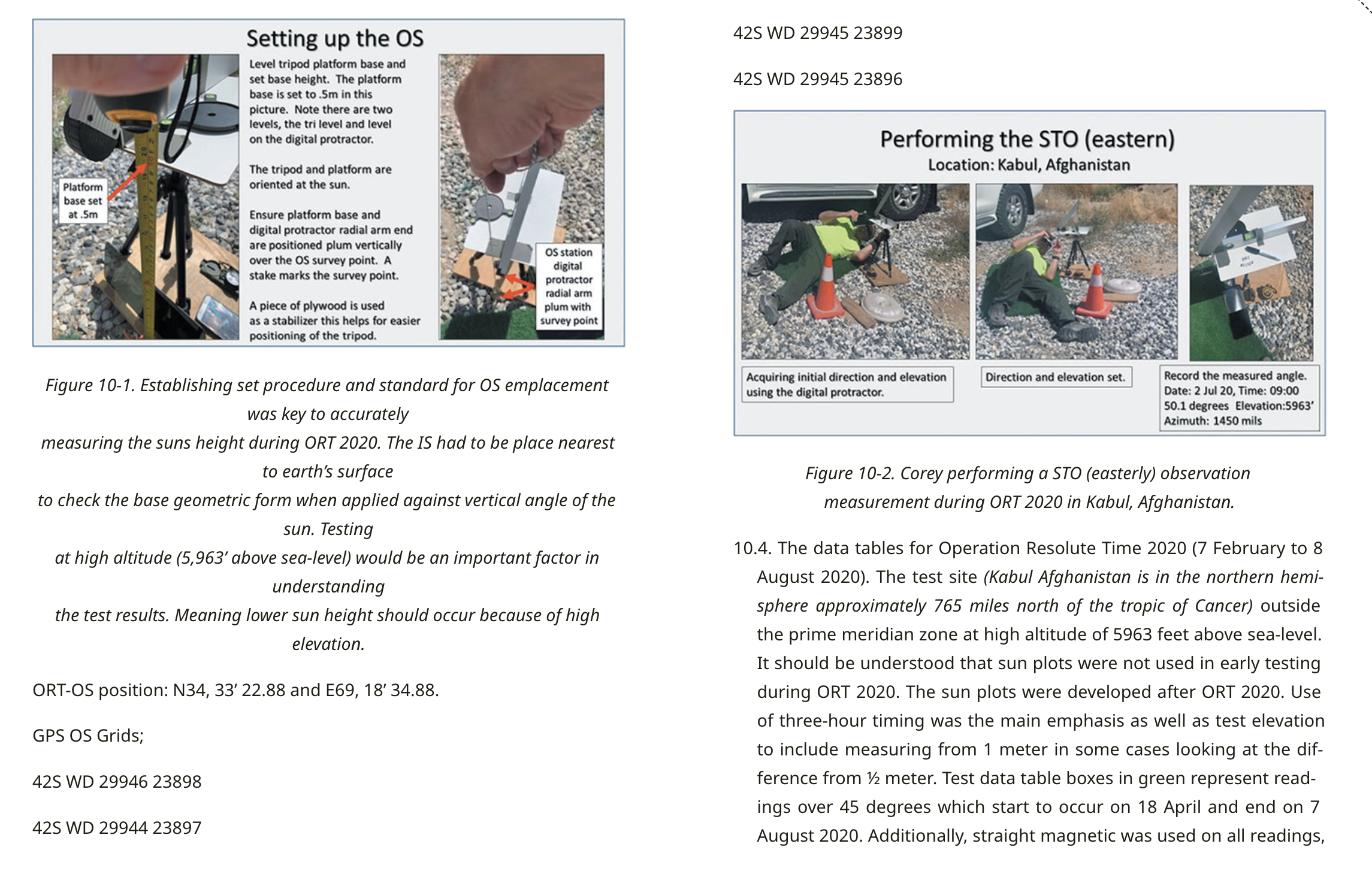
The observer station (OS) used a leveled tripod platform base set at 0.5m height, with a digital protractor and radial arm positioned plumb vertically over the sun survey point (SSP). The sun survey point was established along the line of magnetic using a compass and MARX device at solar noon.
Concept of Operations
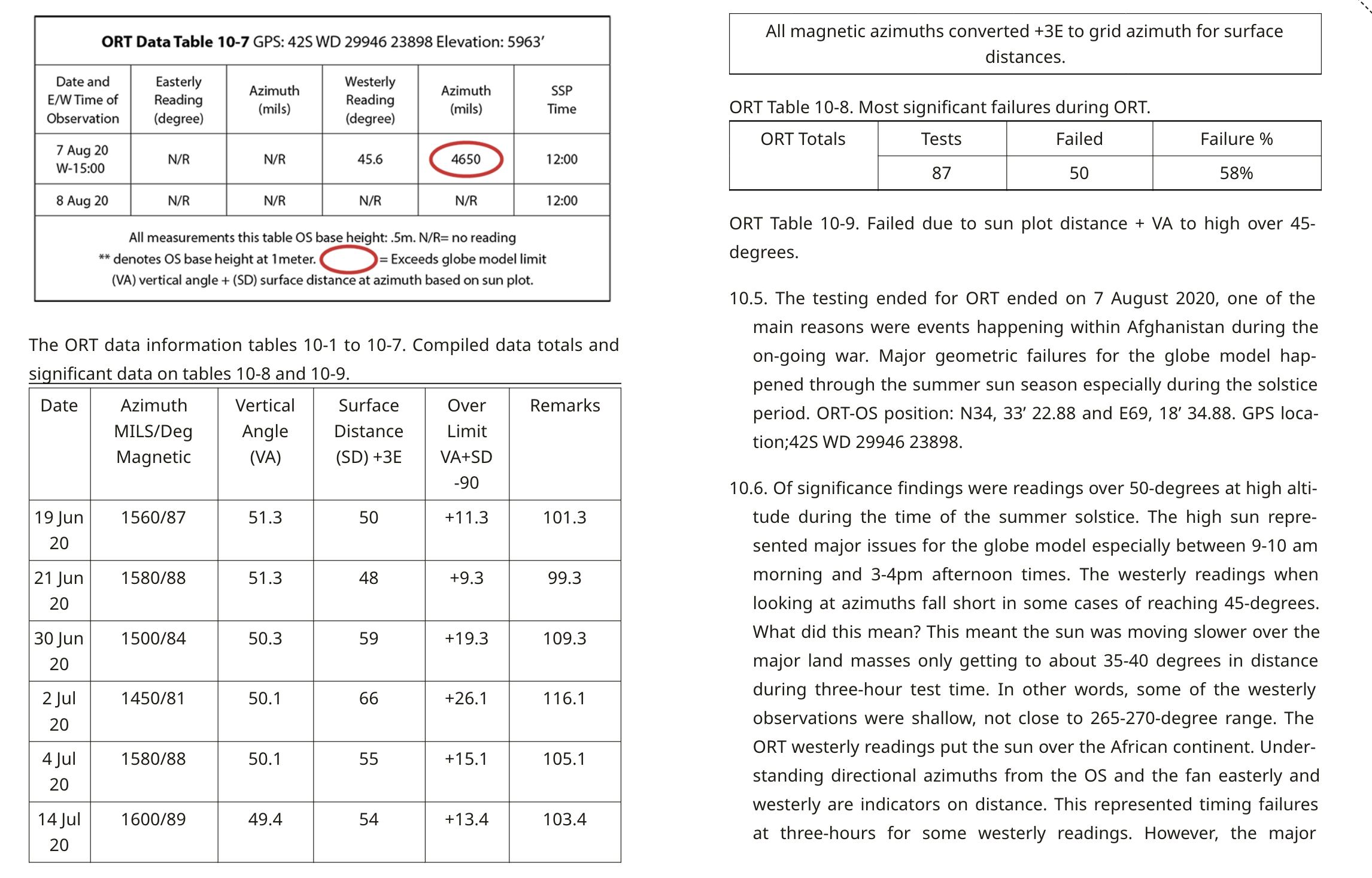
ORT 2020 Summary Results
| ORT Totals | Tests | Failed | Failure % |
|---|---|---|---|
| Globe Model | 87 | 50 | 58% |
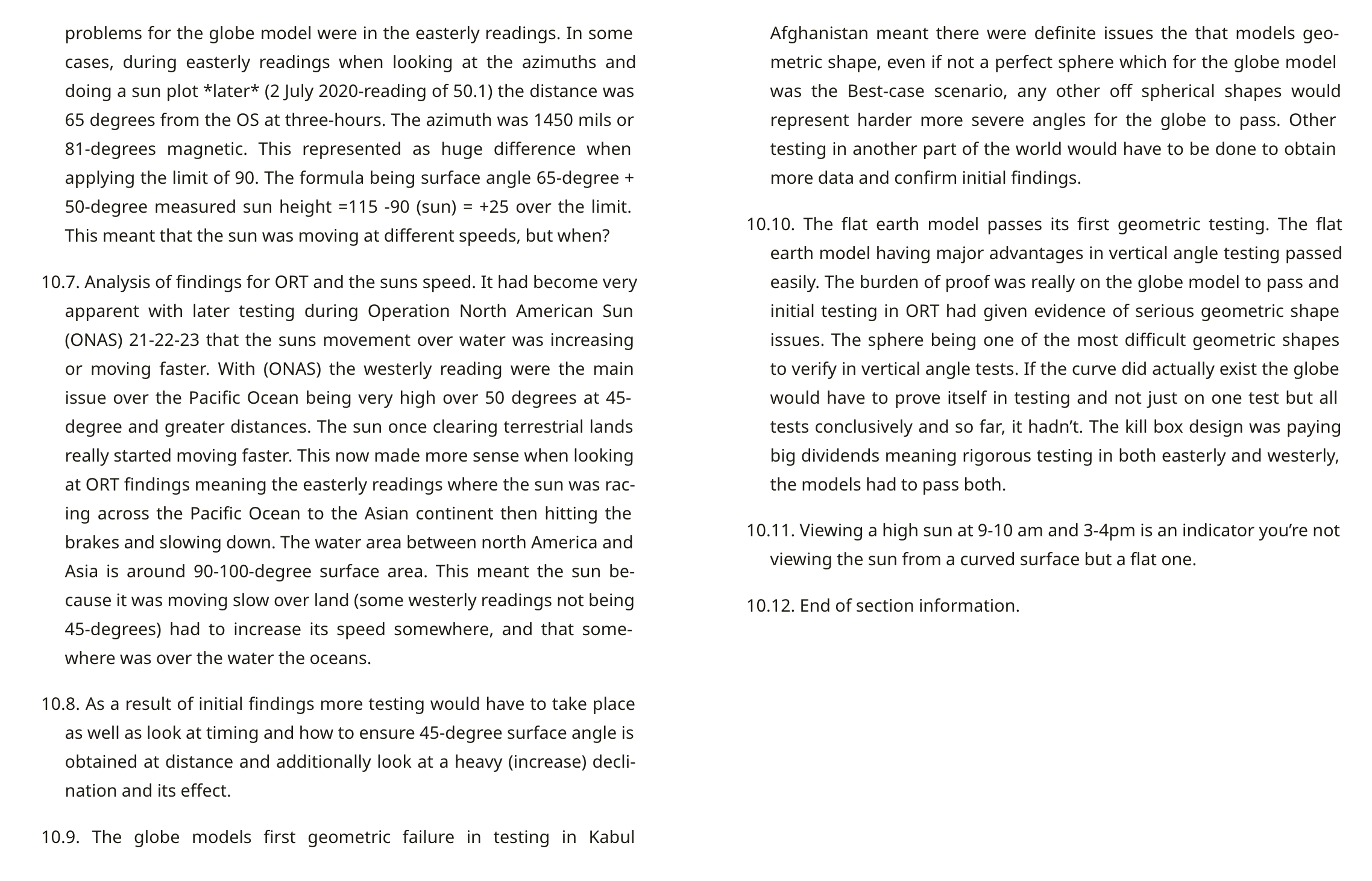
Kell defines "failure" as any measurement exceeding his 45° limit. As shown in our analysis, the globe model predicts these values — they are not failures but expected results.
3. ORT 2020 Data Tables (Transcribed)
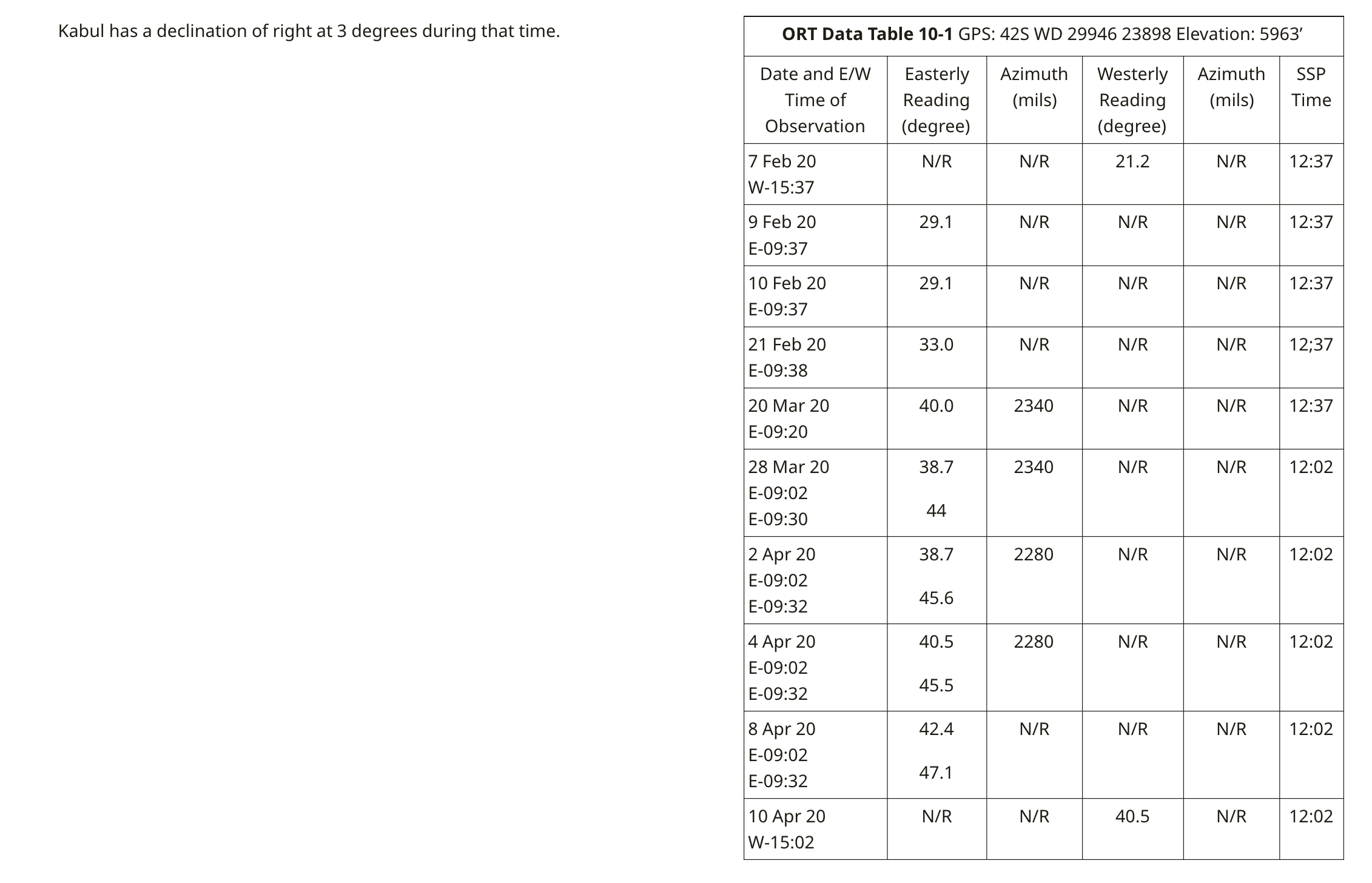
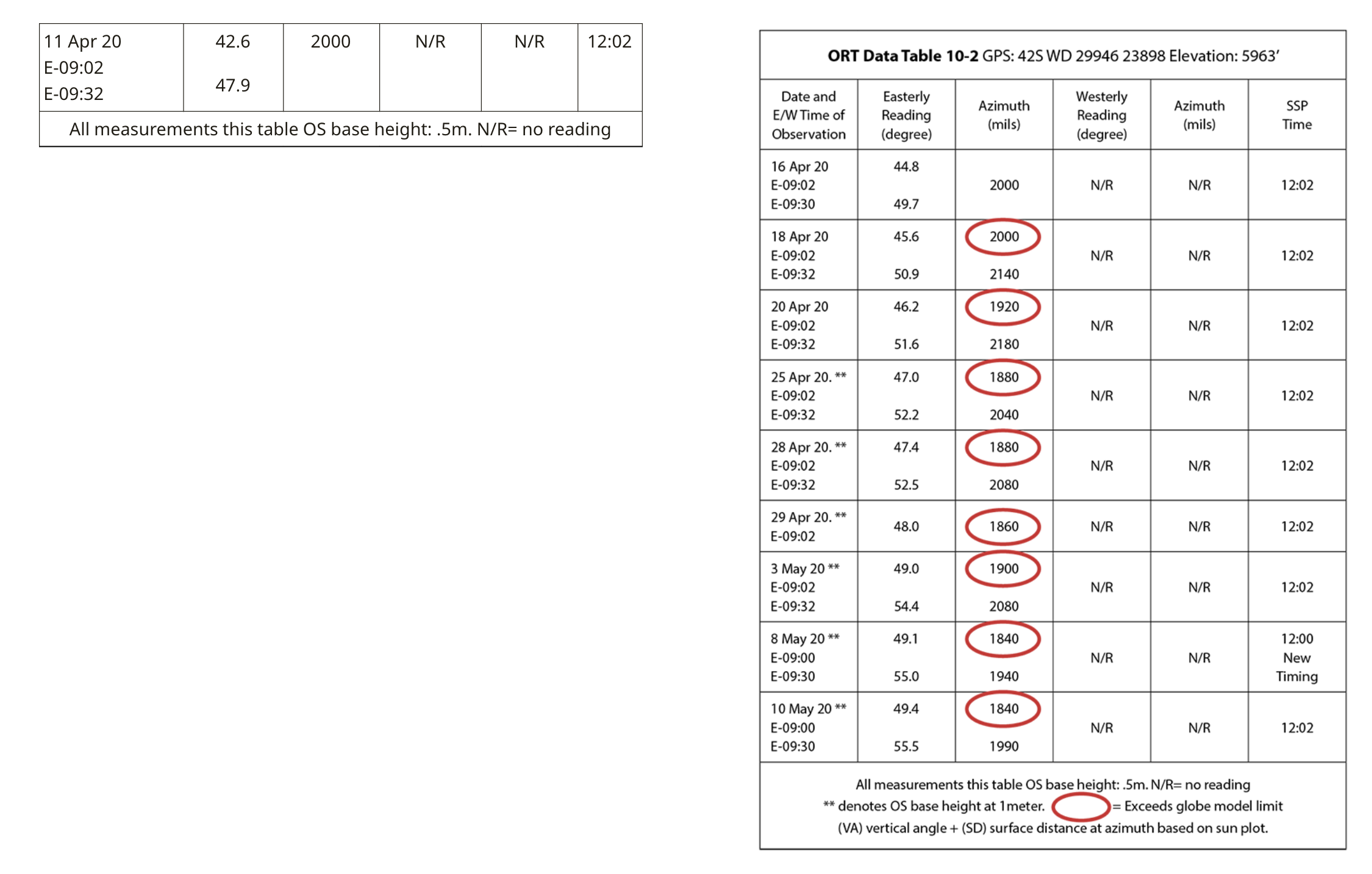
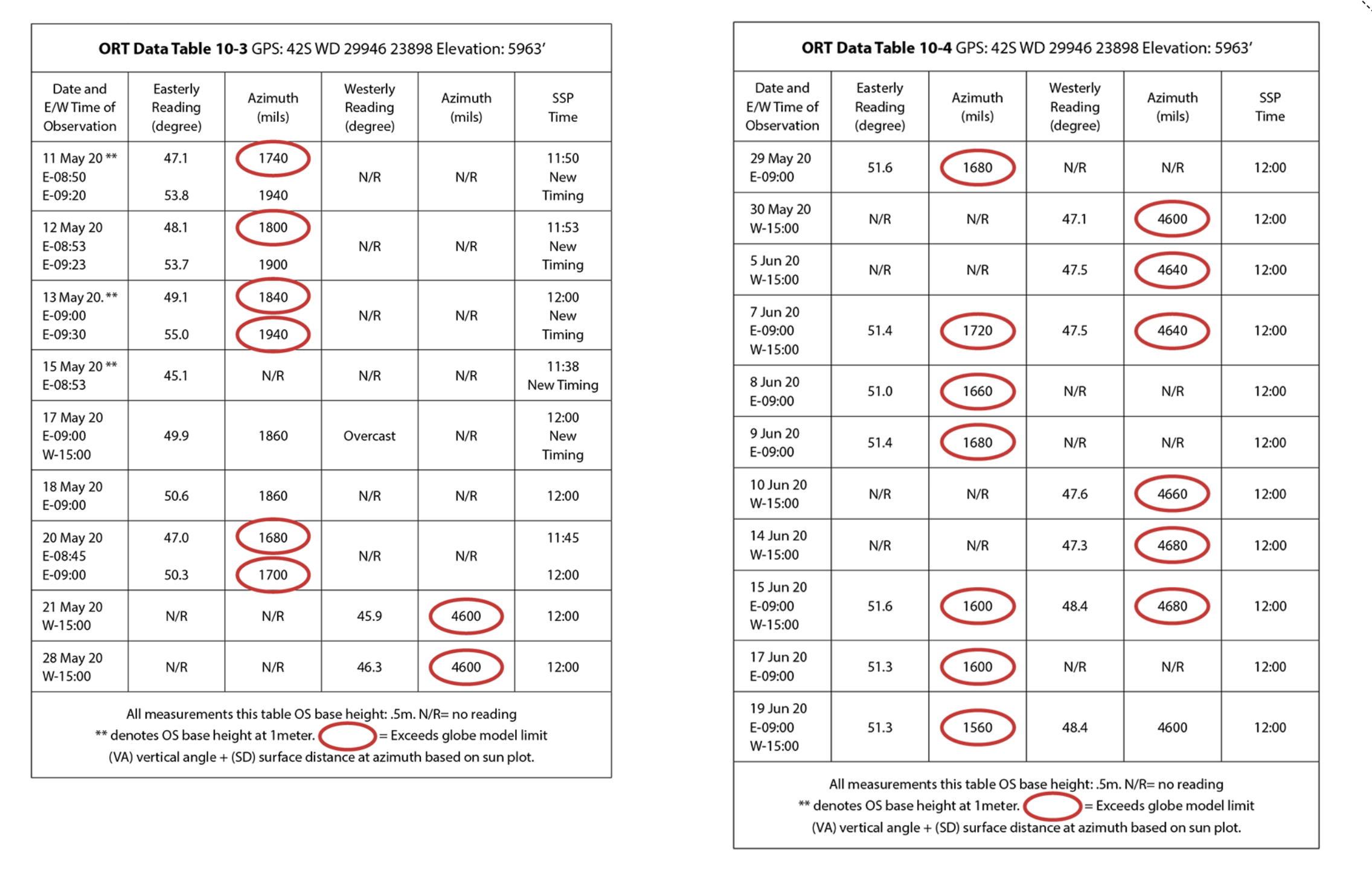
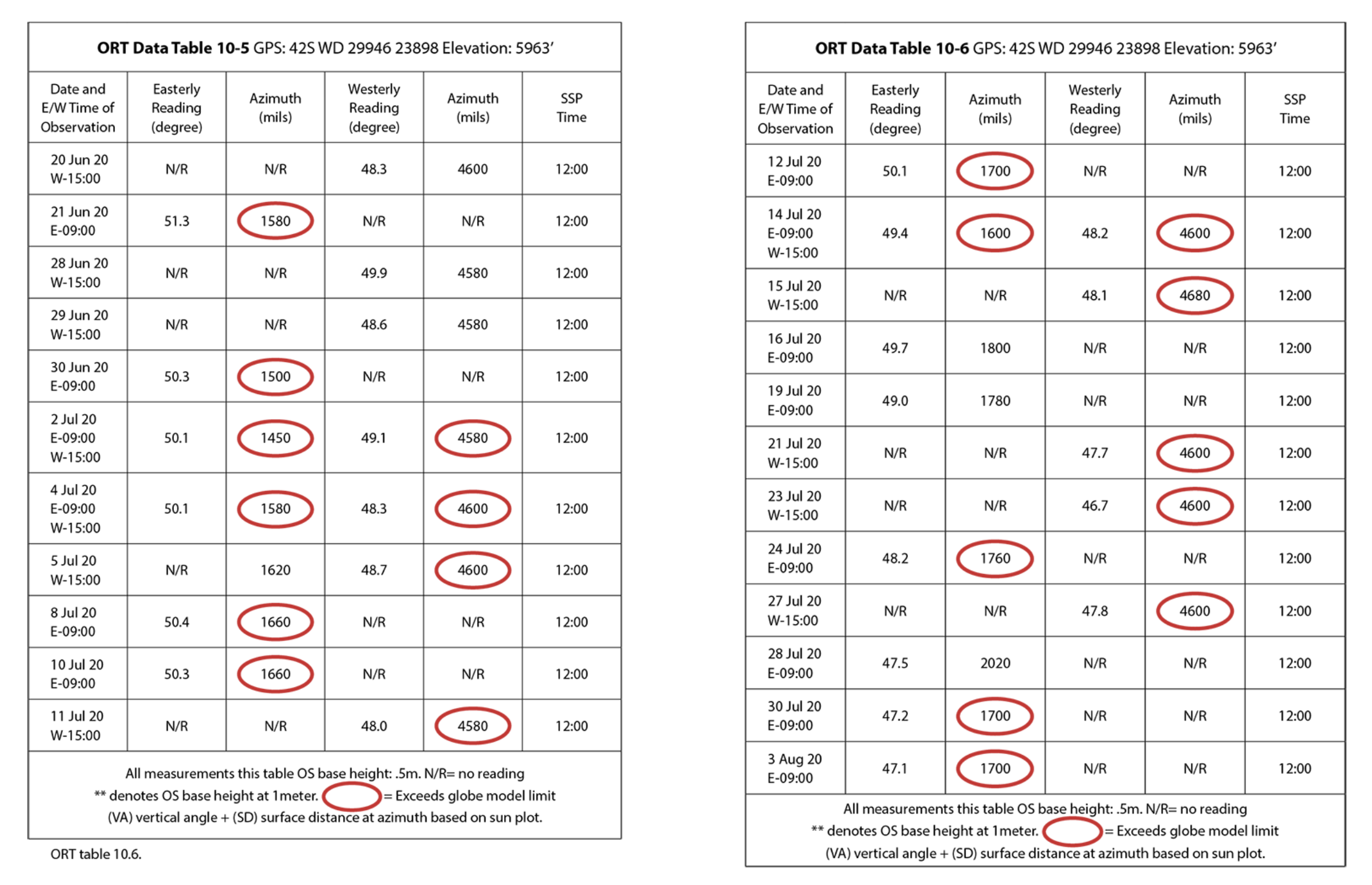
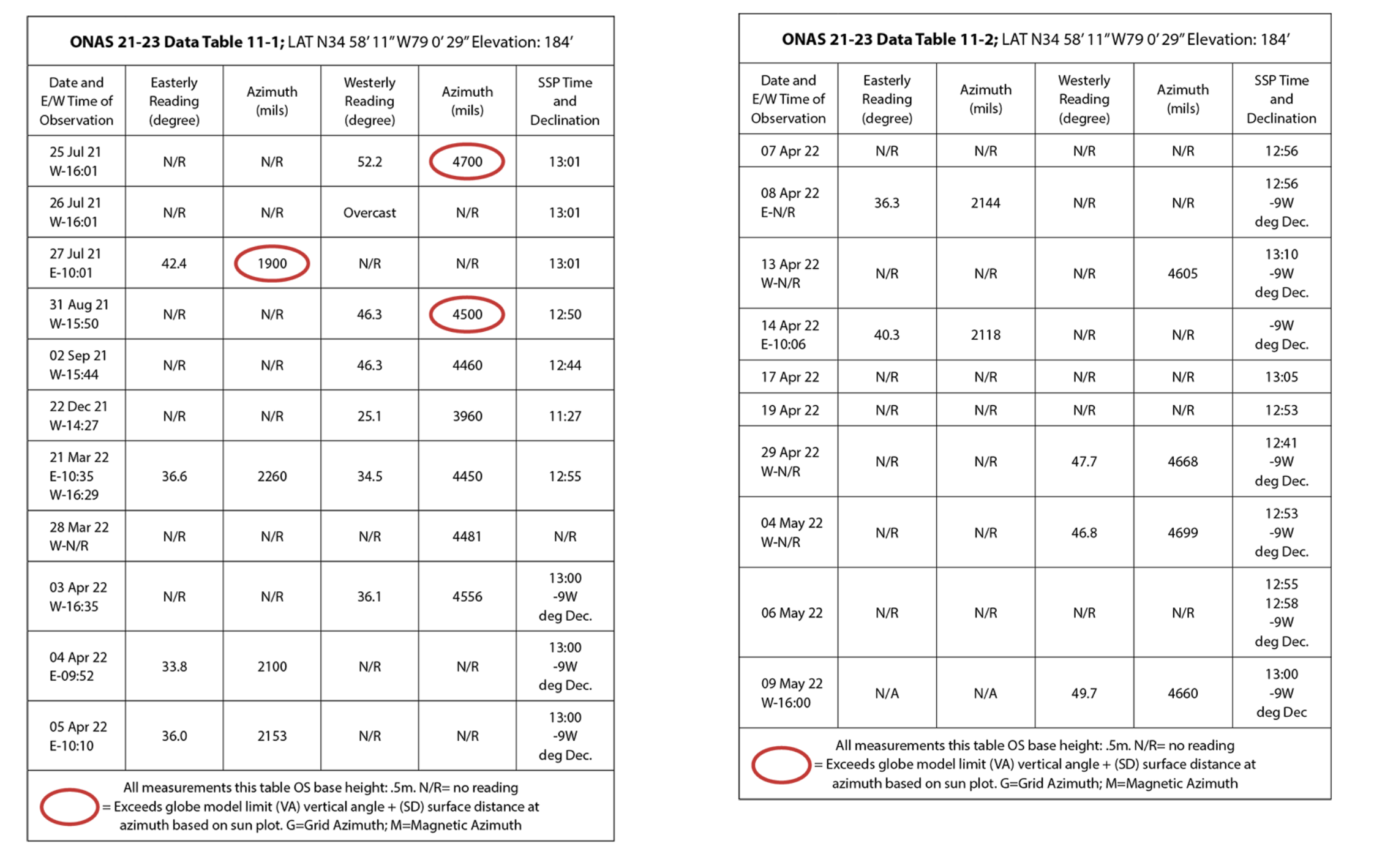
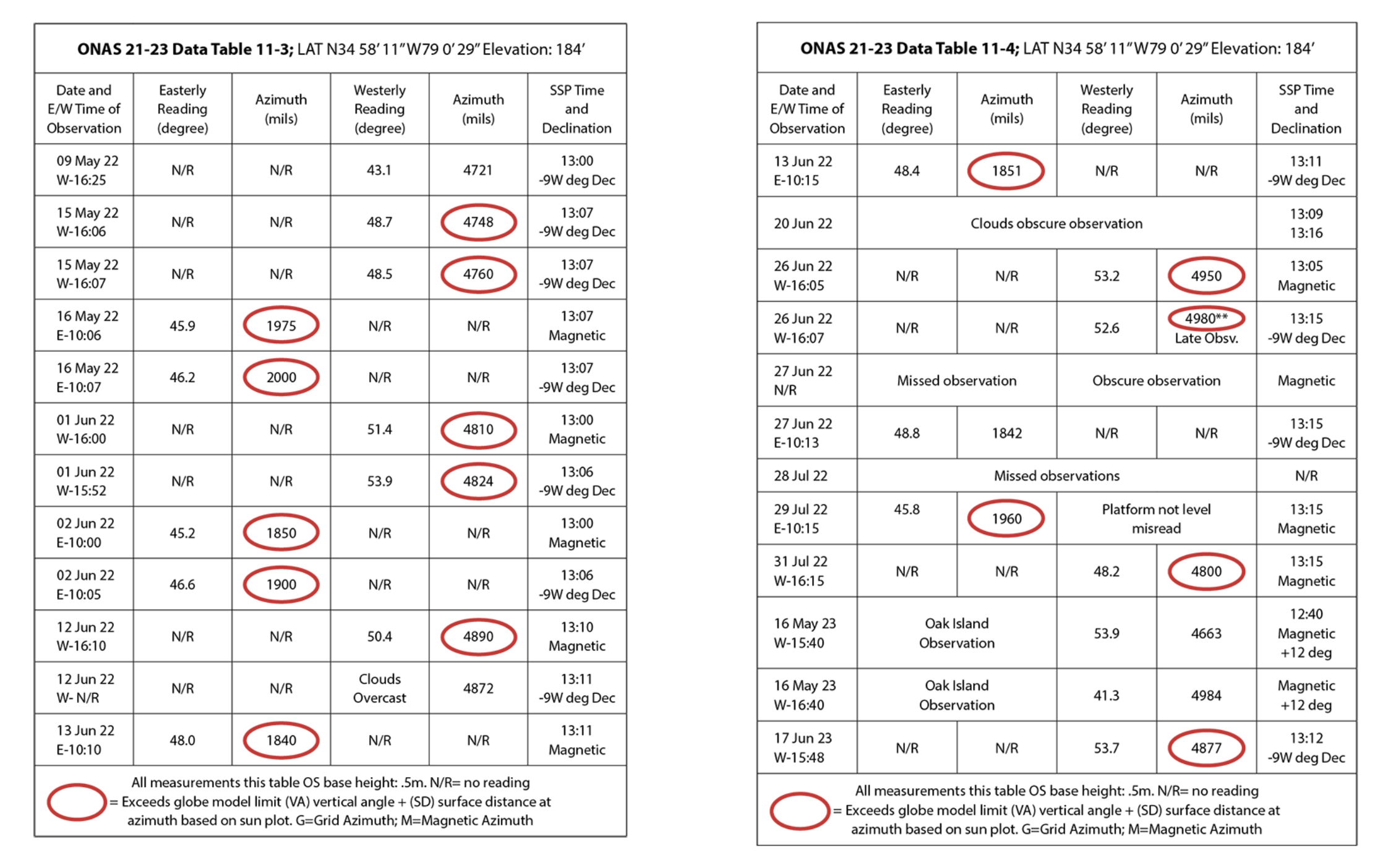
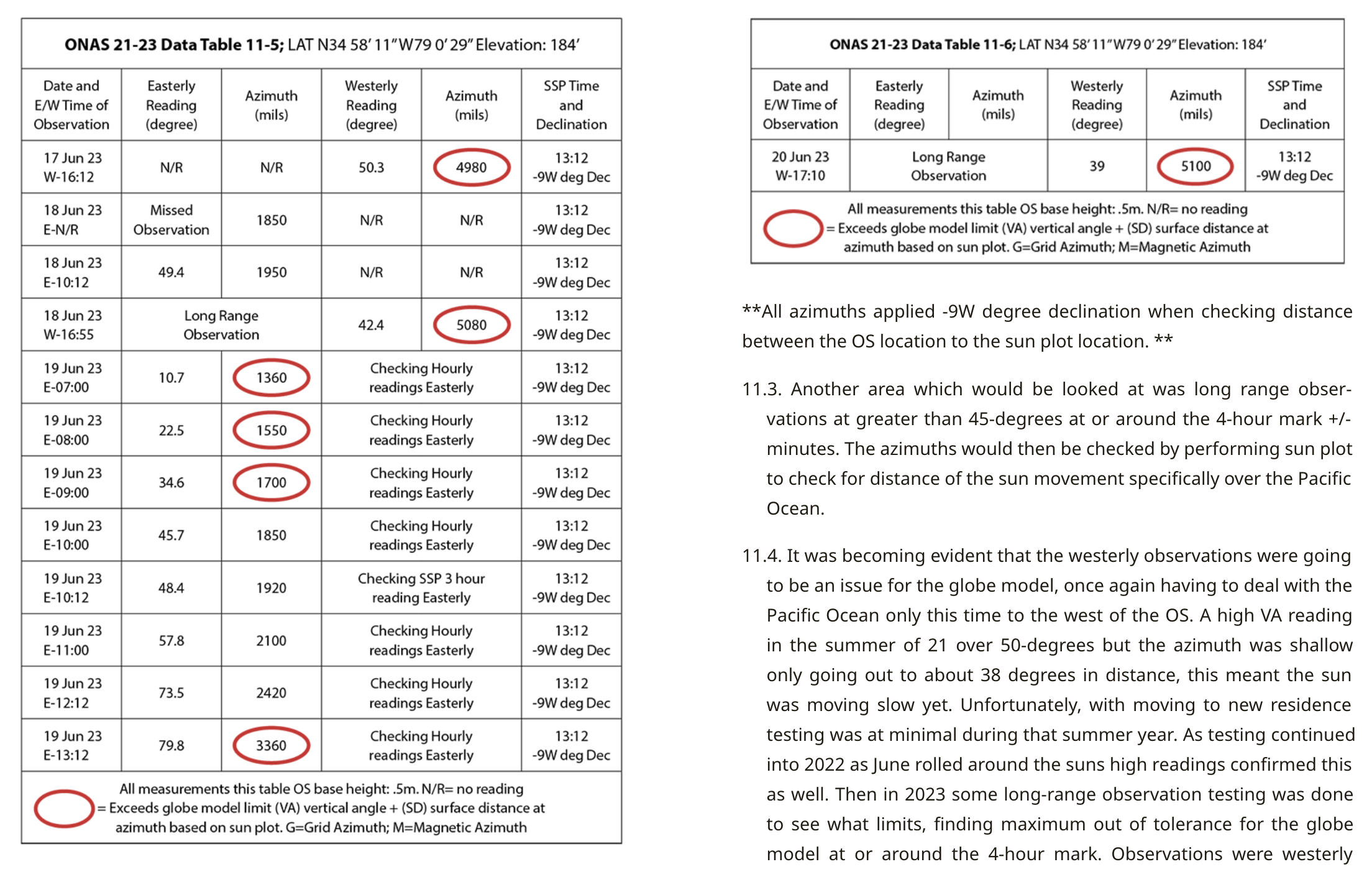
Red-circled values in Kell's original tables indicate readings that exceed his "globe model limit." N/R = No Reading.
Table 10-1 (Feb–Apr 2020)
| Date | E/W Time | Easterly (°) | Az (mils) | Westerly (°) | Az (mils) | SSP |
|---|---|---|---|---|---|---|
| 7 Feb 20 | W-15:37 | N/R | N/R | 21.2 | N/R | 12:37 |
| 9 Feb 20 | E-09:37 | 29.1 | N/R | N/R | N/R | 12:37 |
| 10 Feb 20 | E-09:37 | 29.1 | N/R | N/R | N/R | 12:37 |
| 21 Feb 20 | E-09:38 | 33.0 | N/R | N/R | N/R | 12:37 |
| 20 Mar 20 | E-09:20 | 40.0 | 2340 | N/R | N/R | 12:37 |
| 28 Mar 20 | E-09:02/09:30 | 38.7 / 44 | 2340 | N/R | N/R | 12:02 |
| 2 Apr 20 | E-09:02/09:32 | 38.7 / 45.6 | 2280 | N/R | N/R | 12:02 |
| 4 Apr 20 | E-09:02/09:32 | 40.5 / 45.5 | 2280 | N/R | N/R | 12:02 |
| 8 Apr 20 | E-09:02/09:32 | 42.4 / 47.1 | N/R | N/R | N/R | 12:02 |
| 10 Apr 20 | W-15:02 | N/R | N/R | 40.5 | N/R | 12:02 |
| 11 Apr 20 | E-09:02/09:32 | 42.6 / 47.9 | 2000 | N/R | N/R | 12:02 |
Table 10-8 — Most Significant Compiled Data
| Date | Azimuth (MILS/Deg Mag) | Vertical Angle | Surface Dist (SD)+3E | Over Limit (VA+SD-90) | Remarks |
|---|---|---|---|---|---|
| 19 Jun 20 | 1560/87 | 51.3 | 50 | +11.3 | 101.3 |
| 21 Jun 20 | 1580/88 | 51.3 | 48 | +9.3 | 99.3 |
| 30 Jun 20 | 1500/84 | 50.3 | 59 | +19.3 | 109.3 |
| 2 Jul 20 | 1450/81 | 50.1 | 66 | +26.1 | 116.1 |
| 4 Jul 20 | 1580/88 | 50.1 | 55 | +15.1 | 105.1 |
| 14 Jul 20 | 1600/89 | 49.4 | 54 | +13.4 | 103.4 |
4. ONAS 21-23 — Operation North American Sun
Operation Details
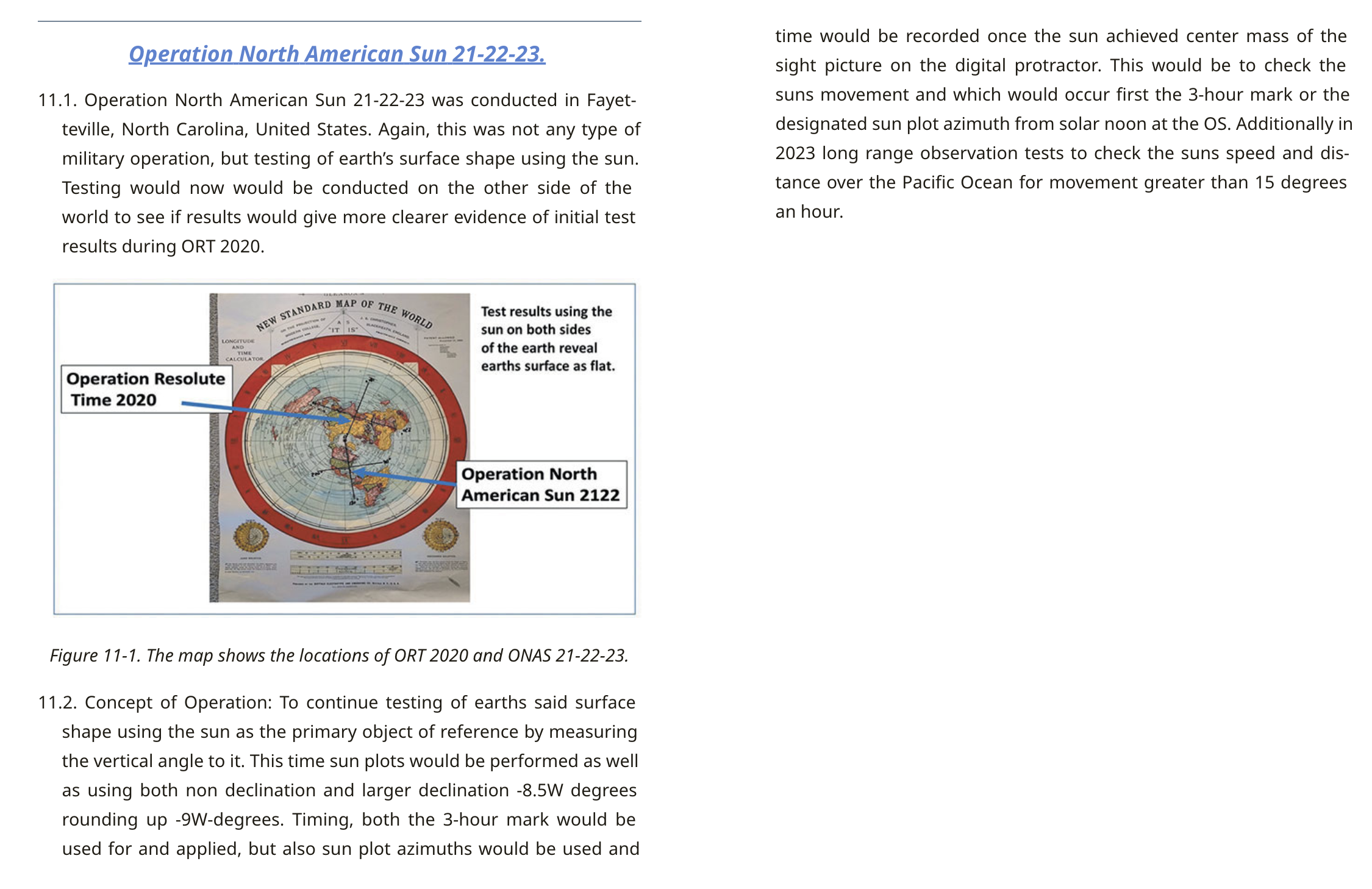
Period: July 2021 – June 2023
Location: Fayetteville, North Carolina, United States
Coordinates: N34°58'11", W79°0'29"
Elevation: 184 feet above sea level
GPS: 17S PU 81842 71503
Concept of Operations
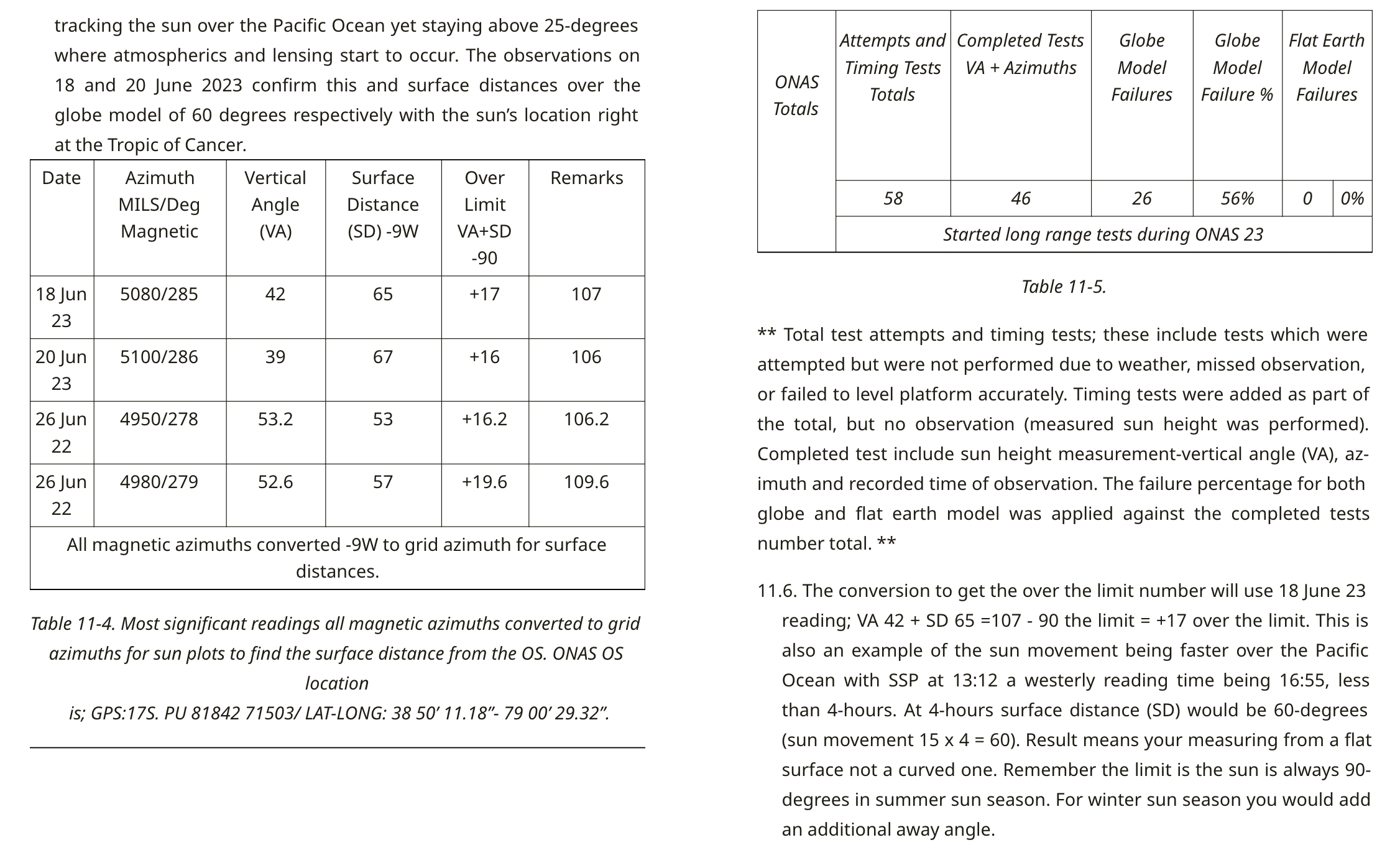
ONAS Summary Results
| ONAS Totals | Attempts/Timing | Completed Tests | Globe Failures | Globe Fail % | Flat Earth Failures | FE Fail % |
|---|---|---|---|---|---|---|
| Totals | 58 | 46 | 26 | 56% | 0 | 0% |
The 19 June 2023 Hourly Dataset
Kell's most detailed single-day dataset — hourly readings from 07:00 through 13:12 (solar noon):
| Time | Easterly Reading (°) | Azimuth (mils) | Note |
|---|---|---|---|
| 07:00 | 10.7 | 1360 | Hourly check |
| 08:00 | 22.5 | 1550 | Hourly check |
| 09:00 | 34.6 | 1700 | Hourly check |
| 10:00 | 45.7 | 1850 | Hourly check |
| 10:12 | 48.4 | 1920 | SSP 3-hour mark |
| 11:00 | 57.8 | 2100 | Hourly check |
| 12:12 | 73.5 | 2420 | Hourly check |
| 13:12 | 79.8 | 3360 | Solar noon |
This hourly curve traces out exactly the solar elevation arc the globe model predicts — a smooth climb from ~11° near sunrise to ~80° at solar noon. This is the standard behavior of a sun 93 million miles away being observed from a rotating globe.
5. Kell's Key Claims & Our Responses
Claim: "The 45° Limit"
Response: This treats hour angle as directly determining elevation. In reality: sin(alt) = sin(lat)·sin(dec) + cos(lat)·cos(dec)·cos(HA). At 34.5°N with declination +23.4° and HA=45°, the predicted elevation is ~49.4° — well above 45°.
Claim: "58% / 56% Failure Rate"
Response: The globe model predicts the majority of his summer measurements should exceed 45°. His "failure rate" is the globe model's success rate — his data matches predictions.
Claim: "Sun Moves Faster Over Oceans"
Response: The apparent speed difference is an artifact of using magnetic azimuths without proper declination correction, combined with the observer's position relative to the subsolar point and atmospheric refraction effects. The sun's apparent motion is constant at 15°/hour.
Claim: "Flat Earth Passes, Globe Fails"
Response: The flat earth model has 0% failure rate in his test because his "limit" is defined in a way that only tests the globe model. He never applies equivalent geometric constraints to the flat earth model. On a flat earth with a sun at ~3,000 miles altitude, simple trigonometry would predict very different elevation angles than what he measures — angles his own data contradicts.
Claim: "Simulation Theory"
Response: When your data perfectly matches the predictions of the model you're trying to disprove, invoking simulation theory is an admission that the globe model works.
6. Two Locations, One Conclusion
| Kabul (ORT 2020) | Fayetteville (ONAS 21-23) | |
|---|---|---|
| Latitude | 34.556°N | 34.970°N |
| Longitude | 69.310°E | 79.008°W |
| Elevation | 1,817m (5,963 ft) | 56m (184 ft) |
| Separation | ~148° longitude, 1,761m elevation difference | |
| Summer peak elevation | ~51.3° (21 Jun) | ~79.8° at noon, ~48-51° at 3hr |
| Globe prediction match | Yes — within ~2-3° | Yes — within ~2-3° |
Both sites at ~35°N produce nearly identical solar elevation patterns, exactly as the globe model predicts. This cross-continental consistency is a powerful confirmation — and something a flat earth model with a local sun cannot explain.