Scale height of bromine, H = RT / Mg
—
A classic chemistry demo shows orange bromine vapour rushing into a vacuum the moment a valve opens. Flat-earth videos use it to argue that air cannot sit next to the vacuum of space without a dome. The demo is real. What it leaves out is the size of the apparatus compared with the height at which gravity starts to win. This lab puts both forces on screen with real numbers.
"Gas must spread evenly because entropy always increases" is the second law for an isolated gas with no forces on it. With gravity present, lifting gas costs energy, and at constant temperature that energy arrives as heat from the surroundings, which lowers their entropy by Q / T. The law applies to the total:
ΔStotal = ΔSgas − ΔUgravity / T ≥ 0 (the same statement as: free energy F = U − TS can only fall)
Write that per mole for a gas with density profile n(z), then ask which profile makes it largest for a fixed amount of gas:
maximise −R ∫ n ln n dV − (M g / T) ∫ n z dV ⟹ R ln n + M g z / T = constant ⟹ n(z) = n₀ · e−Mgz / RT
The barometric profile is therefore the maximum-entropy state, the one the second law drives the gas toward. An even fill is the special case g = 0, or a container so short that Mgz / RT is effectively zero, which is every bench demo. The ledger above tracks all three terms live, and the last cell shows what an even fill would score.
Open the valve at the default settings and the bromine fills the top bulb in a few hundredths of a second of real time in this model. Gravity is switched on the whole time, at full Earth strength. It loses because the bulb centres sit 17 cm apart and bromine's scale height is 1.6 km: the weight of that little gas can only support a pressure difference of about one pascal, against a push of tens of thousands.
Now change the odds. Make the same apparatus kilometres tall, or turn gravity up by a factor of ten thousand, and open the valve again. The top bulb stays visibly thinner even though the valve is wide open and nothing stops the gas rising into it. There is still a glass roof, and it still carries some load: at 6 km the glass at the very top feels about 2% of the pressure at the bottom, and at 20 km about 0.0003%. The taller the column, the less the lid has to do, which is the limit the later tabs take. Nothing about the gas changed. Only Δz / H did.
The flat-earth reading of this demo is correct as far as it goes: at bench scale a gas really does fill whatever volume it is given, and you really do need glass to keep it in. Nobody disputes that. The claim that fails is the extrapolation, that the same must hold for a layer of gas a hundred kilometres deep. A fair test of that is to scale this exact apparatus up and see if the behaviour changes. It does.
The other common objection is "pressure needs a container by definition." Press Air in the top bulb to see what does the containing when gas meets gas: each layer is held by the pressure of the layer next to it. The later tabs show the same thing with the weight of the gas above.
Every dot is a real ballistic particle: it flies in a straight line, falls under the gravity you set, collides with other dots (conserving momentum and energy), and leaves the glass with a speed drawn from the wall temperature. The pressure profile on the right is counted from the dots, never painted on. The dashed line is the textbook prediction, P(z) = P₀·e−z/H.
The simplifications, stated plainly:
Mixing speed is not to scale. Each dot stands for an enormous number of molecules. The dots travel about a third of a bulb radius between collisions, where real molecules manage about a ten-millionth of a metre. So this model cannot show how slow real diffusion into air is: here it takes roughly twice as long as into a vacuum, while in a real tube it takes tens of minutes. Use the air case for where the gas ends up, not how fast.
One temperature throughout. Any individual dot slows as it climbs and speeds up as it falls, but the mix of speeds you find at every height is the same. Only the number thins out. The real lower atmosphere is not isothermal; it cools with height, which changes the numbers but not the argument.
Ideal gas, uniform gravity, 2D. Real bromine would condense above about 23 kPa at 20 °C, or at any pressure shown once it is cold enough; the sliders go beyond that to show the trend. Gravity is held constant with height (real g falls about 0.6% over 20 km). The entropy figures are for this flat flask; a 3D pair of spheres gives slightly different values (about +0.93 and −3.73 at 6 km instead of +0.97 and −3.77) with the same signs. At the most extreme corners, a 20 km flask under thousands of g, the gas is a film thinner than one chart bar and the numbers are approximate.
Gravity does not stop at the wall of a container. In a sealed tank the gas at the floor is always a little denser than the gas under the lid, because each layer has to hold up the weight of everything above it. In a real 1.2 m cylinder of nitrogen the difference is about 0.014%, far too small to see in the dots, but it is there: the floor of the tank carries more force than the lid, and the difference is exactly the weight of the gas. That is why a full cylinder weighs more on a scale than an empty one.
Now drag Tank height up. Same gas, same walls, same lid. By a few kilometres the gradient is obvious; by a few tens of kilometres most of the gas is in the bottom of the tank and the lid is holding back very little. The walls and lid never changed what the gas does vertically. Gravity set the profile the whole time.
"You still have a lid." True, and at bench height the lid matters: open a 1.2 m cylinder at 200 bar and the gas rushes out until it is down to the pressure of the room. The point of this tab is narrower. Flat-earth arguments usually treat pressure in a container as one number, with gravity playing no part. The tank shows gravity acting on contained gas and producing a gradient, and it shows the load on the lid falling toward zero as the tank grows. Whether the lid can then be removed altogether is tab 4's question.
"Nobody builds a 50 km tank." Also true. The same gradient is what a barometer or an altimeter reads on the way up a tall building or a mountain, and that air is not in a tank at all.
Same engine as tab 1: ballistic dots, real gravity, walls at one temperature, pressure counted from the dots. The vertical axis is to scale. The width is not: the tank is drawn wide enough to see into at every height, and the horizontal direction plays no part in any number shown. The number of dots is fixed, so each dot stands for more molecules as you raise the fill pressure. The gas is ideal and isothermal, and gravity is constant with height. At 200 bar real nitrogen departs from the ideal-gas law by several percent, which shifts the mass of gas slightly and leaves the shape of the gradient alone. In the tallest tanks at that fill the floor pressure passes 1,000 bar, where no real gas is close to ideal; lower the fill pressure for a realistic tall case.
Carbon dioxide and sulfur hexafluoride will sit in an open fish tank for many minutes with no lid. The reason is on the two top readouts: the gas in the tank and the air above it are at the same pressure. There is no unbalanced push at the rim, so nothing rushes out. Compare tab 1, where the gas faced a vacuum and the full pressure was unbalanced.
Press Remove the air and the heavy gas is gone in an instant, sides or no sides. Put the air back and it stays. The sides of the tank stop it spreading sideways; what stops it spreading upward is the atmosphere pressing down on it.
What is left is slow mixing. Molecules wander across the rim one collision at a time, and the heavy gas thins out gradually. In a real tank, being denser than air also keeps the gas low and stops it being stirred out (the model does not show that part), but at fish-tank size gravity cannot hold it there for ever. Make the container kilometres deep, or turn gravity up, and gravity takes over: the heavy gas stays near the floor, sorted by weight, and only a trace reaches the rim to mix away.
"So the gas does escape without a lid." At this size, yes, eventually, and the page shows it. An open tank of heavy gas is temporary. The claim being tested is narrower: that gas pressure always needs a solid barrier to oppose it. Here the barrier on top is another gas, and it works because it pushes back just as hard.
"Then why doesn't the atmosphere sort itself into layers, heaviest at the bottom?" Below about 100 km turbulence stirs the air far faster than gravity can sort it, so the mix is nearly uniform. Above that height stirring stops and the gases do separate by weight, with the lightest reaching highest. Both regimes are measured.
The outer edges of the picture are open air, not walls: a dot that crosses an edge is gone, and the surrounding air sends dots in at the rate its pressure dictates. Heavy-gas dots that leave do not come back, as if the room were large.
Mixing speed is not to scale. Dots in this model travel about one percent of the tank width between collisions; real molecules travel about a ten-millionth of a metre. The model empties a 30 cm tank in a fraction of a second of real time, where a real, undisturbed tank takes of the order of an hour or more by diffusion alone (the estimate is shown in the readout) and minutes in a room with draughts. The model also has no bulk flow, so it does not show a heavy gas pouring like a liquid. What it gets right is the pressure balance, and where the gas ends up.
| Altitude | Standard atmosphere average of measurements | Gravity, no dome this model at the temperature set | Dome, no gravity gas simply fills the container | Dome and gravity anywhere below the dome |
|---|
Start with a metre-tall open column of ordinary air. Inside and outside are the same pressure at every height, so the walls have nothing to hold: untick Column walls and nothing changes. Then make the column taller. The pressure inside falls with height, and the pressure outside falls with it, at the same rate, set by gravity and temperature alone. Remove the walls at any height and the two profiles stay on top of each other.
The top edge of the picture is open. With gravity on, the air above the frame is real air held down by its own weight, and it sends molecules back down as often as the air below sends them up. Raise the top to 100 km and that traffic stops in both directions: almost nothing gets that high, so there is nothing for a lid to hold.
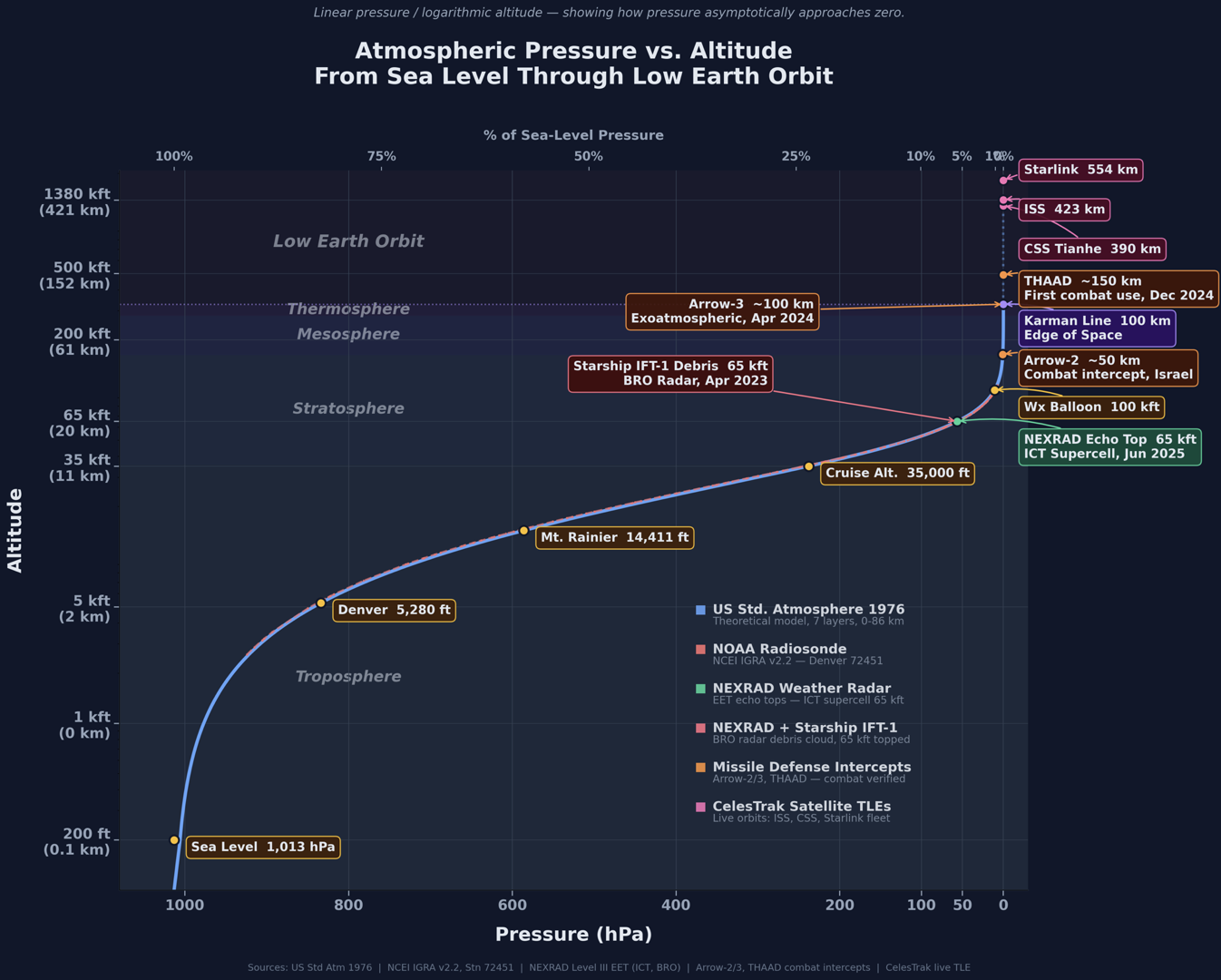
Tick Add a dome and Gravity off to see the alternative. A dome with no gravity is a sealed container: the gas spreads evenly and the pressure is the same at every height, as tab 1 showed for any bench-sized vessel. That predicts sea-level pressure on the summit of Everest and at the top of a weather balloon's flight. The observed values are about a third and about one percent.
Tick the dome with gravity left on and the profile is the one you had without it. The gradient comes from the weight of the air, dome or no dome, and the dome is left carrying whatever pressure remains at its height. Put it at 100 km and the pressure left is a few millionths of sea level in this constant-temperature model (0.7 Pa), and about a third of a millionth in the real, colder atmosphere (0.03 Pa), on a structure nobody has detected. With gravity present the dome explains nothing that gravity has not already explained; without gravity the dome predicts a uniform atmosphere that no barometer agrees with.
Turn gravity off without a dome and the air leaves. That much of the flat-earth argument is right: gas does need something to hold it. The candidates are a container or gravity, and the measured fall of pressure with height is what tells them apart.
"The gradient is caused by density and buoyancy, not gravity." Density sorting needs a direction to sort along and a force to do the sorting. Whatever that downward force is called, the measured profile fixes its size: it must give air a scale height of about 6 to 8.5 km depending on the temperature of the layer, which is RT / Mg with g = 9.8 m/s². A dome plays no part in that calculation.
"The dome could be very high, where the pressure is tiny, so you would never notice it." Then it is doing no containing, which was the original claim. The argument started as "gas pressure requires a container" and has become "there may be a container where there is no pressure left to contain".
"Your model's line misses the standard curve." It does, by the amount you would expect: this model holds the air at one temperature, and the real atmosphere is colder aloft than at the ground. Set the temperature to about 230 K, the average over the lowest 30 km, and the line meets the standard curve at the ground and at 30 km and stays within about 13% in between. A single temperature cannot do better, because the real air is warm at the bottom and cold above.
Open edges work as in tab 3: dots that cross are removed, and the air beyond sends dots in at the rate the barometric law gives for that height. With gravity off there is no reason for air to exist beyond the edges, so open edges become a vacuum and a dome becomes a sealed box. The number of dots on screen is kept roughly constant, so each dot stands for more air as the column grows. The green curve is the 1976 US Standard Atmosphere, an agreed mid-latitude average built from balloon and rocket soundings, shown up to 86 km. Real days and latitudes differ from it by a few percent. Gravity is held constant with height and the air is ideal and at one temperature.